Official Archive Record
Case File CF-0100
The Lost Colony of Roanoke: The Mystery of CROATOAN
Also known as: Lost Colony of Roanoke, Roanoke Colony, 1587 Roanoke Colony
In 1587, a group of English men, women and children crossed the Atlantic hoping to establish a permanent colony in North America. Three years later, the settlement was empty.
There were no colonists waiting for rescue. No bodies. No obvious signs of a battle. The buildings had been dismantled, and the people who had lived there were gone.
But they did leave a message: CROATOAN.
More than four centuries later, the disappearance of the Roanoke colonists remains one of the most famous mysteries in American history.
What Happened
In April 1587, an expedition led by John White left England carrying more than one hundred colonists. Their intended destination was the Chesapeake Bay, where they hoped to establish a settlement known as the Cittie of Ralegh. Roanoke Island was supposed to be a stop along the way.
Instead, the expedition’s pilot, Simon Fernandes, refused to carry the settlers farther north. The colonists were left on Roanoke Island, off the coast of what is now North Carolina, where an earlier English settlement had already failed.
The new colony included White’s pregnant daughter Eleanor Dare and her husband, Ananias Dare. On August 18, 1587, Eleanor gave birth to Virginia Dare, remembered as the first English child born in the English colonies of North America.
The settlement immediately faced problems. Food supplies were uncertain, relations with some of the surrounding Algonquian communities had deteriorated, and winter was approaching. The colonists decided John White should return to England for supplies and additional settlers.
Before White left, the colonists developed a plan in case they had to move. They would leave a message indicating where they had gone. If they were forced to leave because of danger or distress, they would also carve a cross with the message.
White sailed for England in late August 1587 expecting to return quickly. He would not see Roanoke again for three years.
Three Years Away
White’s return could hardly have come at a worse time. England was preparing for war with Spain, and the Spanish Armada threatened the country in 1588. Ships that might have carried supplies back to Roanoke were needed for England’s defense, and attempts to send help failed.
White eventually found passage aboard a privateering expedition in 1590. After months at sea, he finally reached Roanoke Island on August 18 — Virginia Dare’s third birthday.
The colony was abandoned.
The houses had not simply collapsed. They had been taken apart. A defensive palisade had been constructed around the settlement after White left.
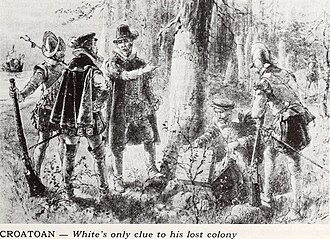
Then the searchers found the first message. Carved into a tree were three letters: CRO.
At the palisade they found the complete word: CROATOAN.
There was no cross indicating that the settlers had left under distress.
White did not initially treat the carving as a mysterious warning. Croatoan was the name of both an island and the Indigenous people who lived there. Croatoan Island is generally identified with modern Hatteras Island, and Manteo, one of the English colonists’ most important Indigenous allies, was Croatoan.
To White, the message appeared to tell him where the colonists had gone.
The Search That Never Happened
White wanted to sail to Croatoan and look for the settlers. He never made it.
Bad weather, damaged equipment and problems aboard the expedition forced the ships away from the coast. White returned to England without reaching Croatoan Island and would never return.
That may be the most frustrating part of the entire mystery. The colonists had apparently followed the plan. They left the name of a location, and they did not include the agreed-upon distress symbol.
The man who knew exactly what the message meant was simply unable to follow it.
Where Could They Have Gone?
The idea that all of the colonists vanished together may itself be wrong.
Before White left in 1587, the colonists had already discussed moving away from Roanoke. National Park Service accounts indicate that the group intended to divide, with some remaining temporarily on Roanoke and others moving inland in search of a better location and more reliable supplies.
That creates the possibility that there was never one final destination.
Some colonists may have gone south toward Croatoan. Others may have traveled west through the Albemarle Sound. Another group could have attempted to reach the Chesapeake Bay, the colony’s original destination.
Survival may also have required cooperation with Indigenous communities. The Croatoan theory remains compelling because the colonists themselves apparently left the name behind. Archaeological finds on Hatteras Island from the appropriate general period have fueled speculation that at least some settlers may have lived among the Croatoan people.
But no graves, settlement or collection of artifacts has conclusively identified the missing colonists there.
The Inland Evidence
Another major theory sends part of the colony west along the Albemarle Sound.
John White’s surviving map of the region contains a patch covering a fort-like symbol approximately fifty miles inland near modern Bertie County, North Carolina. Archaeologists from the First Colony Foundation began investigating the area, eventually identifying locations known as Site X and Site Y.
They recovered English pottery and other artifacts dating to the general period of the Roanoke expeditions.
In June 2026, the First Colony Foundation went significantly further and announced that it believed its archaeological work had located the Lost Colony. The organization argues that Sites X and Y represent parts of a dispersed English settlement along the Chowan River and that the settlers did not disappear at all. Instead, according to this interpretation, groups of colonists relocated inland and established farms in the region.
That is a major claim. It is not yet the same thing as universal agreement.
The National Park Service, whose Fort Raleigh National Historic Site preserves the Roanoke story, still describes the ultimate fate of the colonists as unproven. Archaeological evidence in Bertie County is promising, but artifacts have not yet been individually connected to named members of the 1587 colony, and no confirmed graves or settlement containing the entire group have been found.
The archaeological evidence may be narrowing the mystery without completely closing it.
What Probably Did Not Happen
The abandoned settlement offers some clues about what did not happen.
White did not describe signs of a violent attack at Roanoke. The buildings appeared to have been deliberately dismantled rather than suddenly destroyed. There were no bodies waiting at the settlement and no large group of graves.
The colonists also had enough time to build a palisade after White left and apparently enough time to leave the agreed-upon message. A sudden disappearance therefore seems less likely than an organized relocation.
That does not tell us what happened afterward.
Drought, hunger, disease, conflict and hurricanes were all serious threats. Some colonists could have died while others survived. Different groups may have experienced completely different outcomes.
The Lost Colony may not have one answer.
Why It Matters
Roanoke is usually presented as a story about people who mysteriously vanished. The historical record suggests something more complicated.
These people were stranded in a difficult location, waited years for supplies that never arrived, and apparently decided they could not remain where they were.
They moved.
The mystery is where they went and what happened to them afterward.
The answer may eventually come from archaeology rather than another mysterious document. Every piece of sixteenth-century pottery, metalwork or evidence of an English settlement found in the region can be compared against what is known about the colonists.
More than four hundred years after John White found CROATOAN carved into the abandoned settlement, people are still following the message he never had the chance to investigate.
T Funk Take
This is one of those mysteries where I think the word “lost” makes the story sound stranger than it probably was.
These people did not just disappear into thin air. They left a message. John White had specifically told them to leave behind the name of the place they went if they moved. He comes back three years later and finds CRO carved into a tree and CROATOAN carved into the settlement. There is no distress cross.
That sounds less like a mysterious disappearance and more like somebody leaving directions.
The unbelievable part to me is that White never got to follow them. Imagine spending three years trying to get back to your daughter, granddaughter and the rest of the colony, finally finding a message telling you where they may have gone, and then the weather forces you to leave before you can look.
Then you never get another chance.
I also don’t think all 117 people necessarily stayed together. If you are starving and trying to survive, splitting into smaller groups and finding communities that can support you makes sense. Some could have gone to Croatoan. Others could have gone inland. Some probably survived, and some probably didn’t.
The archaeology in North Carolina makes this even more interesting. If those inland sites really do belong to the colonists, maybe we are finally starting to understand where at least some of them went.
But one archaeological organization saying the Lost Colony has been found isn’t enough for me to close the file yet.
We still don’t know what happened to Virginia Dare, Eleanor Dare, Ananias Dare, or most of the people whose names survive on the colony’s list.
CROATOAN may not have been the mystery. It may have been the first clue.
Case remains open in the T Funk Era archive.
Sources & Further Reading
-
1587: The Lost Colony
National Park Service — Fort Raleigh National Historic Site
View Source -
1590 Rescue Voyage
National Park Service — Fort Raleigh National Historic Site
View Source -
The Lost Colony is Found! How We Did It.
First Colony Foundation
View Source