Official Archive Record
Case File CF-0131
The Fouke Monster: Arkansas’s Beast of Boggy Creek
Also known as: Fouke Monster, Boggy Creek Monster, Beast of Boggy Creek
What Happened
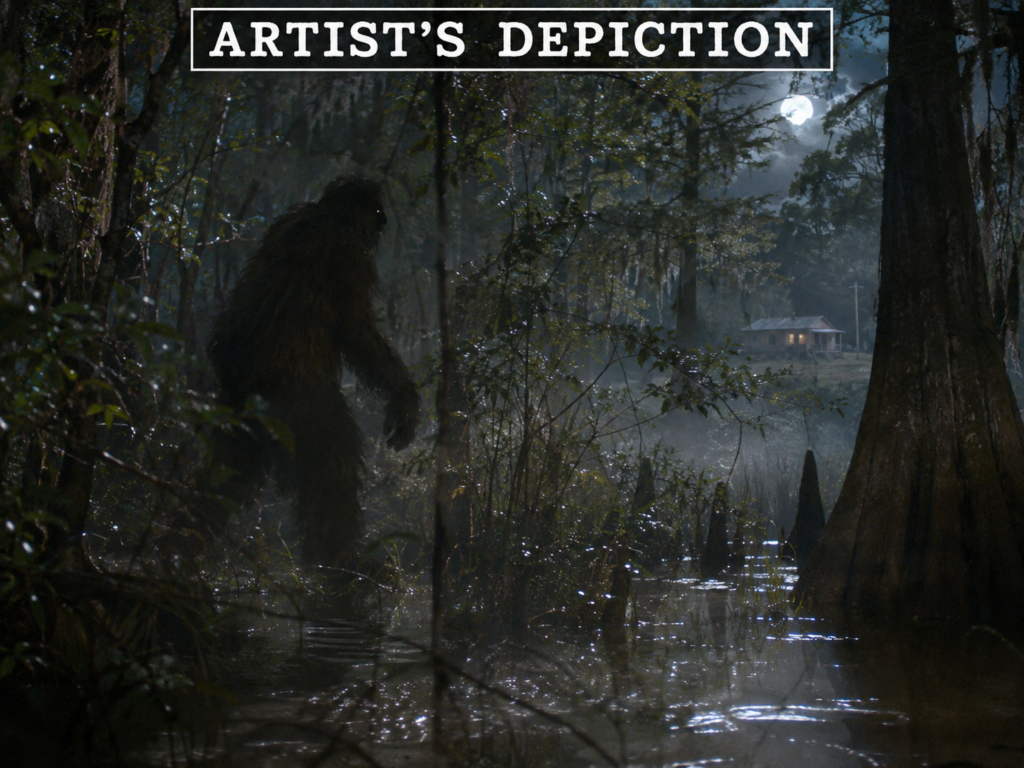
In May 1971, a family living near the small town of Fouke in southwestern Arkansas reported a terrifying encounter with a large, hairy creature outside their home. Bobby Ford said the animal was roughly seven feet tall, enormously broad through the chest and capable of moving with surprising speed. His wife Elizabeth reported seeing a hairy arm reach through a window and red eyes outside the house, while Bobby later claimed the creature physically grabbed him before he escaped inside.
Ford was treated at a local hospital for minor scratches and shock, and law-enforcement officers searched the property. Investigators reportedly found unusual tracks and scratches around the house, but they found no blood even though the men said they had fired repeatedly at the creature. Within days, local newspaper coverage gave the unknown animal a name that would permanently attach it to the town: the Fouke Monster.
The House Outside Fouke
The Ford family had been living at the property for less than a week when the incident occurred. According to later summaries of the contemporary reporting, the family had already noticed unusual activity around the house before the main encounter. On the night that brought national attention, Elizabeth Ford reportedly saw what initially looked like a large animal’s paw or hairy arm near the window.
Bobby Ford, his brother and a hunting companion went outside with firearms and flashlights. They said they saw a large upright figure behind the house and fired at it, believing they may have hit it. When screams came from the women inside, Bobby returned toward the house and claimed the creature approached from behind and wrapped an arm around his shoulder.
Ford said he broke free and ran for the house so quickly that he crashed through the closed front door rather than stopping to open it. That detail became one of the most memorable parts of the case because it suggested the fear itself was genuine regardless of what caused it. The family was sufficiently frightened that reporters arriving afterward found them preparing to leave a house they had occupied for only a few days.
The Monster Gets a Name
Reporter Jim Powell of the Texarkana Gazette covered the incident, and the following day’s reporting included the name “Fouke Monster.” The story was then distributed nationally through the Associated Press and United Press International, rapidly transforming a local Arkansas incident into a national curiosity.
That publicity matters because the case changed almost immediately after entering the news. Once people throughout the region knew a monster was supposedly roaming the woods, additional sightings, monster hunts and footprint discoveries began accumulating around Fouke. The original Ford encounter and the later wave of reports therefore have to be evaluated separately rather than treated as one continuous body of evidence.
Something Crosses Highway 71
Later in May 1971, another group reported seeing an ape-like figure cross U.S. Highway 71 south of Fouke. The witnesses described a large upright animal moving quickly across the road, adding another reported encounter soon after the Ford story became public.
Accounts like this helped standardize the image of the Fouke Monster as Arkansas’s version of Bigfoot. Instead of simply an unidentified animal near one family’s house, it became a large, hairy, bipedal creature supposedly moving through the swamps and wooded bottomlands around Fouke and Boggy Creek.
The Three-Toed Tracks
Footprints became one of the most famous pieces of supposed physical evidence. In June 1971, large three-toed tracks were discovered in a soybean field near Fouke and plaster casts were made from them. Some descriptions put them around size 14EE, and photographs of the casts became closely associated with the monster.
The tracks also created one of the biggest problems for the case. Archaeologist Frank Schambach of Southern Arkansas University examined the evidence and was strongly skeptical, later saying he believed the prints were fabricated. Former Miller County sheriff Leslie Greer, who had participated in searches during the original excitement, also later said he thought the tracks had been faked.
Former Fouke mayor Virgil Roberts reached the same conclusion, suggesting that someone may have created the tracks using homemade stilts or similar equipment. That does not prove the Ford family’s earlier encounter was also a hoax because the soybean-field tracks appeared after the case had received major publicity. It does mean the most visually impressive physical evidence associated with the legend cannot safely be treated as proof of an unknown animal.
Monster Fever
Once news of the creature spread, Fouke experienced what can reasonably be described as monster fever. People traveled into the area with guns, dogs and hopes of capturing the animal, while rewards were discussed for anyone who could produce it. The attention became intense enough that local authorities had to deal with trespassing, false reports and increasingly unreliable claims mixed in with sincere eyewitness accounts.
That creates a familiar problem in cryptid investigations. An unusual initial incident can attract enough public attention that later hoaxes become almost inevitable. Once fake tracks and fraudulent reports enter the record, they make it harder to determine whether earlier witnesses encountered something genuinely unexplained.
Stories Before 1971
The monster did not remain tied only to the Ford incident. Local tradition eventually connected the Fouke Monster with earlier sightings, including a reported 1946 encounter in which a woman told Miller County Sheriff Leslie Greer that she had seen a strange creature near her home. The Encyclopedia of Arkansas notes that reported sightings around Fouke have been traced at least that far back.
Those older reports are important because they suggest that strange-creature stories existed in the region before the national publicity of 1971. They are also less thoroughly documented than the Ford case, and later folklore can easily absorb older stories into a more famous legend. The safest interpretation is that wild-man and unusual-animal stories existed in the area before 1971, while the modern Fouke Monster identity became firmly established after the Ford encounter.
What Did Witnesses Describe?
The most familiar description is a large biped covered in dark hair, standing roughly six to seven feet tall or more. Stories frequently add glowing or red eyes, broad shoulders, long arms and a strong unpleasant odor. Later versions sometimes describe the monster as having three toes because of the famous tracks.
Those features overlap heavily with Bigfoot and other Southern wild-man legends. The odor in particular appears in stories about the Florida Skunk Ape and other regional hairy humanoids, while upright movement and exceptional size are central to nearly every Sasquatch-style tradition.
Could It Have Been a Bear?
A black bear is one obvious conventional candidate for at least some sightings. Bears can stand upright, appear surprisingly humanlike in poor light and move much faster than their size suggests. A frightened observer seeing a large animal briefly at night could easily have difficulty judging exact height, body proportions or whether it spent most of its time walking on two legs.
The Ford account complicates that explanation because Bobby claimed the creature physically grabbed him and multiple people said they observed it around the property. However, no biological evidence recovered from the site established what species was present. A bear therefore remains plausible for some reports without providing a definitive explanation for every detail of the 1971 story.
No Blood From the Gunfire
One important detail is what investigators did not find. The men said they fired several times at the creature and believed they struck it, yet investigators found no blood. If a seven-foot biological animal had been wounded by repeated gunfire, blood, hair or other biological material would have provided the strongest evidence in the entire case.
Instead, the surviving evidence consisted largely of testimony, scratches and footprints whose authenticity later became disputed. No body, verified hair, tissue or DNA emerged from the encounter. That leaves the case much stronger as a documented frightening experience than as proof of a previously unknown primate.
The Legend of Boggy Creek
The Fouke Monster might have remained a regional Arkansas story if filmmaker Charles B. Pierce had not arrived. In 1972, Pierce directed The Legend of Boggy Creek, a low-budget pseudo-documentary that combined reenactments with local residents discussing supposed encounters with the creature. Much of the movie was filmed around Fouke, and some residents and witnesses appeared in it.
Pierce financed the movie independently for roughly $160,000 to $165,000. The gamble paid off spectacularly, with the movie eventually earning more than $20 million and becoming one of the most successful independent films of its era. The film’s combination of documentary language, real locations and dramatized monster encounters made the Fouke story feel less like ordinary fiction and more like something audiences might actually discover outside their own homes.
A Movie That Changed Horror
The Legend of Boggy Creek also became important beyond Arkansas cryptid culture. Its documentary-style approach anticipated later films that blurred the boundary between fictional horror and supposedly real footage or testimony. Daniel Myrick, co-director of The Blair Witch Project, later cited Pierce’s film as an influence.
That makes the Fouke Monster unusual among cryptids because the story did not merely inspire a monster movie; the movie helped permanently shape the legend itself. Later generations encountered Boggy Creek through the film and then interpreted older witness accounts through the creature Pierce put on screen.
The Monster Becomes Part of Fouke
Fouke eventually embraced the creature that once caused panic. The town has hosted a Boggy Creek Festival, and Monster Mart on U.S. Highway 71 maintains a museum and sells merchandise connected with the legend. Visitors still travel to Fouke specifically because of the creature and the film.
That cultural afterlife is undeniably real regardless of what walked around the Ford house in 1971. The monster became part of Fouke’s identity, turning a frightening local incident into tourism, folklore and one of Arkansas’s most recognizable strange stories.
The Evidence Problem
The strongest part of the case is the original testimony. A frightened family reported an encounter, Bobby Ford received medical treatment, law enforcement searched the property and reporters arrived while the family was still shaken enough to leave their new home. That is considerably better documentation than a cryptid story appearing for the first time decades later.
The physical evidence is much weaker. No blood or body was recovered, no photograph documented the animal, and the most famous later tracks were viewed skeptically by the archaeologist, former sheriff and mayor who discussed them. A 1986 Associated Press retrospective noted that despite major attention and reward offers, the monster had never been trapped or photographed.
Why It Matters
The Fouke Monster case is a good example of how an unexplained event can become folklore almost in real time. Something frightened the Ford family badly enough to involve police, medical personnel and reporters, but publicity then surrounded the original event with additional sightings, questionable tracks, false reports and eventually a successful movie. Separating those layers is essential if we want to evaluate what actually happened.
The most defensible conclusion is therefore narrower than either side usually wants. There is enough documentation to say that the Ford family reported a genuinely frightening encounter with something they could not identify, but there is not enough physical evidence to establish that the cause was an unknown species of giant bipedal primate living in Arkansas.
T Funk Take
This is one of the stronger Bigfoot-type stories for me simply because we’re not starting thirty years later with somebody remembering something they saw as a kid. Bobby Ford goes to the authorities, gets treated at a hospital, reporters show up and find the family packing up to leave. Whatever happened, they seem to have been genuinely scared of it.
Where I start losing confidence is when monster fever kicks in afterward. Now everybody knows Fouke has a monster, people are hunting it, rewards are involved and giant three-toed footprints start showing up. When the archaeologist, sheriff and mayor all end up thinking those famous tracks were fake, I’m definitely not using them as my smoking gun.
That doesn’t automatically mean Bobby Ford faked his encounter. The footprints in the soybean field came later, after the story was already famous, and that’s an important distinction. Somebody can have a legitimate unexplained encounter and then have a bunch of other people muddy the water with pranks because they want attention or money.
The movie is probably the most important part of why we’re still talking about this. The Legend of Boggy Creek took one weird night outside a small Arkansas town and turned it into
Sources & Further Reading
-
Fouke Monster
Encyclopedia of Arkansas — Central Arkansas Library System
View Source -
The Legend of Boggy Creek
Encyclopedia of Arkansas — Central Arkansas Library System
View Source -
Monster or Hoax? Three-Toed Tracks Produced Legend of Boggy Creek
Associated Press / The Pampa News — archived by Texas Tech University Southwest Collection
View Source