Official Archive Record
Case File CF-0130
The Mogollon Monster: Arizona’s Bigfoot of the Rim
Also known as: Mogollon Monster, Arizona Bigfoot, Mogollon Rim Monster
What Happened
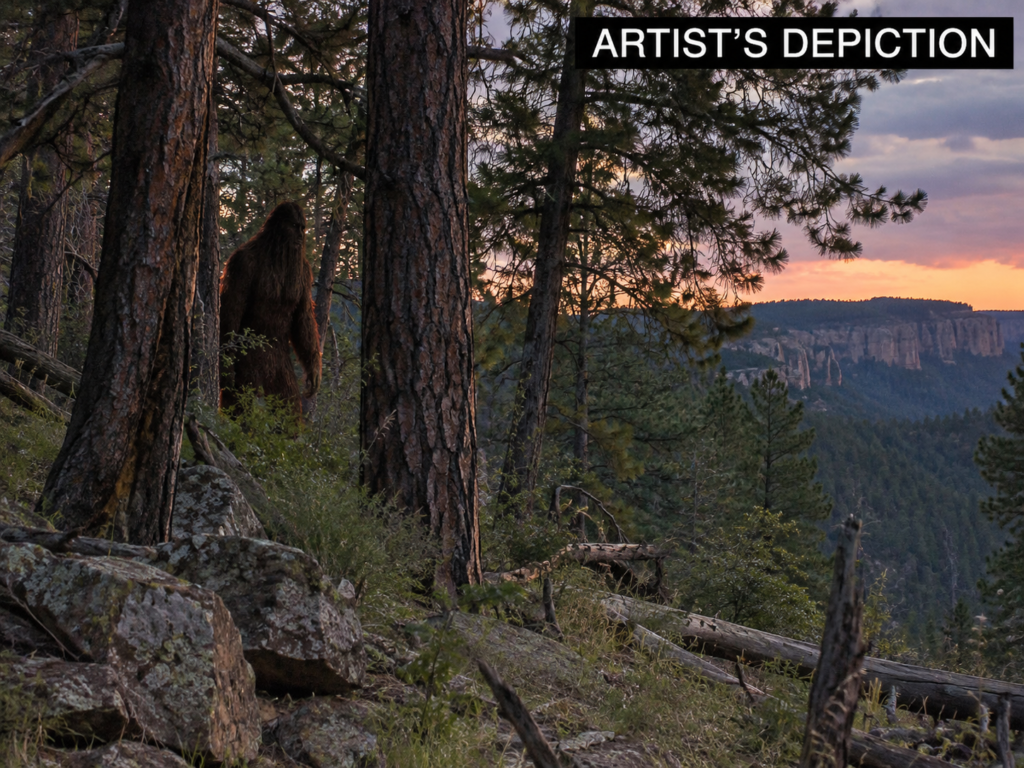
High above the desert landscape most people associate with Arizona, the Mogollon Rim cuts across the state through thick ponderosa pine forests, steep canyons and isolated mountain country. For decades, campers, hunters and hikers have told stories about a large hairy figure moving through those forests on two legs. The creature is commonly called the Mogollon Monster, Arizona’s regional version of the Bigfoot legend.
Descriptions vary, but the familiar version is a large biped standing more than seven feet tall, covered in dark or reddish-brown hair and accompanied by a powerful unpleasant odor. Witnesses have also described whistles, screams and other unusual vocalizations coming from the forest. No body, verified biological sample or clear photograph has established that an unknown primate actually lives along the Rim.
The Mogollon Rim
The Mogollon Rim is real and enormous. It stretches across central and eastern Arizona as a dramatic escarpment separating lower country from the Colorado Plateau, with towns such as Payson, Pine, Strawberry and Show Low associated with the wider Rim region. Much of the landscape is heavily forested rather than desert, creating exactly the kind of terrain where a Bigfoot-style legend can seem plausible.
The forests are also home to substantial wildlife populations. Black bears are especially relevant because the Arizona Game and Fish Department says some of the state’s highest bear densities occur along the Mogollon Rim. A large bear standing upright, moving through poor light or disappearing quickly into dense timber provides one obvious source for at least some unusual sightings.
The 1903 Wild Man
Most modern histories of the Mogollon Monster begin with a newspaper story from 1903. On June 3 of that year, The Arizona Republican reprinted an account attributed to a man named I. W. Stevens, who claimed he encountered a strange hairy man while traveling in northwestern Arizona. The figure supposedly had long white hair, a beard reaching toward its knees, gray hair over much of its body and unusually long fingernails.
Stevens claimed the wild man carried a heavy club and moved across the rocks with remarkable speed. The story became even more dramatic when Stevens said the creature killed two young cougars and drank blood from the carcasses before climbing away through the canyon. It is exactly the kind of description that later readers could easily reinterpret as an early Bigfoot encounter.
The Newspaper Was Already Skeptical
There is an important problem with using the 1903 story as straightforward evidence. The Arizona Republican itself introduced the article sarcastically, joking that the Grand Canyon had finally acquired the kind of sensational monster every tourist attraction supposedly needed. The paper even mocked the reliability of the newspaper from which the story had been obtained.
The account was therefore not presented as a carefully investigated scientific report. It belonged to a long tradition of newspaper “wild man” stories that mixed entertainment, rumor and supposed eyewitness testimony. That does not prove Stevens invented his story, but it means the original source itself was already warning readers not to treat the tale too seriously.
It Wasn’t on the Mogollon Rim
There is an even bigger geographical problem. Stevens said his encounter took place near the extreme lower end of the Grand Canyon along the Colorado River in Mohave County. That location is well away from the forests normally associated with the Mogollon Monster.
Arizona Highways still treats the 1903 wild-man story as an important precursor to the legend, but the connection appears to have been made later. The historical newspaper does not call the creature the Mogollon Monster, and it does not place the encounter on the Mogollon Rim. Calling the 1903 story the first Mogollon Monster sighting is therefore more convenient than historically precise.
The Boy Scout Encounter
A much better geographical connection comes from a story told by Don Davis, who later became interested in cryptozoology. Davis said that while attending Boy Scout camp near Tonto Creek at the base of the Mogollon Rim during the early 1940s, he and another boy saw a reddish-brown figure walking through the forest with an unusual rocking motion.
Later that night, Davis claimed he woke to find a massive humanlike figure standing only a few feet from his sleeping bag. His description emphasized huge shoulders, arms and chest along with an overall humanlike appearance. The account is much closer to the modern Mogollon Monster because it actually occurs in Rim country and describes the kind of large hairy biped now associated with the legend.
The problem is documentation. Davis related the experience decades after it supposedly happened, which means researchers do not have a contemporary Scout report, photograph or newspaper article from the 1940s confirming what he saw. It remains an eyewitness story remembered long afterward rather than a documented biological encounter.
When the Name Appears
Arizona Highways reports that the earliest newspaper reference it located using the actual name “Mogollon Monster” dates to 1967. The article concerned a Boy Scout camping trip in the White Mountains and casually mentioned that some of the boys claimed to have seen the creature. The wording suggests the name was already familiar enough that the newspaper did not need to explain it.
That leaves an interesting gap in the legend’s development. The 1903 story provides an Arizona wild man, the 1940s account places a hairy figure near the Rim, and by 1967 the name Mogollon Monster appears in print. Somewhere during those decades, separate wild-man and campfire stories seem to have solidified into the regional creature recognized today.
The Modern Monster
Later accounts describe a fairly standardized creature. It is usually tall, heavily built and covered in black, brown or reddish hair, with a humanlike or ape-like face. Stories frequently add a powerful smell and unusual screams or whistles, giving people something to identify even when the creature itself is difficult to see.
Modern reports have been associated with the Payson area, the White Mountains and other portions of eastern Arizona. Some residents around Whiteriver and the Fort Apache region have also reported large dark figures moving through remote country. The stories continue, but none has produced the kind of physical evidence necessary to demonstrate that Arizona contains an unknown population of large primates.
Why the Smell Matters
A strong odor is common in Bigfoot-style stories throughout North America, and the Mogollon Monster follows that pattern. Witnesses sometimes describe a smell strong enough to notice before seeing the creature. That detail has become so common that it is now treated as one of the monster’s identifying characteristics.
Unfortunately, smell is one of the least useful forms of biological evidence after an encounter is over. Bears, decaying animals, wet vegetation and numerous other natural sources can produce powerful odors in the woods. Once a foul smell becomes part of the expected legend, it can also reinforce someone’s interpretation of an otherwise ambiguous encounter.
The Screams
Stories also credit the Mogollon Monster with screams, whistles and other strange calls. A frightening vocalization coming from an unseen animal at night can be extremely convincing, especially in a forest where sound travels unpredictably between trees and canyon walls. People unfamiliar with wildlife calls can easily underestimate how disturbing completely ordinary animals can sound.
A scream therefore establishes that someone heard something, but not necessarily what produced it. Without a clear recording tied to a visible animal, the sound remains another piece of testimony rather than physical evidence of an unknown species.
The Bear Problem
Black bears provide the most obvious conventional candidate for at least some Mogollon Monster sightings. Arizona Game and Fish identifies the Mogollon Rim as one of the areas with the highest relative densities of black bears in the state, so witnesses are operating in genuine bear country.
Bears can stand upright, have substantial body mass and can appear surprisingly humanlike when briefly seen from a distance. Their coats also vary in color, and a bear disappearing through forest cover could easily leave a witness with only seconds to estimate its size and posture. That does not prove every witness saw a bear, but it is an explanation that has the advantage of involving a large mammal already known to live exactly where the monster is reported.
A Population Would Leave Evidence
The largest biological problem is that one Mogollon Monster would not be enough. For an unknown primate population to survive for generations, there would need to be enough animals to reproduce, which means Arizona would presumably contain far more than one hidden individual. Those animals would leave bodies, bones, scat, hair, DNA and other physical traces.
Modern wildlife research detects rare and elusive animals through exactly those kinds of evidence. Yet no verified Mogollon Monster specimen, tissue sample or genetic material has established the existence of a new primate species in Arizona. The longer the legend continues without that evidence, the harder it becomes to explain how an entire breeding population avoids leaving identifiable remains.
The Landscape Helps the Legend
None of that makes the Mogollon Rim feel less mysterious at night. The region contains vast stretches of ponderosa forest, steep slopes and isolated recreation areas where a person can quickly lose sight of roads or buildings. Arizona Highways describes the Rim as a massive feature extending for hundreds of miles, with thick forest covering much of the upper country.
That environment is almost perfectly designed for campfire folklore. A broken branch, distant scream or large shadow can happen beyond the edge of a flashlight, and the person experiencing it may never get a second look. Once a community already has a monster story, ambiguous events naturally begin collecting under the same name.
Arizona Gets Its Own Bigfoot
The Mogollon Monster also demonstrates how national folklore becomes regional. The Pacific Northwest has Sasquatch, Missouri has Momo and other parts of the country have their own hairy wild-man traditions. Arizona’s version became attached to the landscape that best supports the idea: the high forests of the Mogollon Rim rather than the open desert.
That regional identity matters because it allows the monster to become part of local culture even without scientific confirmation. The name appears in businesses, recreational events, stories and tourist material, while people continue sharing encounters around campsites and communities. The creature can therefore become culturally real long before it becomes biologically real.
Why It Matters
The Mogollon Monster has a surprisingly useful paper trail because the history shows how legends become cleaner over time. Modern summaries often begin confidently with a 1903 sighting, but the actual newspaper story described a Grand Canyon wild man hundreds of miles from the monster’s modern home and was introduced with obvious skepticism. Later retellings pulled that story into the Mogollon tradition because it fit the creature people already knew.
That does not erase later eyewitness accounts. It means we should evaluate each report on its own evidence instead of treating every Arizona wild-man story as one continuous biological record. At present, the Mogollon Monster is extremely well established as Arizona folklore and remains unestablished as an unknown animal.
T Funk Take
I like this case more after finding out the famous 1903 story isn’t actually as clean as everybody makes it sound. You constantly see it described as the first Mogollon Monster sighting, but the guy says he’s at the Grand Canyon, not the Mogollon Rim, nobody calls the thing the Mogollon Monster and the newspaper basically introduces the story by making fun of it. That’s a pretty big set of details to lose when the story gets repeated.
The Boy Scout account is more interesting to me because at least that one puts a big hairy figure where the legend actually lives. The problem is that it was told years later, so I’m still dealing with somebody’s memory rather than a photograph, hair sample or report written the next morning. I don’t think that means Davis was lying; it just limits what we can prove from the story.
The bear explanation has to stay near the top of the list because Arizona itself says the Mogollon Rim has some of the state’s highest black bear densities. If I’m in a dark pine forest where large bears are known to live and I see something hairy stand up for five seconds, I want to rule out the animal we already know is there before creating a new one.
That said, the Rim is exactly where I would expect Arizona to grow its own Bigfoot legend. It’s huge, wooded, isolated and completely different from the cactus-and-desert version of Arizona most people picture. I don’t see physical evidence strong enough to say there’s an unknown giant primate living there, but enough people have kept this story alive that the Mogollon Monster definitely belongs in the T Funk Era archive as Arizona’s Bigfoot.
Sources & Further Reading
-
Snallygasters and Cadborosauruses: Exploring American Cryptids with Chronicling America
Library of Congress
View Source -
Neither Hide Nor Hair
Arizona Highways
View Source -
Black Bear
Arizona Game and Fish Department
View Source