Official Archive Record
Case File CF-0128
Huggin’ Molly: Alabama’s Screaming Woman in Black
Also known as: Huggin’ Molly, Huggin Molly, Hugging Molly
What Happened
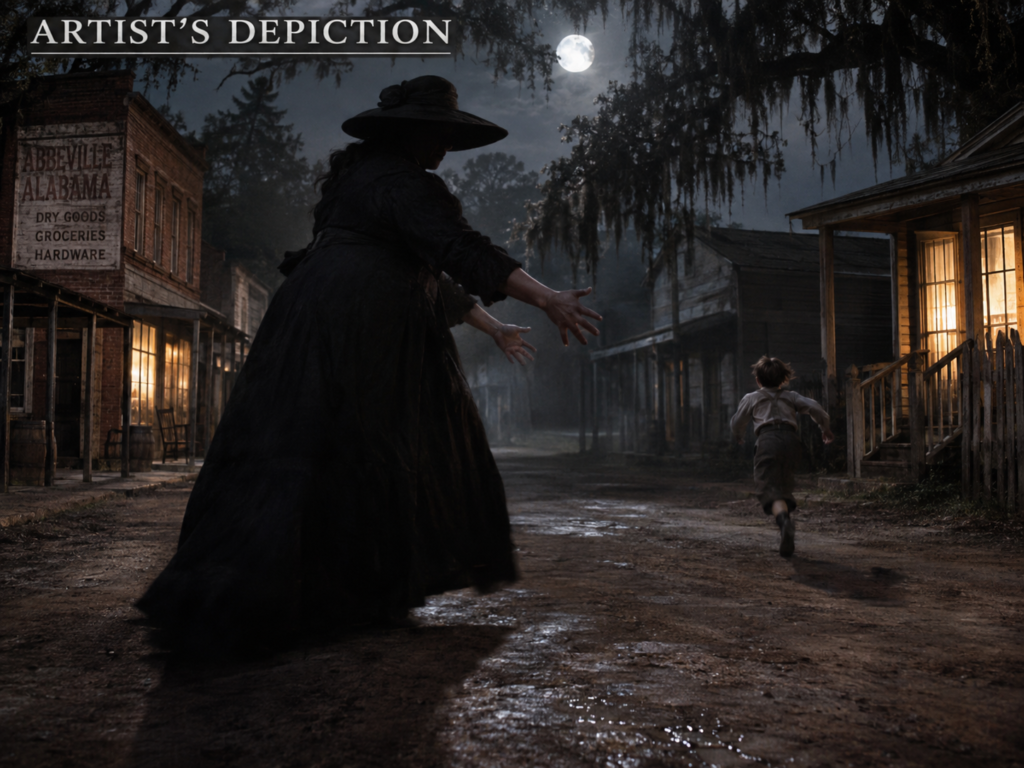
For generations, children in Abbeville, Alabama, have grown up with a warning about what might happen if they stayed outside after dark. Somewhere on the streets was supposedly a huge woman dressed in black who would chase down anyone wandering too late, wrap them in an enormous hug and scream directly into their ear. Her name was Huggin’ Molly, and unlike most monsters used to frighten children, Molly usually let her victims go after delivering the message.
The most commonly repeated description makes Molly approximately seven feet tall and extremely broad, sometimes described as being as big around as a bale of cotton. She wears dark clothing, and some versions give her a large or wide-brimmed hat that makes her appearance even more imposing at night. Despite her frightening size and scream, Alabama tourism accounts emphasize that she was not normally said to seriously injure anyone.
The Streets of Abbeville
Huggin’ Molly belongs specifically to Abbeville, a small community in Henry County in southeastern Alabama. The legend is so closely identified with the town that Abbeville’s welcome sign openly calls the community the “Home of Huggin’ Molly,” turning what was once a childhood threat into part of the town’s public identity. A restaurant in downtown Abbeville also carries her name and preserves the legend for visitors.
Local recollections describe Huggin’ Molly as something practically every Abbeville child knew about. Abbeville native Jimmy Rane has recalled that parents could invoke Molly whenever they wanted their children home before dark, and children took the warning seriously. The story therefore functioned as more than entertainment because it gave parents a supernatural method of enforcing a very ordinary curfew.
The Chase
The usual encounter begins after sunset when a child or young person is walking through town alone. A large figure appears somewhere behind them, begins following and then gives chase when the frightened victim runs. Once Molly catches up, she grabs the person in a crushing embrace and unleashes a scream at extremely close range.
That strange combination is what makes Huggin’ Molly different from most Southern ghost stories. She does not normally drag children away, murder them or disappear with them into the woods. The terror comes from being pursued by an impossibly large woman, grabbed without warning and deafened by a scream before being released to presumably run straight home.
Who Was Molly?
This is where the historical trail becomes extremely thin. The sources agree on what Molly does far more consistently than they agree on who she was, and no securely documented historical woman has emerged as the original Huggin’ Molly. Local versions simply describe a mysterious woman or ghost whose identity changes depending on who is telling the story.
Some later tellings attempt to give Molly a personal history, describing her as a grieving mother, a murdered woman or someone who deliberately frightened young people into obeying curfew. None of those biographies has become the established origin of the legend, and the better-supported local accounts do not require one. What survives most consistently is the behavior rather than the biography: a huge woman in black, children outside after dark, a chase, a hug and a scream.
A Boogeywoman With a Purpose
Huggin’ Molly fits into a much larger tradition of supernatural figures used to regulate children’s behavior. Cultures around the world have stories about creatures waiting for children who wander into dangerous places, refuse to sleep or ignore their parents. The details change, but the practical result is usually the same: children behave differently because something frightening supposedly happens if they do not.
Abbeville’s version is unusually specific to nighttime wandering. Local and state accounts explicitly connect the story with parents wanting their children home after dark, suggesting that the legend’s social purpose may be more important than whether anybody ever encountered a literal ghost.
That would have been a useful warning in an earlier Abbeville with darker streets, fewer vehicles and much less artificial lighting than today. A supernatural woman lurking outside offered children a much more memorable reason to come home than an abstract discussion about nighttime safety. The fact that generations continued repeating the warning indicates that, supernatural or not, Molly was apparently very good at her job.
More Hug Than Harm
Another unusual feature is that Huggin’ Molly is not entirely evil. Alabama Travel describes her as a friendly ghost in one account, while other versions make her frightening without making her murderous. Even the scream and aggressive embrace can be interpreted as a supernatural version of a scolding rather than an attempt to kill the victim.
That gives the legend a strange sense of humor that many darker ghost stories lack. Children were supposed to be terrified of getting caught, but the punishment amounted to being hugged and screamed at until they learned the lesson. The name itself undercuts some of the horror because “Huggin’ Molly” sounds more like an eccentric relative than a demonic entity.
More Than a Century of Storytelling
Modern accounts commonly describe the legend as more than a century old, and secondary collections of Alabama folklore place the tradition in the early twentieth century or earlier. What is much harder to establish is a specific first sighting, first storyteller or contemporary document showing exactly when Huggin’ Molly entered Abbeville folklore.
That means the age of the tradition should not be confused with proof of a supernatural event. Oral legends can circulate for decades before anyone records them, but repeated storytelling can also add details and apparent history that were absent from earlier versions. For Huggin’ Molly, the longevity of the folklore is better established than the identity of the person who supposedly inspired it.
From Monster to Mascot
Over time, Huggin’ Molly stopped being only something children feared and became something Abbeville embraced. The town identifies itself with the legend, its official tourism presence discusses Molly and the downtown restaurant named after her uses the story as part of its identity. Alabama folklore collections likewise continue including her among the state’s distinctive legends.
That transformation is almost the reverse of the original story. Instead of Abbeville residents running away from Molly, the community now advertises that she lives there. A supernatural threat meant to empty the streets after dark has effectively become one of the town’s most recognizable ambassadors.
Ghost, Prank or Parenting Tool?
There are several ordinary ways a Huggin’ Molly encounter could potentially develop without requiring a supernatural woman. A parent, older sibling or local prankster familiar with the story could frighten younger children, while darkness and expectation could turn an unfamiliar large person or shadow into exactly the figure a frightened child expected to see. After the story was established, every ambiguous nighttime encounter had a ready-made explanation.
That does not prove that every reported encounter was fabricated. People can sincerely experience something frightening without having enough information to identify what caused it, and oral tradition can preserve sincere experiences alongside obvious storytelling. The problem is that there is no strong physical or contemporary documentary evidence establishing a seven-foot supernatural woman roaming Abbeville’s streets.
Why It Matters
Huggin’ Molly is valuable because the legend shows what folklore actually does inside a community. It can frighten children, enforce behavior, create shared memories and eventually become part of a town’s identity even when nobody can establish exactly where the story began. Abbeville’s public embrace of Molly demonstrates that a local legend can become culturally real regardless of whether the supernatural figure was physically real.
That makes the case less about proving one ghost encounter and more about watching a small-town story survive across generations. The details that matter most have remained remarkably simple: stay out too late, Molly finds you, Molly catches you and Molly makes sure you remember not to do it again.
T Funk Take
I think Huggin’ Molly may be the least efficient monster we’ve covered because she goes through all the trouble of chasing you down just to give you a hug. Granted, screaming directly into your ear afterward ruins the friendly part a little bit, but compared with some of the other things in this archive, getting caught by Molly is probably a pretty good outcome.
This also looks to me like a story that worked really well as parenting technology. If you’re trying to get a kid home when the streetlights come on, “because I said so” has competition from a seven-foot woman in black who can apparently outrun you. I can absolutely see that story getting passed from parents to kids until nobody remembers which parent started it.
The weak part for me is trying to turn Molly into one specific historical ghost. We have a very consistent description of what she supposedly does, but the story of who she actually was becomes much less stable. When the behavior survives but the biography keeps changing, that usually makes me think I’m looking at folklore rather than a police report on one dead woman.
I still like this case because the town seems to have completely adopted her. The monster your parents used to scare you off the streets eventually gets her own restaurant and ends up on the welcome sign, which is a pretty good retirement plan for a ghost. I don’t see evidence that a supernatural seven-foot woman is hunting children in Abbeville, but Huggin’ Molly is absolutely real as Alabama folklore, and that’s enough to give her a place in the T Funk Era archive.
Sources & Further Reading
-
Abbeville: Yatta Abba Yella Fella Tour
Alabama Tourism Department
View Source -
The Legend of Huggin’ Molly
Huggin’ Molly’s — Abbeville, Alabama
View Source -
Alabama Lore: The Choccolocco Monster, Huggin’ Molly, the Lost Town of Cottonport and Other Mysterious Tales
The History Press / Arcadia Publishing — Wil Elrick
View Source