
Official Archive Record
Case File CF-0125
The Dybbuk Box: How an eBay Horror Story Became a Haunted Legend
Also known as: Dybbuk Box, Dibbuk Box, Haunted Jewish Wine Cabinet
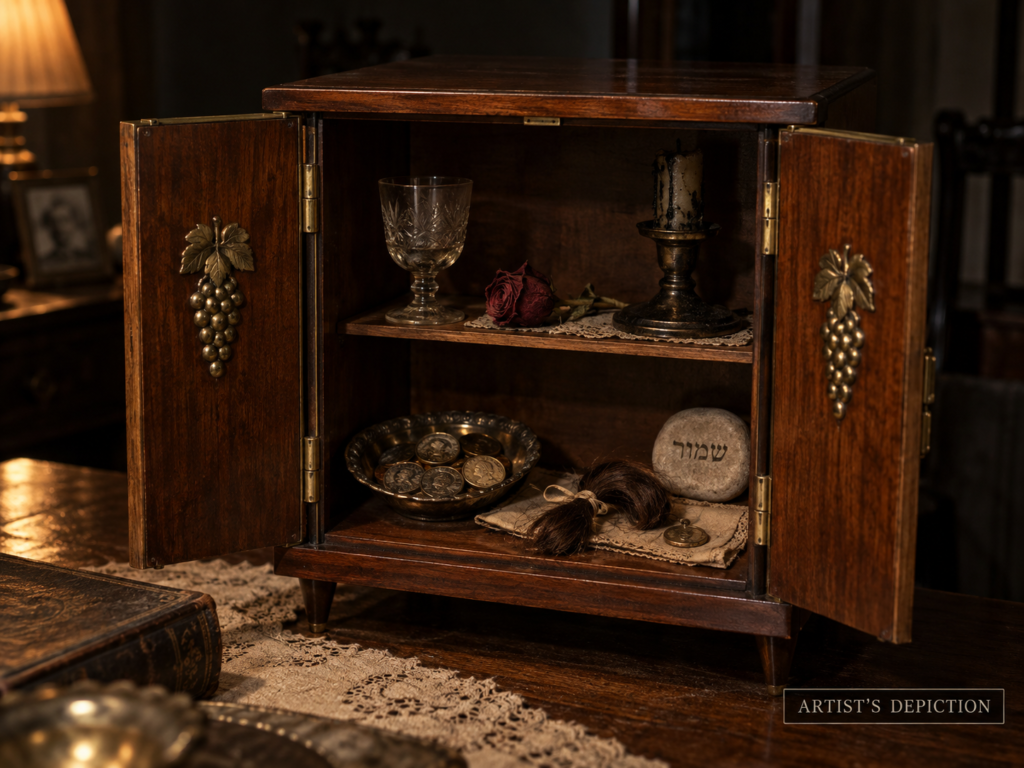
In 2003, an unusual wooden cabinet appeared for sale on eBay accompanied by one of the most elaborate haunted-object stories the internet had seen. Seller Kevin Mannis claimed the cabinet had once belonged to an elderly Jewish Holocaust survivor who called it a “Dybbuk Box” and warned that it should never be opened. Mannis described nightmares, strange odors, illnesses and other disturbing events that supposedly followed anyone who came into contact with it.
The story spread far beyond the original auction. Later owners reported their own frightening experiences, a book expanded the legend, Hollywood turned it into a horror movie and the cabinet eventually became a featured attraction in a paranormal museum. There was only one major problem: years later, Mannis acknowledged that he had created the Dybbuk Box story himself.
The 2003 eBay Listing
Mannis’s original story said he acquired the cabinet at an estate sale in Portland, Oregon. According to the listing, the seller’s grandmother had survived a Nazi concentration camp, eventually reached Spain and brought the cabinet with her to the United States. Her granddaughter supposedly warned Mannis that the woman had always called the object a Dybbuk Box and had insisted that it never be opened.
Inside the cabinet, Mannis claimed he found several peculiar objects, including old pennies, locks of hair, a dried rosebud, a small goblet, a candlestick holder and a stone bearing Hebrew writing. After bringing the cabinet home, he described foul smells, electrical problems and recurring nightmares involving a frightening elderly woman. Family members and friends supposedly experienced similar dreams.
One of the most disturbing elements involved Mannis’s mother. He claimed he gave her the cabinet as a birthday present and that she suffered a stroke shortly afterward. In the story, the event became further evidence that something attached to the cabinet was capable of harming the people around it.
What Is a Dybbuk?
The word dybbuk does come from Jewish folklore, but the traditional concept is substantially different from the object Mannis described. A dybbuk is generally understood as the restless soul or spirit of a deceased person that attaches itself to and possesses a living human being. The word is related to the Hebrew concept of clinging or attachment.
Accounts of dybbuk possession became especially prominent in early modern Jewish folklore, with stories describing spirits speaking through possessed people and religious authorities attempting exorcisms. The concept became internationally famous through S. Ansky’s play The Dybbuk, written in the early twentieth century and first performed in 1920.
What traditional dybbuk folklore does not appear to contain is a standard practice of trapping one inside a wooden cabinet. Researchers examining the history of the Dybbuk Box found no established Jewish tradition of “dybbuk boxes” predating Mannis’s 2003 story. The famous haunted container appears to be a modern creation built around a genuine term from Jewish folklore.
The Box Changes Owners
The cabinet sold and eventually passed to college student Iosif Nietzke, who later placed it back on eBay accompanied by additional paranormal claims. Jason Haxton, who worked at the Museum of Osteopathic Medicine at A.T. Still University in Missouri, then purchased it and became one of the most important people in expanding the legend.
Haxton reported health problems, strange smells, nightmares and other disturbing experiences that he associated with the cabinet. He eventually wrote a book about the object, helping expose the story to a much larger audience than the original eBay auction had reached.
The pattern was ideal for developing an urban legend. One owner made a claim, another owner reported something similar and every retelling added another layer of apparent confirmation. Instead of one person’s haunted-object story, the Dybbuk Box now appeared to have a history of repeatedly affecting unrelated owners.
Hollywood Finds the Box
The story eventually reached Hollywood and inspired the 2012 horror film The Possession, produced by Sam Raimi. The movie did not simply reproduce the original eBay story but used the concept of a box containing a dangerous Jewish spirit as the foundation for a supernatural horror film.
That exposure transformed the Dybbuk Box from an internet curiosity into a recognizable paranormal object. Copycat boxes began appearing online, frequently advertised as containing spirits or carrying curses of their own. A concept that apparently did not exist as a recognized category before 2003 suddenly became an entire type of haunted object.
That is one of the most fascinating parts of the case. Folklore usually seems ancient because we encounter it after generations of repetition, but the Dybbuk Box allows us to watch a new supernatural tradition form within a few years.
The Cabinet Wasn’t What the Story Claimed
Investigator Kenny Biddle examined the physical cabinet and traced its design to mid-twentieth-century home bar furniture produced by Karoff Originals. A 1957 U.S. patent describes a similar liquor cabinet structure designed to hold bottles and glasses. That finding conflicts with the original portrayal of the object as an old Jewish wine cabinet carried from Europe by a Holocaust survivor.
The distinction matters because the cabinet’s supposed history was one of the strongest parts of the original story. If the object was manufactured in the United States during the middle of the twentieth century, it could not have followed the European history described in the eBay narrative.
The cabinet itself is real. The extraordinary biography attached to it is another matter entirely.
Then Kevin Mannis Explained What Happened
Mannis eventually began publicly acknowledging that he had created the story. In a 2021 interview, he was especially explicit, telling journalist Charles Moss that the Dybbuk Box was a story he created and that the original eBay description was fiction. He said the project was intended to become an interactive horror story that continued developing as people reacted to it.
Mannis said he actually obtained the cabinet at a yard sale from an attorney rather than from the granddaughter of a Holocaust survivor. He also said he personally created elements associated with the cabinet, including the carving in the back and one of the objects placed inside it. Two people who knew him during the period also confirmed portions of his account to the interviewer.
One friend even identified hair supposedly discovered inside the haunted cabinet as his own. At that point, the original supernatural backstory was no longer merely questioned by skeptics; the person who created it was describing how he had constructed it.
The Holocaust Problem
One of the more uncomfortable parts of the Dybbuk Box story is its use of Holocaust history. The original narrative gained emotional weight by claiming that the cabinet belonged to a Polish Jewish woman whose relatives were murdered during the Holocaust and who carried the object after escaping persecution.
Mannis’s later admission means those details were not a family history attached to the object. They were narrative elements created for the story. Modern scholarship examining the Dybbuk Box has consequently looked not only at paranormal folklore but also at how internet storytelling can appropriate genuine historical trauma to make fictional supernatural narratives appear older and more authentic.
That distinction is important when discussing the case. Dybbuks belong to real Jewish folklore, and the Holocaust was a real historical catastrophe. The specific story connecting those things to this cabinet was created in the twenty-first century.
The Legend Refuses to Die
Mannis’s admission did not kill the Dybbuk Box legend. Jason Haxton has continued to suggest that something unusual may have become associated with the cabinet regardless of how the original story began. Other paranormal investigators and television personalities have likewise continued treating the object as potentially dangerous.
The cabinet eventually entered the collection of Zak Bagans’s Haunted Museum in Las Vegas, where its reputation only became larger. Stories connected it with illnesses, bad luck and unusual experiences involving people who visited or approached it.
From a folklore perspective, that may be the most interesting outcome possible. Once enough people participate in a legend, proving that the original story was fabricated does not necessarily destroy it. New experiences become attached to the object independently of the story that started everything.
A New Type of Haunted Object
The Dybbuk Box also helped create an entire online category of paranormal merchandise. Searches for supposedly haunted boxes now produce objects described as spirit vessels, demon containers and other supernatural artifacts, often borrowing terminology from the original story.
That transformation demonstrates how quickly internet folklore can create its own traditions. Someone sees the Dybbuk Box, creates another object using similar ideas and sells it to somebody who may then report their own experiences. Within a few years, a newly invented concept can begin looking as though it has always existed.
Future generations encountering hundreds of supposedly haunted dybbuk boxes might reasonably assume the tradition is centuries old. Without preserving the original internet record, its creation in 2003 could easily disappear behind the legend.
Why It Matters
The Dybbuk Box may be more valuable as a case study in folklore than it ever was as evidence of the paranormal. We have an unusually clear starting point, an original storyteller, subsequent owners adding experiences, mass-media amplification, Hollywood adaptation and finally an admission from the creator explaining that the foundational story was fictional.
That makes this almost a laboratory example of how legends grow. A story does not need to begin with an unexplained event. It can begin with fiction, collect sincere believers and alleged experiences afterward, and eventually become culturally real even after its invented origin is exposed.
The cabinet exists. Dybbuks exist within Jewish folklore. People have genuinely reported frightening experiences involving the cabinet. What the available evidence does not support is the original claim that this particular object was an old Jewish container holding a supernatural entity.
T Funk Take
This might be one of my favorite Case Files because we almost never get to catch a legend at the moment somebody creates it. Usually we’re digging through stories that are hundreds of years old trying to figure out what the original version even was. With the Dybbuk Box, we’ve basically got the guy who started it saying, “Yeah, I made that story up.”
That should normally be the end of the supernatural part for me. If the person who sold the thing says the Holocaust-survivor story was fiction, says he created the Dybbuk Box concept and says some of the creepy stuff inside it was put there by him, I don’t really need another explanation for where the legend came from. The fact that the box itself appears to be a mid-century minibar instead of some ancient Jewish artifact doesn’t exactly help the haunting either.
What makes it interesting is that the story kept going anyway. Other people reported nightmares, illness and strange experiences after they owned or encountered the box, and some of them still believe something is attached to it. I can’t tell those people what they felt, but once I know the original story was deliberately designed as horror fiction, coincidence and expectation move way higher on my list than a spirit trapped inside a cabinet.
The part I really don’t like is using a fake Holocaust-survivor backstory to make the object seem authentic. Jewish folklore actually has dybbuks, and the Holocaust obviously doesn’t need fictional additions to make it disturbing. Taking those real things and attaching them to a minibar makes a good horror story, but it shouldn’t be confused with actual Jewish history.
Still, as an internet legend, this thing is almost perfect. One guy posts a creepy story on eBay, other people add their experiences, Hollywood makes a movie, paranormal television picks it up and suddenly people are selling their own dybbuk boxes like this has been a tradition for five hundred years. I don’t think we’ve got a demon in a cabinet here, but we definitely have a great example of how modern folklore gets manufactured right in front of us, which earns the Dybbuk Box a place in the T Funk Era archive.
Sources & Further Reading
-
Finally, the Truth Behind the 'Haunted' Dybbuk Box Can Be Revealed
Input / Inverse
View Source -
Dibbuk (Dybbuk)
Encyclopaedia Judaica / Jewish Virtual Library
View Source -
The Dibbuk Box
Skeptical Inquirer
View Source