
Official Archive Record
Case File CF-0124
Bloody Mary: The Woman in the Mirror
Also known as: Bloody Mary, Mary Worth, Mary Whales
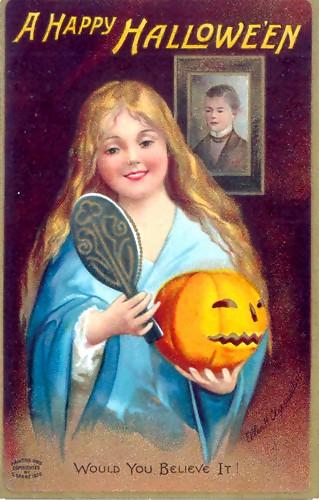
Almost everyone seems to know some version of the Bloody Mary challenge. Go into a dark bathroom, stand in front of a mirror and repeat her name several times. If you do it correctly, a woman is supposed to appear in the glass, sometimes only to frighten you and sometimes with much worse intentions. The details change constantly, but the mirror, darkness and repeated name remain remarkably consistent.
The strange part is that nobody can clearly identify who Bloody Mary is supposed to be. Depending on the storyteller, she was a murdered woman, a witch, a mother who lost a child, a girl named Mary Worth or even Queen Mary I of England. Those contradictory biographies suggest that the ritual may be older and more important than the character attached to it.
The Bathroom Ritual
The basic ritual usually requires a dark room and a mirror, often in a bathroom. A participant looks into the glass and chants “Bloody Mary” a specific number of times, commonly three, although versions of the game require many more repetitions. Some traditions add candles, spinning in circles, running water or other instructions intended to make the summoning more elaborate.
What happens next varies almost as much as the ritual itself. Mary may appear behind the participant, emerge from the mirror, scratch the person’s face, reveal the future or simply appear as a frightening reflection. That flexibility is one of the reasons the game spreads so easily because each group of children can inherit the basic structure while changing the details.
Nobody Knows Who Mary Is
Unlike a traditional ghost story tied to one deceased person, Bloody Mary has no agreed biography. Folklore versions use names including Mary Worth and Mary Whales, while other tellings describe a woman killed by a jealous lover, a disfigured girl, a witch or a mother whose child died. In many versions, the storyteller knows very little about Mary beyond the fact that saying her name summons her.
Queen Mary I of England is sometimes proposed as the historical source because she was later given the nickname “Bloody Mary.” Her reign included the execution of hundreds of Protestants for heresy, but there is no strong historical trail connecting the Tudor queen directly to the children’s mirror ritual. The shared name may have made the association attractive after the legend was already circulating rather than providing its original source.
Mary Worth
One of the most important American variants involves a figure called Mary Worth. Folklorist Alan Dundes examined versions in which children entered a dark bathroom, stared into the mirror and repeatedly called Mary Worth or Bloody Mary until an apparition was expected to appear. His 1998 study treated the game not simply as a ghost story but as a ritual performed largely by children approaching adolescence.
Dundes proposed that the blood imagery, mirrors and bathroom setting could symbolically relate to anxiety surrounding puberty and menstruation. That interpretation is influential but remains an interpretation rather than a proven explanation for why every child plays the game. The larger point is that folklorists have treated Bloody Mary as a ritual with social and psychological functions, not merely as a story about one supposedly real ghost.
Mirrors Were Strange Before Bloody Mary
People were using mirrors for supernatural games long before the modern Bloody Mary challenge became popular. During the nineteenth and early twentieth centuries, young people participated in mirror-divination rituals intended to reveal a future husband or wife. Halloween postcards even depicted young women staring into mirrors hoping to see the face of the person they would eventually marry.
The ritual could also produce something frightening. Depending on the tradition, a mirror might reveal a ghost, witch, devil or omen of death instead of a future spouse. Bloody Mary therefore fits into an older pattern in which the mirror acts as a boundary where information from another world might supposedly appear.
Why Mirrors?
Mirrors are especially effective tools for a supernatural game because they show something familiar while making it feel slightly separate from the person looking at it. A reflection copies every movement but exists inside a space that looks like another room extending beyond the glass. In darkness, familiar facial details become difficult to see, making the reflection even less stable.
The participant is also waiting for something to happen. Every shadow, blink, movement and change in expression is being examined for evidence that another face has entered the mirror. Fear and expectation therefore create ideal conditions for an ordinary visual effect to become something much more convincing.
The Strange-Face Illusion
There is a particularly interesting scientific explanation for why the ritual can work even when nobody is playing a prank. Psychologist Giovanni Caputo studied what happens when people stare at their own faces in a mirror under low illumination. In controlled experiments, participants began reporting unusual changes to their reflections after roughly a minute of sustained mirror gazing.
The reported experiences included large distortions of their own faces, unfamiliar people, relatives, animals and monstrous figures. The effect has become known as the strange-face-in-the-mirror illusion. It demonstrates that someone can genuinely see something disturbing in a dark mirror without inventing the experience and without requiring an external figure to actually be standing inside the glass.
Your Face Starts Disappearing
Part of the effect involves the way the visual system handles information that remains relatively unchanged. When someone stares steadily at one point, surrounding details can fade or become less distinct, especially in poor lighting. The brain then continues trying to interpret a face even though portions of the available information have become unstable.
Faces are particularly important to human perception, so the brain is constantly searching for eyes, mouths and familiar arrangements. When parts of a dim reflection fade and return, those features can seem to move, stretch or belong to somebody else. Add the expectation that a dead woman is about to appear and the resulting distortion has an immediate supernatural explanation.
Fear Makes the Game Better
Bloody Mary is usually performed with other children nearby, often during sleepovers, camps or late-night gatherings. That social setting turns fear itself into part of the entertainment. Somebody has to be brave enough to enter the bathroom, turn off the light and perform the ritual while everyone else waits outside expecting screaming.
The person performing the challenge is therefore already frightened before anything appears. A strange shadow or distorted reflection can trigger a genuine panic response, and running from the bathroom screaming only confirms to everyone waiting outside that something happened. The next participant enters with even stronger expectations.
Did Bloody Mary Come From Witchcraft?
Many versions claim Mary was a witch who was executed, sometimes even connecting her with the Salem witch trials. There is no evidence establishing one woman from Salem or another historical witchcraft prosecution as the original Bloody Mary. The identity tends to change according to the storyteller, which is exactly what we would expect from an oral legend without one fixed historical source.
The witch explanation probably survives because it provides an easy reason why Mary would possess supernatural powers and seek revenge after death. It also fits the atmosphere of the ritual, which already resembles a forbidden summoning ceremony. A child does not need a detailed biography if the basic warning is that calling the woman’s name is something they are not supposed to do.
A Ritual That Rewrites Itself
Bloody Mary is unusually adaptable because the ritual needs almost no equipment. Nearly every house, school or public restroom contains a mirror, and darkness is easy to create. The instructions can therefore travel from child to child without requiring a specific haunted location or physical object.
That portability also explains the enormous number of variations. One school can insist Mary must be summoned three times, another says thirteen, and another might require saying that you killed her baby. The differences do not weaken the legend because performing the version your friends know is more important than following one official rulebook.
Why Bathrooms?
The bathroom is an especially effective setting because it combines privacy, mirrors and darkness in a small enclosed space. A participant can shut the door and temporarily separate themselves from the safety of the group outside. Running water, pipes, ventilation systems and the ordinary noises of a house can also sound very different when someone is standing alone waiting for a ghost.
Bathrooms also carry associations with bodies and privacy that can make them feel more uncomfortable than an ordinary room. Dundes used that setting as part of his interpretation linking the ritual with adolescence and menstruation. Whether or not that explanation accounts for the entire legend, the bathroom gives Bloody Mary an almost perfect stage.
The Legend Survives the Internet
Bloody Mary was already widespread before online horror stories and social media, but the internet gave the ritual new ways to spread. Videos, horror films and online challenges can now introduce someone to Bloody Mary without the traditional sleepover or playground storytelling that once carried the legend. The rules continue changing just as they did when children passed them verbally.
That continuity is important because Bloody Mary remains folklore even when technology changes how people encounter her. A legend does not stop being folklore simply because someone learned it from a video instead of an older sibling. What matters is that people continue repeating, performing and modifying the ritual.
Why It Matters
Bloody Mary provides an unusually good example of how folklore, psychology and human perception can reinforce one another. The legend tells a participant that a face will appear in a dark mirror, while the conditions of the ritual make visual distortions genuinely more likely. When something strange does appear, the experience can feel like confirmation that the story was true.
That does not mean everyone who says they saw Bloody Mary is lying. Laboratory research gives us a reason to believe people can sincerely see frightening faces while staring into a dim mirror. The unresolved question becomes not whether they experienced something, but whether the cause was an external supernatural person or the visual system trying to interpret an unstable reflection.
T Funk Take
I remember Bloody Mary being one of those things where everybody basically knows the rules even though nobody knows who Mary actually is. That’s probably the biggest clue for me. If this were one historical ghost, I would expect the story about who she was to stay somewhat consistent, but instead we have Mary Worth, witches, murdered women, Queen Mary and whatever version somebody at school heard from their older cousin.
The mirror experiment makes this one a lot better because it explains why people might honestly swear they saw something. Put me in a dark bathroom, tell me a dead woman is supposed to appear and make me stare at my own face long enough for it to start visually distorting, and I can absolutely understand how my brain could turn that into a ghost. I don’t have to accuse the person of making anything up.
I also think this explains why the ritual has survived so well. Bloody Mary gives you an experiment you can actually perform yourself, which is different from most ghost stories. You don’t have to travel to a haunted castle or wait for Bigfoot to cross the road because everybody has access to a bathroom mirror and a light switch.
I don’t think there is a murdered woman living inside mirrors waiting for somebody to say her name three times, but I do think Bloody Mary accidentally created a pretty effective demonstration of how expectation and perception can work together. You’re told exactly what you’re going to see, then you create almost perfect conditions for your own reflection to start looking wrong. That is a much more interesting explanation than one ghost somehow being assigned to every bathroom mirror in America, and Bloody Mary stays in the T Funk Era archive as one of Halloween’s best urban legends.
Sources & Further Reading
-
How Bloody Mary Turns Fear Into Fun
PBS — Monstrum
View Source -
Bloody Mary in the Mirror: A Ritual Reflection of Pre-Pubescent Anxiety
Western Folklore / Western States Folklore Society
View Source -
Strange-Face-in-the-Mirror Illusion
Perception — Giovanni B. Caputo
View Source