Official Archive Record
Case File CF-0123
La Llorona: The Weeping Woman Who Wanders the Night
Also known as: La Llorona, The Weeping Woman, The Wailing Woman
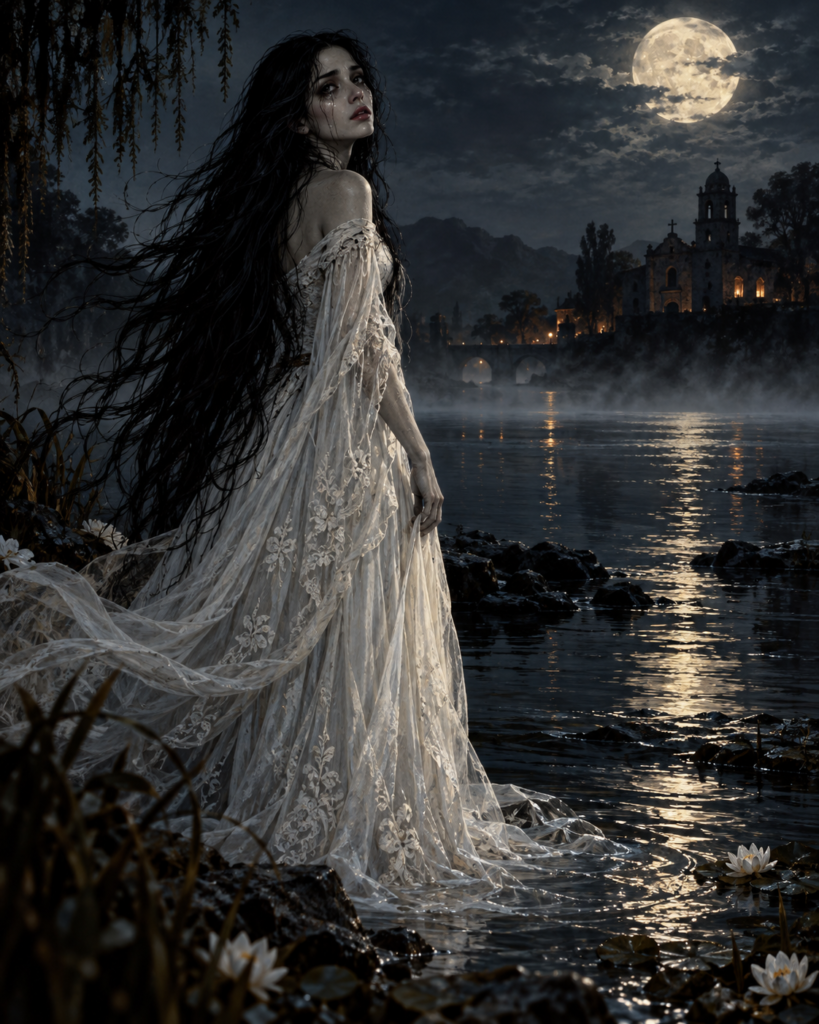
La Llorona is one of the most recognizable ghosts in Mexican and Mexican American folklore. Her name means “The Weeping Woman,” and nearly every version of the legend shares the same basic image: a woman wandering through the night, crying for children she has lost. She is especially associated with rivers, canals and other bodies of water, where her cries can warn that something dangerous is nearby.
Everything beyond that basic description becomes much less certain. In some stories La Llorona murdered her children after being abandoned by their father, while in others the children drowned accidentally or were lost through circumstances outside her control. Some versions portray her as a murderous spirit who threatens children, while others make her a tragic mother condemned to search forever for the family she can never recover.
The Woman by the Water
The version most familiar today tells of a beautiful woman who has children with a wealthy or socially powerful man. When he eventually abandons her or chooses another woman, she becomes overwhelmed by rage or grief and takes her children to a river. There she drowns them, only to immediately realize what she has done.
After her own death, she is denied peace and condemned to wander near the water searching for the children she killed. Her cries are often represented by the famous phrase “¡Ay, mis hijos!”—“Oh, my children.” Depending on the storyteller, meeting her can mean being frightened, attacked, carried away or receiving a warning to return home before something worse happens.
The legend has also been used as a cautionary story for children. Parents and grandparents could warn children not to wander near rivers, canals or isolated places after dark because La Llorona might find them. In that role, a supernatural ghost also becomes a practical method of keeping children away from genuinely dangerous places.
A Story With No Single Beginning
Trying to identify the first La Llorona produces problems almost immediately. Folklorists have documented numerous versions with different names, motives, appearances and origins, suggesting that the legend was not created once and then repeated unchanged. Instead, several older traditions may have contributed to the figure recognized today.
One of the most important possible roots comes from Indigenous Mexico. Bernardino de Sahagún and the Nahua scholars who worked with him on the sixteenth-century Florentine Codex recorded stories about a mysterious woman heard weeping in Tenochtitlan before the Spanish conquest. She cried during the night about her children and the catastrophe that was approaching the city.
The account is strikingly similar to the later image of La Llorona, but the woman in the Indigenous account was not called La Llorona. Scholars have connected her with Cihuacoatl and related supernatural female figures within Nahua tradition. That makes the story an important possible ancestor of the legend without proving that the modern La Llorona is simply one unchanged Aztec goddess surviving into the present.
The Omen Before the Conquest
The Florentine Codex records a series of omens supposedly witnessed before the Spanish conquest of Mexico. One involved a female spirit moving through the night and lamenting the fate of her children. Sahagún collected these traditions from Nahua informants decades after the conquest, preserving a memory of Indigenous beliefs from the period surrounding the fall of Tenochtitlan.
The connection is tempting because the imagery is so familiar: a supernatural woman wandering at night, crying for her children and warning of disaster. Later Mexican folklore would feature another weeping woman walking through the darkness with children at the center of her tragedy. That similarity has encouraged generations of writers to identify the two figures with each other.
The evidence is not strong enough to say they are definitely the same being. Folklore changes as cultures interact, and a familiar Indigenous supernatural figure could have merged with stories introduced from Europe after the conquest. La Llorona may therefore be the product of cultural combination rather than a direct continuation of one pre-Hispanic legend.
The European Connection
Europe had its own traditions of restless female ghosts long before the modern La Llorona story was written down in detail. Stories circulated about women who murdered children, were betrayed by lovers or wandered after death because of some unresolved tragedy. White Lady legends and other female apparitions appeared across parts of Europe with themes that resemble pieces of the La Llorona story.
Researchers have therefore proposed that Spanish settlers brought their own ghost traditions to the Americas, where those stories encountered Indigenous beliefs about dangerous or grieving supernatural women. Over generations, elements from both traditions could blend together. A European child-murdering ghost and an Indigenous nocturnal weeping spirit did not have to remain separate once people began telling stories in the same communities.
That possibility helps explain why La Llorona can seem simultaneously ancient and surprisingly modern. Pieces of the legend may be centuries older than the familiar biography usually told today, while the recognizable story could have developed gradually after the Spanish conquest.
Was La Llorona Really La Malinche?
Another common interpretation identifies La Llorona with Malintzin, also known as Doña Marina or La Malinche. Malintzin was an Indigenous woman who became an interpreter and intermediary for Hernán Cortés during the Spanish conquest and had a son with him. Over later centuries, her historical role was transformed into a complicated cultural symbol involving conquest, betrayal, motherhood and the origins of mestizo Mexico.
Some writers eventually connected those themes with La Llorona. A woman associated with the conquest, motherhood and cultural loss could easily be folded into a legend about a mother mourning her children. The association became especially powerful in literature and later cultural interpretation.
There is no historical evidence that Malintzin became a wandering ghost or drowned her children. Treating her as the original La Llorona therefore turns later symbolism into biography. The connection is important to the legend’s development, but it should not be confused with established history.
The Murdered Children
The child-killing version of La Llorona became especially prominent in later storytelling. A commonly repeated narrative describes a woman of lower social status abandoned by a wealthier lover who intends to marry someone from his own class. Driven by rage or despair, she kills the children they had together and is immediately consumed by regret.
That story gives the ghost a clear reason to weep and a moral explanation for why she cannot rest. Her punishment mirrors her crime because she searches forever for the children she destroyed. The legend can therefore function simultaneously as ghost story, tragedy and warning about jealousy, abandonment and violence.
Other versions soften the woman’s guilt. Her children may drown accidentally, be taken away or die through circumstances she cannot control, leaving their mother wandering because grief will not allow her to move on. The existence of these contradictory versions is another indication that La Llorona is a folklore figure rather than one historical woman with a recoverable biography.
A Ghost That Changes Faces
Even La Llorona’s appearance varies dramatically. She may be a beautiful woman in white, a dark figure wearing a shawl, a skeletal woman, a faceless apparition or something that initially appears human before revealing a horrifying face. Sometimes she is seen clearly, while in other stories witnesses only hear her cries coming from somewhere near the water.
Her behavior changes just as much. She can chase people, appear inside vehicles, frighten men traveling alone, warn people about their behavior or threaten children who stay outside too late. In some stories encountering her means death, while in others surviving the encounter becomes proof that the storyteller came dangerously close to the supernatural.
Those variations helped the legend travel because communities could adapt La Llorona to their own landscape. A ghost associated with canals in Mexico City could become a woman beside an arroyo in Arizona or New Mexico without losing her identity. The important feature was not the exact river but the crying woman beside it.
La Llorona Crosses the Border
Mexican and Mexican American communities carried the legend throughout the American Southwest and beyond. Folklorists documented La Llorona stories in Texas, Arizona, New Mexico, California and other places where Spanish-speaking communities preserved and adapted the tradition. She became one of the most recognizable pieces of Mexican American ghostlore.
Bess Lomax Hawes documented a particularly interesting example during the 1960s while studying stories told by young women in a California juvenile detention facility. The girls described multiple versions of La Llorona, changing details about her children, appearance and behavior while still recognizing the same supernatural character. The setting showed that folklore could remain alive even far from the places where older versions supposedly occurred.
That flexibility explains much of the legend’s durability. La Llorona does not require one historic river, one dead woman or one exact set of events. She can travel wherever the people telling the story travel.
Why the Water Matters
Water appears so frequently in La Llorona stories that it has become one of the legend’s defining features. Rivers and canals are natural places for a story about drowned children, but they are also dangerous environments where a warning story can serve a practical purpose. Children genuinely can drown if they wander alone near water.
The association also gives the ghost a natural territory. Running water, fog, darkness and the sound of wind or animals along a river can create an environment where ordinary noises become difficult to identify. A distant cry heard beside a dark canal already feels strange before anyone connects it with a famous ghost.
Once someone knows the legend, an unexplained nighttime sound can become La Llorona almost immediately. That does not mean the person is lying about hearing something; it means the legend provides an explanation for an otherwise unidentified experience.
A Warning for Children
One of La Llorona’s most practical roles has always been behavioral. Adults have used the story to keep children close to home, discourage wandering after dark and warn them away from waterways. In some communities, children were told that La Llorona would take them if they stayed outside too late or behaved badly.
That makes her similar to many supernatural figures used as informal enforcement. The monster does not need to exist physically for the warning to work. A child who believes something terrifying waits beside the river is far less likely to investigate that river alone at night.
As generations grow older, the childhood warning can turn into cultural memory. Someone who no longer believes La Llorona will physically appear can still remember exactly what it felt like to hear the story from a parent or grandparent.
The Legend Becomes Culture
La Llorona eventually moved far beyond oral storytelling. She appears in novels, songs, plays, films, television and public performances, while communities continue adapting her to new social and political meanings. In places such as Xochimilco in Mexico City, modern performances use waterways themselves as the setting for retelling the legend.
Writers have also reinterpreted La Llorona as a symbol of motherhood, colonial violence, migration, gender expectations and cultural identity. A ghost once used to frighten children can therefore become a much more complicated figure depending on who is telling the story. The legend survives partly because no single interpretation has ever completely replaced the others.
That is also why attempts to identify the one “real” La Llorona usually fail. The weeping woman is not one story anymore, if she ever was. She is a family of stories sharing a recognizable ghost.
Why It Matters
La Llorona demonstrates how folklore can preserve pieces of history without functioning like a historical record. Indigenous stories of a weeping supernatural woman, European ghost traditions, colonial society, stories about abandoned mothers and later interpretations involving La Malinche may all have contributed something. The result is a figure that feels ancient because parts of her story genuinely are ancient.
What we cannot do is reconstruct one woman who definitely drowned her children and then became the ghost responsible for centuries of sightings. The evidence instead shows generations of people telling, modifying and experiencing versions of the same legend. La Llorona is exceptionally real as folklore while remaining unproven as a supernatural being.
T Funk Take
La Llorona is more interesting to me once you stop trying to force her into one origin story. I always thought it was basically a simple ghost story about a woman drowning her kids and then spending eternity crying about it. Once you start digging into it, you find an Indigenous weeping woman before the conquest, European ghost stories, La Malinche, abandoned lovers and about fifty different versions of what actually happened to the children.
I also understand why this particular ghost refuses to die as a story. A woman crying beside a river at night is simple enough that you can move the legend almost anywhere without breaking it. Mexico City, Texas, New Mexico, Arizona or California can all have their own La Llorona because every place has dark roads, dangerous water and somebody who heard something strange after midnight.
The part where I pump the brakes is when somebody tries to turn all of those stories into evidence for one literal ghost. If the identity, appearance, number of children and even the reason they’re dead changes depending on where the story is told, I have a hard time treating that as an eyewitness file on one supernatural person. It looks much more like folklore doing exactly what folklore does: changing enough to survive.
That doesn’t make La Llorona less interesting. If anything, surviving for centuries across different cultures and countries is more impressive than one ghost hanging around one river. I don’t think we’ve proven a dead woman is wandering the waterways looking for her children, but I would still think twice if I heard somebody crying beside a river at two in the morning, which is probably exactly why this legend is still here. La Llorona remains a legend in the T Funk Era archive.
Sources & Further Reading
-
La Llorona: An Introduction to the Weeping Woman
Library of Congress — American Folklife Center
View Source -
La Llorona: Roots, Branches, and the Missing Link from Spain
Library of Congress — American Folklife Center
View Source -
There Was a Woman: La Llorona from Folklore to Popular Culture
University of Texas Press
View Source