Official Archive Record
Case File CF-0120
Zombies: From Haitian Zonbi to the Walking Dead
Also known as: Zombie, Zombi, Zonbi
The modern zombie is almost impossible to separate from the apocalypse. A mysterious infection spreads, the dead rise, civilization collapses and crowds of mindless corpses begin hunting the living. That version has become so familiar that it feels like ancient folklore, but the zombie that entered Western culture from Haiti was a very different creature.
In Haitian tradition, the frightening part was not necessarily being attacked by a corpse. It was becoming the zombie. A person could supposedly lose freedom, personality and control over their own body, becoming an obedient servant to someone else. Over the twentieth century, American writers and filmmakers gradually removed the zombie from that cultural setting and transformed it into one of the most successful monsters in modern horror.
The Haitian Zonbi
The word appears in several forms, including zombie, zombi and the Haitian Creole zonbi. Haitian beliefs surrounding zonbi developed within a complicated religious and cultural world shaped by West and Central African traditions, Christianity, slavery and Haiti’s own history. Vodou itself is a religion with spirits, ritual practices, community traditions and ideas about the relationship between the living, the dead and the spiritual world; reducing it to zombies and black magic badly misrepresents the religion.
Within some Haitian traditions, zombification could involve a person whose body remained alive while an essential part of personality, will or spirit had been taken away. A bòkò, often described as a sorcerer operating outside ordinary religious practice, might supposedly create or control such a person. The result was not a ravenous corpse looking for human flesh but a powerless human being forced to obey.
That distinction changes the entire monster. The traditional zonbi is frightening because the person has been robbed of autonomy. The horror is slavery, control and social death rather than being eaten.
A Monster Born in a Slave Society
The association between zombies and forced labor is difficult to separate from Haiti’s history. The French colony of Saint-Domingue became enormously profitable through plantation agriculture worked by enslaved Africans under extraordinarily brutal conditions. Enslaved people successfully revolted beginning in 1791, and Haiti declared independence in 1804 after defeating French forces.
The zombie later became a powerful image of a human being reduced to labor without freedom, personality or control. Scholars have consequently interpreted the figure in relation to the experience and memory of slavery. A body that works endlessly for a master after losing its independent will is almost a perfect supernatural representation of enslavement.
That historical connection also makes the original zombie more disturbing than the movie version in a different way. The creature does not primarily represent death coming after you. It represents the possibility of remaining alive while losing ownership of yourself.
The United States Discovers the Zombie
American fascination with Haitian Vodou expanded dramatically during and after the U.S. occupation of Haiti from 1915 to 1934. American soldiers, journalists and travelers returned with stories portraying Haiti as mysterious, primitive and filled with supernatural practices. These accounts frequently stripped Vodou from its religious and cultural context and presented it to American audiences as exotic black magic.
Writer William Seabrook helped popularize the zombie in his 1929 book The Magic Island. His descriptions presented zombies as apparently dead human beings revived through sorcery and forced to work. The book became influential in American popular culture and helped establish the image of Haiti as a land where mysterious religious practitioners could create the living dead.
That image said at least as much about American attitudes toward Haiti as it did about Haitian beliefs. A complicated religious tradition was being converted into a horror attraction for readers who knew very little about the country.
White Zombie
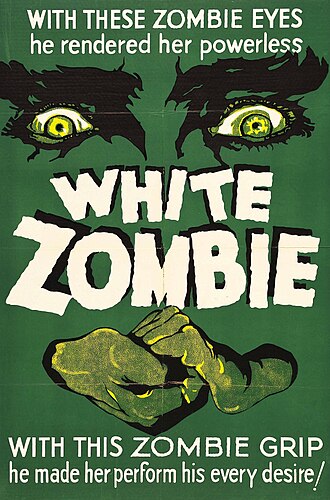
Hollywood moved quickly. The 1932 film White Zombie, starring Bela Lugosi, is generally regarded as the first feature-length zombie film. Its zombies are controlled laborers rather than flesh-eating monsters, keeping them much closer to the Haitian concept than later movie zombies would be.
The film nevertheless continued the American habit of portraying Haiti and Vodou through sinister sorcery. Bela Lugosi’s character controls people through supernatural power and turns them into obedient workers. The basic fear of losing one’s will remained, but Haitian religion became part of an exotic horror setting designed primarily for American audiences.
The movie helped push the word zombie permanently into popular culture. From that point forward, filmmakers could increasingly reshape the creature without remaining connected to the tradition that had introduced it.
Could Someone Actually Be Zombified?
The possibility that some zombie reports had a physical explanation attracted scientific attention during the twentieth century. One of the most famous researchers was ethnobotanist Wade Davis, who traveled to Haiti during the early 1980s and investigated substances said to be used in zombification. He collected preparations that included puffer fish, which can contain the extremely powerful neurotoxin tetrodotoxin.
Tetrodotoxin can cause paralysis, weakness and respiratory failure while a severely poisoned person may remain conscious. Davis proposed that a carefully controlled exposure might create a deathlike condition in which a victim could be mistakenly declared dead and later revived. Other substances could theoretically then keep the victim confused or impaired after recovery.
Tests have detected tetrodotoxin or related compounds in at least some material described as zombie powder, but that does not establish a reliable recipe capable of producing the complete traditional zombification story. Dosage would be extraordinarily difficult to control, severe poisoning can simply kill the victim and reported zombie cases may have multiple explanations. The poison hypothesis remains one attempt to explain part of the phenomenon rather than proof that Haitian zombies are chemically manufactured on demand.
People Who Returned From the Dead
Researchers have also examined individuals in Haiti who were identified by communities or relatives as people who had previously died and later returned. These cases are especially interesting because they move the subject beyond mythology into questions of medicine, identity and social belief.
A 1997 medical report examined three alleged cases of zombification. Researchers considered possibilities including neurological or psychiatric disorders, mistaken identity and culturally shaped interpretation of unusual individuals. Later anthropological work has likewise suggested that some supposed zombies may be vulnerable people with mental illness or other conditions who are recognized by communities as missing or deceased relatives.
That does not mean the people involved were pretending. A community can sincerely interpret a confusing medical or identity situation through a cultural belief that already provides an explanation for someone who appears to have returned from death.
Clairvius Narcisse
The most famous supposed zombie case is Clairvius Narcisse. Narcisse was reportedly declared dead in Haiti in 1962 and buried, only to reappear years later claiming he had been poisoned, buried while conscious and subsequently forced to work as a zombie. His story became central to Wade Davis’s investigation of Haitian zombification.
According to Narcisse’s account, he remained aware while apparently dead and could hear people around him before burial. He later claimed that he was removed from his grave and kept under control with drugs while working with other supposed zombies. The story provided an apparently extraordinary example of a person returning after an officially recorded death.
The case remains disputed. Narcisse’s story helped generate serious research into poisoning and Haitian zombie beliefs, but it did not produce scientific proof that a supernatural resurrection had occurred. The important distinction is that a person could conceivably survive poisoning, medical misdiagnosis or another extreme condition without having literally died and returned from the dead.
The Haitian Criminal Code
One of the stranger pieces of zombie history is a provision in Haiti’s nineteenth-century criminal law involving poisoning. Article 246 addressed the use of substances capable of producing a prolonged state of lethargy without causing death. If the victim was then buried as though dead, the law treated the act severely.
This provision is frequently described online as a Haitian law specifically outlawing the creation of zombies, but that description is misleading. Library of Congress research into the provision found that the statute dealt with poisoning and artificial lethargy rather than explicitly declaring supernatural zombies to exist. Later American writers and movie publicity helped turn the law into supposed official proof that Haiti recognized zombies.
That is almost a perfect example of how the legend developed. A real law dealing with poisoning became evidence for a supernatural phenomenon after it passed through sensational books, advertising and popular culture.
Then George Romero Changed Everything
The largest transformation happened in 1968 with George A. Romero’s Night of the Living Dead. Romero’s creatures are reanimated corpses that attack and eat living people, but the movie itself does not actually call them zombies. Romero later explained that he thought of them as ghouls and considered his creatures different from the Haitian zombie tradition.
Audiences and later filmmakers connected the creatures with the word zombie anyway. The connection stuck so completely that Romero’s version eventually replaced the older image in most popular culture. From then on, the zombie increasingly became a dead body that had physically returned and wanted to consume the living.
Romero also changed the scale of the threat. Traditional zombification generally involved an individual victim under another person’s control. The modern zombie arrives in numbers, multiplying until society itself begins collapsing.
The Bite
Another rule gradually became standard: infection. Modern zombie stories often treat the condition almost like a contagious disease, with one bite transforming a victim into another zombie. That creates the mathematical engine necessary for a zombie apocalypse because every attack can produce another attacker.
The disease model was largely a creation of modern horror rather than traditional Haitian folklore. Once zombies became contagious, storytellers could use them to explore epidemics, government collapse, social panic and survival. The supernatural monster began behaving more like an uncontrolled public-health disaster.
That flexibility explains much of the zombie’s modern success. Vampires and werewolves usually remain individual monsters, while zombies can become an entire environmental threat.
And No, Romero’s Zombies Did Not Eat Brains
The idea that zombies specifically crave brains is another example of popular culture rewriting the rules. Romero’s creatures ate human flesh rather than specifically seeking brains. Romero himself later pointed out that his zombies never had a special brain-eating requirement.
The brain obsession became strongly associated with zombies after The Return of the Living Dead in 1985. Like the full moon for werewolves or some of Dracula’s later cinematic characteristics, repeated movies eventually turned one particular creative choice into something audiences assumed had always been part of the monster.
Zombie lore is therefore unusually easy to date because many of its supposed ancient rules are actually younger than the people watching the movies.
From Slave to Apocalypse
The distance between the Haitian zonbi and the modern zombie is enormous. One represents a person deprived of will and condemned to forced labor, while the other represents a contagious dead body trying to eat everyone around it. They share a name and the general idea of life continuing unnaturally after death, but much of the similarity ends there.
The transformation happened because every generation used the zombie for a different fear. Haitian folklore could express fears surrounding slavery, sorcery and loss of autonomy. Early American films used Haiti itself as an exotic source of horror, while Romero turned the living dead into a vehicle for social collapse and later filmmakers turned them into pandemic monsters.
The zombie survives because it can absorb whatever people are frightened of at the moment.
Why It Matters
Understanding the zombie’s origins changes the monster completely. The Hollywood zombie was not simply imported intact from Haitian Vodou. American culture borrowed a culturally specific figure, stripped away much of its religious and historical meaning and gradually rebuilt it into something almost unrecognizable.
That does not make modern zombie movies illegitimate. Monsters evolve, just as vampires, werewolves and ghosts have changed over time. It does mean that the original Haitian zonbi deserves to be understood on its own terms instead of being treated as the primitive first draft of The Walking Dead.
The strangest part of zombie history may therefore be that the monster underwent a transformation more dramatic than anything happening to the people in the stories.
T Funk Take
This one surprised me because I always assumed the zombie was basically the same monster all the way back and Hollywood just added better makeup. It turns out the original fear is almost the opposite of the modern one. The Haitian zombie isn’t terrifying because it’s trying to eat you; it’s terrifying because somebody can supposedly take away your will and turn you into a slave.
Given Haiti’s history, that makes a lot more sense than a random obsession with dead people walking around. If your country’s history includes one of the most brutal slave systems in the world, the idea of being trapped inside your own body and forced to work forever for somebody else is a pretty serious nightmare. That is a much darker origin than somebody yelling about brains.
The poisoning part is where this gets especially interesting for me. Tetrodotoxin is real, extreme paralysis is real and people can absolutely look far closer to death than most of us would ever want to experience. That gets me to a possible medical explanation for pieces of some stories, but it doesn’t get me to supernatural resurrection or a reliable zombie-making powder.
Then Hollywood basically steals the name and builds an entirely new monster. By the time Romero comes along, the controller is gone, the plantation is gone and the zombie is now part of a mass disaster. A few movies later it’s contagious, and eventually somebody decides they eat brains. We somehow went from a Haitian symbol of stolen freedom to an emergency plan for what happens when everybody at Walmart starts biting each other.
I don’t see evidence that physically dead people are being magically resurrected and turned into slaves, but the real history behind the zombie is much more interesting than I expected. There are genuine cultural beliefs, documented alleged cases, real poisons worth investigating and a century of movies slowly rewriting the monster. The dead may not actually be walking, but this story has definitely had a life of its own.
Case remains open in the T Funk Era archive.
Sources & Further Reading
-
Vodou and History
Cambridge University Press — Comparative Studies in Society and History
View Source -
Does the Haitian Criminal Code Outlaw Making Zombies?
Library of Congress — In Custodia Legis
View Source -
The Undead in Culture and Science
Baylor University Medical Center Proceedings / PubMed Central
View Source