Official Archive Record
Case File CF-0119
Ghosts: Why the Dead Refuse to Leave
Also known as: Ghost, Apparition, Spirit
Ghosts may be the most universal monster humans have ever created because the basic idea requires almost nothing beyond death itself. A person dies, but someone later sees them, hears them or feels that they are still nearby. Cultures have explained those experiences in very different ways, yet the underlying question remains remarkably consistent: does some part of a person continue after the body is gone?
Unlike vampires or werewolves, ghosts do not require a complicated set of supernatural rules. They can be frightening or comforting, visible or invisible, silent or talkative, and attached to a person, object or location. That flexibility has allowed ghost belief to survive enormous changes in religion, science and technology while remaining recognizable across thousands of years.
The Dead Were Never Completely Gone
Ancient cultures already imagined the dead as capable of existing separately from the body. In ancient Greece, the psyche or spirit was believed to leave the body at death, while the Underworld was populated by the shades of people who had died. Stories of encounters with the dead appeared alongside formal burial practices designed to ensure that the deceased entered the afterlife properly.
The idea that a badly buried, murdered or dissatisfied person might remain troublesome gave ghost stories a purpose beyond simple entertainment. A ghost could signal that something was wrong: a crime had not been punished, a burial had been mishandled, a debt remained unpaid or the dead required some action from the living. That basic structure would survive into later European traditions even as the religious explanations changed.
Ghosts in Medieval Europe
In medieval Christian Europe, ghosts frequently appeared in stories connected with sin, punishment and purgatory. The dead might return to ask relatives or religious communities to pray for them, perform charitable acts or correct something left unfinished during life. Instead of wandering simply because they were spooky, many medieval ghosts had a reason for appearing and could sometimes disappear permanently once that purpose was fulfilled.
That made the ghost part of a larger religious system rather than an unexplained anomaly. A returning spirit could reinforce the idea that actions during life had consequences after death, while stories of suffering souls encouraged prayer and repentance among the living. The haunting was therefore not necessarily proof that the afterlife had failed; it could be interpreted as evidence that the afterlife was working exactly as people believed it did.
The Restless Dead
Not every ghost was peaceful or looking for prayers. Medieval European stories also described revenants, dead people who physically or visibly returned to disturb the living. Some traditions portrayed them as threatening former neighbors or family members, while others connected them with disease, violence or bad deaths.
These stories overlap with the traditions that eventually produced other supernatural beings including vampires. The boundary between ghost, revenant and walking corpse was not always as neat as modern monster categories make it seem. What mattered was that death had failed to keep someone completely separated from the living.
The Reformation Changes the Problem
The Protestant Reformation created a theological problem for some ghost traditions because Protestant reformers rejected the Catholic doctrine of purgatory. If ghosts had previously been understood as souls temporarily returning from purgatory, removing purgatory meant another explanation was needed for people who continued claiming to see the dead. Some Protestant writers argued that apparent ghosts were instead demons impersonating deceased people.
That change demonstrates how ghost experiences can remain while explanations around them shift. People did not necessarily stop reporting apparitions because religious doctrine changed. Instead, existing experiences were placed into a different supernatural framework.
Victorian Spiritualism
The nineteenth century produced another dramatic transformation. Modern Spiritualism spread through the United States and Europe with mediums claiming they could communicate directly with the dead through séances, table movements, automatic writing and other phenomena. Ghosts were no longer necessarily frightening intruders because they could become deceased relatives deliberately contacted for conversation or reassurance.
The movement grew during an era when death remained a regular part of family life and new technologies were changing how people thought about communication. Telegraphy, photography and other inventions made previously impossible forms of communication suddenly ordinary. In that environment, the possibility that another invisible form of communication might connect the living and dead did not seem ridiculous to everyone.
Interest became serious enough that educated investigators began examining claims made by mediums and witnesses. The Society for Psychical Research was established in London in 1882 specifically to investigate controversial phenomena including apparitions, hauntings and Spiritualist claims. Its members included prominent academics and scientists, although investigators encountered both cases they considered puzzling and extensive evidence of fraud.
Photographing the Dead
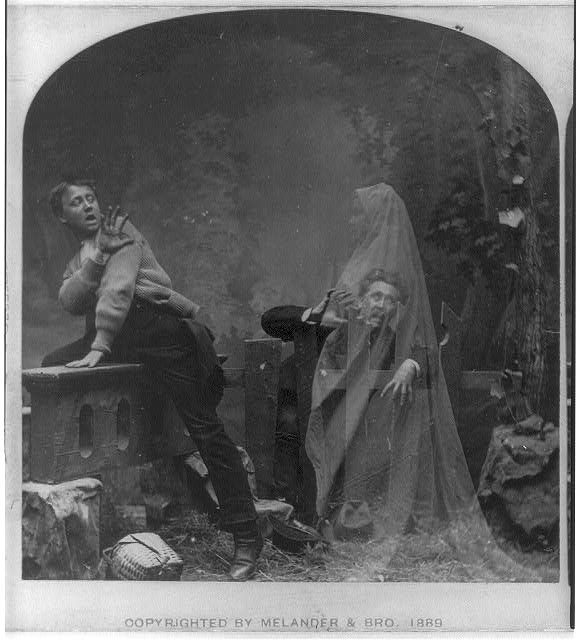
Photography created what appeared to be an entirely new category of ghost evidence. Beginning in the nineteenth century, photographers produced images showing faint human figures standing behind or beside living subjects. Because photography itself was still unfamiliar to much of the public, some people believed a camera might capture something invisible to the human eye.
The problem was that photographers already knew how to produce ghostly figures through techniques including double exposure and composite photography. The Library of Congress notes that these techniques were understood while spirit photography was becoming popular, and photographer William H. Mumler built a business producing supposed spirit photographs before being charged with fraud in 1869. He was acquitted, but the controversy demonstrated that a photograph containing a transparent figure was not automatically evidence of a dead person returning.
Spirit photography did something important to ghost culture even when the images were staged. The ghost now had a visual appearance that could supposedly be captured and preserved. Transparent human figures, misty shapes and pale apparitions became part of the visual vocabulary people still associate with hauntings today.
People Really Do Experience the Dead
One reason ghost belief survives is that people genuinely report experiences that feel like encounters with deceased people. Bereaved individuals sometimes describe hearing a dead person’s voice, seeing them briefly, smelling a familiar scent or simply experiencing an intense sense that the person is standing nearby. These experiences do not have to involve someone who believes strongly in ghosts beforehand.
Modern research treats these experiences more carefully than simply dismissing everyone involved as irrational or mentally ill. An interdisciplinary review found that sensory and quasi-sensory experiences of deceased people are commonly reported during bereavement and that the vast majority appear to be benign. Researchers deliberately use neutral terminology because calling every experience a hallucination can imply a psychiatric disorder that the evidence does not support.
That finding is important because it separates two questions that are often treated as if they were the same. Someone may sincerely experience a deceased spouse standing beside the bed without lying, imagining the story deliberately or suffering from serious mental illness. Whether that experience proves the independent survival of the dead is a different question.
The Brain Has to Interpret the World
Human perception is not a camera recording everything perfectly. The brain constantly interprets incomplete information, especially under poor lighting, stress, fatigue and emotional conditions. A coat hanging in a dark hallway can become a human figure for a moment because the brain is extremely good at finding familiar shapes before all the information has arrived.
Expectation can also influence interpretation. A strange noise inside a house described as haunted carries a completely different meaning than the same noise inside a new apartment building. Floorboards, pipes, animals, reflections, shadows and ordinary structural movement do not stop being ordinary just because a building has a ghost story attached to it.
That does not mean every haunting report has been explained. It means an unexplained sound or visual experience is evidence that someone experienced something they could not immediately identify, not automatically evidence that a dead person produced it. Moving from “I don’t know what caused that” to “therefore it was a ghost” adds a conclusion the experience itself cannot establish.
Why Old Houses Become Haunted
Ghost stories tend to accumulate around places already associated with death, tragedy or age. Castles, hospitals, battlefields, cemeteries, prisons and old houses provide both history and an environment filled with unfamiliar sounds, shadows and architectural features. Once a haunting story attaches itself to a location, future visitors arrive knowing what they are supposed to experience.
That creates a feedback loop similar to other folklore. One visitor hears footsteps, another sees movement and a third reports feeling watched, while every new story becomes part of what the next visitor knows before entering. None of those people necessarily has to fabricate anything for a haunting tradition to become increasingly detailed over time.
Locations also make ghost stories easier to preserve because they give the legend a permanent address. A story tied to one witness can disappear when that person dies, but a haunted staircase or bedroom can produce new witnesses indefinitely. The building remains available for every generation to reinterpret.
Ghost Hunters Arrive
Modern ghost hunting adds technology to the search. Investigators may use audio recorders, temperature sensors, electromagnetic-field meters, infrared cameras and other equipment while attempting to detect unusual activity. Electronic voice phenomena, commonly called EVP, involve sounds recorded during an investigation that are later interpreted as words or voices.
The difficult part is determining what any unusual reading actually means. An electromagnetic field meter can detect electromagnetic fields, but that does not demonstrate that ghosts generate them. A recorder can capture distant speech, radio interference, mechanical sounds or random noise that becomes meaningful once someone begins listening for words.
The same problem affects photographs and video. Cameras regularly produce lens flare, motion blur, insects, dust, compression artifacts and reflections that can look strange without being supernatural. Technology can document an anomaly very well while still leaving the cause of the anomaly completely unresolved.
The Evidence Problem
Ghosts have an enormous amount of testimony behind them. People from different cultures, religions and historical periods have reported seeing apparitions, hearing unexplained voices and sensing the presence of people who have died. The quantity of those reports makes the phenomenon worth studying even if their interpretation remains disputed.
What has been much harder to establish is evidence showing that the cause is actually the surviving consciousness of a dead human being. Photographs can be manipulated or misinterpreted, environmental readings do not identify a spirit and eyewitness experiences can occur without an external person physically present. Even sincere experiences therefore stop short of proving the supernatural explanation.
That does not make the experiences meaningless. A bereaved person who feels the presence of a dead spouse may find the encounter deeply comforting regardless of what produced it. Scientific uncertainty about the cause does not erase the reality or emotional importance of the experience for the person who had it.
Why Ghosts Never Go Away
Ghosts survive because death creates a question that every generation has to confront. People understand intellectually that someone has died while memories, habits and emotional expectations continue treating that person as part of everyday life. Hearing a familiar voice or feeling that someone is still nearby fits naturally into that tension.
Ghosts also adapt extremely well to technology. They moved from oral stories to printed books, from séances to photographs, from tape recorders to digital audio and from haunted-house stories to night-vision videos uploaded online. Every new technology capable of recording something unusual eventually becomes another possible way to search for the dead.
The explanation changes with the era while the central experience remains remarkably stable. Someone who has died seems, for a moment, not to be completely gone.
Why It Matters
Ghosts sit in an unusual place between folklore and human experience. The historical belief is undeniable, and people continue reporting encounters that they sincerely interpret as deceased individuals. Modern research also gives us good reasons not to assume that every person who sees or senses a dead loved one is lying or suffering from a psychiatric disorder.
The unresolved part is what those experiences actually demonstrate. They may tell us a great deal about grief, perception, memory, expectation and the way humans understand death without proving that consciousness survives outside the body. That leaves ghosts in exactly the territory where a good unexplained mystery belongs: the experiences are real, while the explanation remains much harder to establish.
T Funk Take
Ghosts are probably the supernatural thing I understand believing in more than most others because the experience doesn’t require anything complicated. You don’t need a seven-foot reptile, a flying monster or a guy physically turning into a wolf. Somebody you knew your entire life dies, and a week later you hear their voice or swear you see them standing in the doorway for two seconds.
I wouldn’t tell that person they didn’t experience it because I don’t know what they experienced. The research actually makes this more interesting because seeing, hearing or sensing someone who died appears to happen to ordinary grieving people without automatically meaning there is something medically wrong with them. Where I pump the brakes is the next step, because having the experience and proving that the dead person was physically present are two completely different things.
The haunted-house stuff gives me the same problem. If a door closes by itself, I want to know whether the building shifted, there was airflow, the hinges were bad or somebody bumped something before I decide Grandpa came back to shut the bedroom door. An unexplained event can stay unexplained without me having to fill the empty space with a ghost.
The Victorian spirit photographs are probably my favorite part because people immediately used brand-new technology as proof of the supernatural, and almost immediately other people figured out how to fake it. We do basically the same thing today with digital cameras, audio recordings and whatever new sensor somebody brings into a haunted building. The equipment changes, but apparently humans remain very committed to trying to catch dead people on whatever the newest gadget happens to be.
I haven’t seen evidence that convinces me ghosts are literally the surviving spirits of dead people walking around houses, but I also don’t think every ghost story is somebody making something up. People experience strange things, especially around death and grief, and some of those experiences are powerful enough to stay with them for the rest of their lives. I think that gap between a real experience and an uncertain explanation is exactly why ghosts have survived for thousands of years, and it keeps this case open in the T Funk Era archive.
Sources & Further Reading
-
The Haunted Mind, 1750–1850
Cambridge University Press
View Source -
A Ghostly Image: Spirit Photographs
Library of Congress
View Source -
Sensory and Quasi-Sensory Experiences of the Deceased in Bereavement: An Interdisciplinary and Integrative Review
Schizophrenia Bulletin / PubMed Central
View Source