
Official Archive Record
Case File CF-0115
Spring-Heeled Jack: The Leaping Terror of Victorian London
Also known as: Spring-Heeled Jack, Spring-Heel'd Jack, The Suburban Ghost
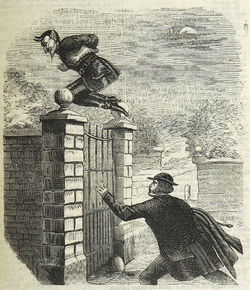
In the winter of 1837 and 1838, London began talking about a frightening figure appearing on dark streets and country lanes around the growing city. Witnesses described a strangely dressed man, ghost or devil who frightened travelers, assaulted young women and supposedly escaped with extraordinary leaps. Before long he had acquired a name that would outlive almost everyone involved: Spring-Heeled Jack.
The story eventually became so exaggerated that Jack was credited with jumping over walls, breathing fire and appearing across Britain for decades. Beneath the legend, however, are genuine contemporary reports of assaults and a public panic serious enough to reach the Lord Mayor of London and the police courts. What remains uncertain is whether one unusual attacker started the phenomenon, several pranksters copied the idea, or newspapers and frightened communities gradually transformed unrelated incidents into one supernatural villain.
The Panic Begins
Stories about a strange figure were circulating around London by 1837. Early descriptions were inconsistent, with witnesses and newspapers referring to ghosts, devils, strange animals and a mysterious leaping man. By January 1838 the reports had become prominent enough that complaints about the supposed attacker were publicly discussed at London’s Mansion House.
One explanation circulating at the time was surprisingly ordinary. An anonymous correspondent suggested that a wealthy young man or group of men had accepted a wager to frighten people while wearing disguises such as a ghost, bear or devil. Whether that specific claim was true was never established, but it shows that even at the height of the panic some Londoners suspected a human prankster rather than a supernatural creature.
The Attack on Jane Alsop
The best-documented incident occurred on the night of February 19, 1838, at the home of eighteen-year-old Jane Alsop near Bow and Old Ford. According to testimony reported by The Times, a man rang violently at the family’s gate and claimed to be a police officer who had captured Spring-Heeled Jack nearby. He asked Jane to bring him a light, and when she returned with a candle the stranger reportedly threw aside his cloak and attacked her.
Alsop described an extraordinary appearance. She said the attacker wore a helmet and tight clothing resembling white oilskin, had eyes like red balls of fire and produced blue and white flame from his mouth. She also reported that he grabbed her and tore at her clothing, neck and arms with claws that seemed to be made of metal.
The attack was not merely a distant ghost sighting. Jane’s sisters heard her screams, came to the doorway and helped pull her away from the assailant, while the family later appeared before a magistrate. Whatever they had encountered, the surviving newspaper account describes a real assault involving a person who apparently used costume, intimidation and some kind of theatrical effect to create the appearance of something supernatural.
Lucy Scales
Another important incident followed only days later. On February 28, eighteen-year-old Lucy Scales was walking through Limehouse with her sister when they encountered a figure standing in a narrow passage. According to reports, the stranger suddenly discharged blue flame toward Lucy’s face, causing her to collapse and suffer violent fits.
The description again contained unusual details, but it was not identical to Jane Alsop’s account. Lucy’s sister described a tall, thin man wearing a large cloak and carrying a small lamp resembling those used by police. He reportedly walked away after the incident rather than performing one of the enormous supernatural leaps that later became central to the legend.
The Man Behind the Monster
The earliest evidence leaves open the possibility that at least some Spring-Heeled Jack incidents involved an actual person. A costume could explain the unusual clothing and metallic claws, while nineteenth-century chemistry and stage effects offered ways to create brief colored flames without requiring a fire-breathing demon. Darkness, fear and surprise could easily make those effects appear even stranger to someone being attacked.
That does not mean every reported sighting had the same explanation. Once Spring-Heeled Jack became famous, anyone wearing a strange costume, committing a prank or simply frightening somebody at night could become another appearance of Jack. Copycats could also exploit a legend that already gave them a ready-made identity.
What About the Leaping?
Jack’s remarkable jumping ability eventually became his defining characteristic. Stories described him clearing walls, gates and other obstacles with impossible ease, sometimes suggesting that springs or mechanical devices were attached to his boots. No verified equipment matching that description was ever recovered, and there is no physical evidence demonstrating that anyone possessed a device capable of the supernatural jumps later credited to him.
Some early accounts did describe a leaping figure, so the idea was not created entirely by later fiction. The problem is determining where an athletic prankster ends and the legendary Spring-Heeled Jack begins. As the story was repeated, each escape over a wall could become a higher wall and each unusual jump could become something no ordinary human could perform.
The Newspapers Help Build Jack
Spring-Heeled Jack arrived at exactly the right moment for a monster to become famous. Nineteenth-century Britain had an expanding newspaper market, growing cities and an enormous appetite for sensational crime and supernatural stories. Reports could spread quickly from one neighborhood to another, giving people who had never witnessed anything themselves a detailed picture of what the mysterious attacker was supposed to look like.
That process could also change future sightings. Once readers knew that Jack had glowing eyes, claws, a cloak and the ability to leap, those features became part of the expectation surrounding the next report. The legend and the eyewitness accounts could begin feeding each other.
From Street Panic to Penny Dreadful
Spring-Heeled Jack eventually escaped the newspapers and entered popular entertainment. Stage adaptations appeared within only a few years of the original panic, and by the 1860s he was appearing prominently in penny dreadfuls, the inexpensive serialized stories popular with Victorian readers. The British Library preserves an 1863 theatrical manuscript based on the urban legend, while surviving publications show how thoroughly Jack moved from rumor into fiction.
The fictional character did not always resemble the terrifying attacker of 1838. Some stories transformed him into an aristocratic adventurer or mysterious antihero who punished villains and defended the weak. A figure who had originally frightened real people gradually became entertainment, and the fictional version began influencing how later generations remembered the supposed historical one.
The Sightings Refuse to Die
Reports associated with Spring-Heeled Jack continued long after the original London panic. Stories appeared in other parts of Britain throughout the nineteenth century, and researchers have traced reports carrying his name into the early twentieth century. By that point it becomes increasingly difficult to determine whether anyone was reporting the same phenomenon or simply attaching a famous name to any strange nighttime encounter.
That longevity is one of the biggest problems with treating Spring-Heeled Jack as a single unidentified person. A human responsible for incidents in 1837 would have been elderly or dead by the time some of the final reports appeared around 1904. Either multiple people adopted the identity, later sightings were unrelated, or Jack had already become a piece of folklore that could appear wherever people expected him.
Ghost Panic or Something Stranger?
Modern researchers have generally treated the case as an example of an urban legend or what folklorist David Clarke described as a nineteenth-century ghost panic. In that interpretation, genuine incidents may have occurred, but rumor, newspaper coverage, copycat behavior and existing supernatural beliefs expanded them into something much larger. Spring-Heeled Jack became less a single suspect and more a character through which Victorians interpreted frightening or unexplained encounters.
That explanation does not require Jane Alsop or other witnesses to have invented their experiences. Someone could have attacked Alsop while dressed in an elaborate costume, while entirely different people later reported pranks, misidentifications or fabricated sightings under the same name. The supernatural Jack may never have existed even if some of the people hiding behind the legend certainly did.
Why It Matters
Spring-Heeled Jack offers an unusually clear look at an urban legend being constructed almost in real time. There were newspapers, named witnesses, police involvement, public discussion and then popular fiction, all feeding into a story that continued changing for decades. The historical record lets us watch an alleged attacker become a supernatural monster and then a fictional character.
It also creates a useful warning about separating the documented event from the legend surrounding it. We have evidence that people reported frightening encounters and that Jane Alsop described being physically assaulted. We do not have evidence for a supernatural creature capable of impossible leaps, nor do we know whether one person was responsible for the incidents that eventually accumulated under the name Spring-Heeled Jack.
T Funk Take
Spring-Heeled Jack looks like somebody designed a Victorian Batman villain and then released him into London. You’ve got a helmet, metal claws, glowing eyes, fire coming out of his mouth and supposedly enough jumping power to clear walls. The only thing missing is a dramatic cape, and apparently he already had one of those too.
What makes this case different for me is the Jane Alsop attack. Once you strip away the monster story, there appears to be a young woman who was actually grabbed, scratched and had her clothing torn by somebody using a costume to scare her. That makes the human explanation a lot more disturbing than the supernatural one because somebody may have realized that pretending to be a demon gave him a pretty good way to terrorize people.
The blue flame doesn’t convince me that anything supernatural happened. People were doing chemical demonstrations, fireworks and stage effects long before 1838, and a brief burst of colored flame in somebody’s face at night would probably look insane if you weren’t expecting it. Metal claws and a strange costume are also much easier for me to believe than a demon whose natural habitat apparently included suburban London.
I think the legend really takes off once the newspapers and copycats get involved. After everybody knows what Spring-Heeled Jack is supposed to do, every weird guy jumping a fence can become another sighting, and every retelling can make the fence a little higher. Eventually the person disappears completely and the legend takes over.
My guess is that there was at least one very real idiot in a costume somewhere near the beginning of this story, followed by imitators, rumors and a lot of Victorian storytelling. I haven’t seen anything that convinces me a fire-breathing supernatural jumper was bouncing around England for nearly seventy years, but as an example of watching an urban legend form in real time, Spring-Heeled Jack is hard to beat.
Case remains open in the T Funk Era archive.
Sources & Further Reading
-
The Late Outrage at Old Ford — The Times, February 22, 1838
The Times / Victorian London
View Source -
Unmasking Spring-Heeled Jack: A Case Study of a 19th Century Ghost Panic
Contemporary Legend / Indiana University Libraries
View Source -
Gothicizing Victorian Folklore: Spring-Heeled Jack and the Enacted Gothic
Gothic Studies / University of Portsmouth
View Source