Official Archive Record
Case File CF-0114
The Wild Hunt: Europe’s Spectral Riders of the Night
Also known as: Wild Hunt, Wilde Jagd, Wütendes Heer, Furious Host, Mesnie Hellequin, Familia Herlechini
Across northern and central Europe, generations of people told stories about something terrifying moving through the night sky. Sometimes it was an army of the dead, sometimes a supernatural hunting party, and sometimes a procession of riders accompanied by horses, hounds, horns and violent winds. Seeing the riders could mean death, disaster or being swept away with them, while different regions gave the procession different leaders and different names.
Today these traditions are usually grouped together under one famous name: the Wild Hunt. Odin or Wotan is often placed at its head, especially in modern descriptions of Germanic and Scandinavian folklore, but the history is considerably messier than that. The Wild Hunt may be less a single ancient legend than a collection of related supernatural traditions that scholars eventually placed under the same banner.
The Riders in the Night
The basic image is remarkably persistent. A person traveling at night hears dogs, horns, shouting or the thunder of horses before witnessing a supernatural procession moving across the land or through the sky. The riders may be dead warriors, condemned souls, hunters, spirits or other supernatural beings, and encountering them is rarely considered a good thing.
Winter was particularly associated with these stories in parts of northern Europe, where darkness, storms and powerful winds created a natural setting for an invisible army passing overhead. Some traditions warned people to stay indoors when the procession approached, while others claimed an unlucky witness could be carried away or forced to join the Hunt. The exact details changed from one community to another, but the combination of nighttime travel, supernatural noise and a dangerous procession appeared repeatedly.
A Medieval Army of the Dead
One of the most famous medieval accounts was recorded by the Anglo-Norman monk Orderic Vitalis during the twelfth century. Orderic told the story of a priest named Walchelin who supposedly encountered a massive procession on New Year’s night in 1091 or 1092. The procession included people from different levels of society, mounted knights and souls suffering punishments connected with sins they had committed while alive.
Walchelin reportedly recognized the gathering as the familia Herlechini, or troop of Herlechin, a supernatural procession he had previously heard stories about but had dismissed. He attempted to seize a horse as physical proof of what he had seen and was supposedly injured during the encounter. In Orderic’s Christian interpretation, the procession was associated with the suffering dead and ideas resembling Purgatory rather than with Odin leading a pagan hunting party.
The Mesnie Hellequin
Related medieval traditions appeared in France under names including the Mesnie Hellequin, a wandering supernatural company associated with the dead. Some accounts pictured the group as warriors, while others increasingly portrayed supernatural hunters moving through the night. Medieval writers connected these processions with punishment, death and the dangerous boundary between the living world and whatever came after it.
These stories are important because they show that beliefs in supernatural processions existed centuries before scholars began calling the entire phenomenon the Wild Hunt. They also demonstrate how much the traditions differed. One procession might consist of suffering Christian souls, another of hunters, another of warriors and another of supernatural beings whose identity was never clearly explained.
Then Jacob Grimm Arrived
The version most people recognize today owes a great deal to Jacob Grimm, one of the brothers famous for collecting German folktales. In his 1835 work Deutsche Mythologie, Grimm examined traditions involving the Wilde Jagd, or Wild Hunt, and the Wütendes Heer, often translated as the Furious Host or Furious Army. He connected these stories with Wotan, the Germanic form of Odin, and interpreted them as survivals of older pre-Christian religious traditions.
Grimm’s interpretation became enormously influential, but modern scholarship has questioned whether all of these traditions originally belonged to one coherent mythology. Historian Ronald Hutton has argued that Grimm effectively combined different medieval processions, ghost traditions and later folklore into the modern idea of the Wild Hunt. That does not mean Grimm invented the individual stories, but he helped create the framework through which people now understand them.
Was Odin Really Leading It?
Odin fits the Wild Hunt extremely well. Norse mythology already associates him with war, death, warriors and supernatural knowledge, and later Scandinavian traditions connected him with terrifying nighttime rides. The image of the one-eyed god leading dead warriors across a stormy winter sky therefore feels almost inevitable.
The problem is that not every regional Wild Hunt had Odin anywhere near it. Other traditions placed historical kings, legendary heroes, supernatural women, the Devil or local figures at the head of the procession. In parts of Britain, even King Arthur became associated with versions of the supernatural hunt, showing how easily the basic idea could attach itself to whichever legendary figure mattered locally.
Arthur Joins the Hunt
Folklore surrounding Cadbury Castle in England offers a good example of how the tradition could change. Local stories portrayed King Arthur riding with his knights around the ancient hillfort as part of a supernatural procession. Archaeological and folklore researchers have documented multiple versions of Arthur leading this Hunt, including traditions involving spectral horses and the surrounding landscape.
There is no reason to think these stories prove that Arthur literally rode with a ghostly army. What they demonstrate is how the Wild Hunt motif could absorb local heroes and local landmarks. Instead of a single story spreading unchanged across Europe, communities appear to have adapted supernatural procession traditions to fit their own history and mythology.
Could People Have Been Hearing Animals?
Some nineteenth-century folklorists proposed surprisingly ordinary explanations for at least part of the legend. William Henderson’s collection of northern English folklore discussed the possibility that migrating geese helped inspire stories of supernatural hounds and hunters. Large groups of birds traveling unseen through darkness can produce strange cries overhead, particularly when the listener cannot see what is making the noise.
Winter storms offer another obvious ingredient. Wind moving across forests, hills and buildings can create sounds resembling voices, horns or distant animals, while darkness removes many of the visual clues people normally use to identify what they are hearing. None of this proves that geese or storms created the Wild Hunt, but it shows how real nighttime experiences could contribute to supernatural traditions.
From Religion to Folklore
The Wild Hunt also demonstrates what happens when religious traditions change. A supernatural procession might begin as a story involving the dead, become interpreted through medieval Christianity as punished souls or demons, and later be reconstructed as the surviving memory of a pagan god. Folklore does not have to remain frozen in one form to remain recognizable.
That creates a problem whenever someone claims to know the Wild Hunt’s single original meaning. The surviving evidence points instead toward overlapping traditions that changed across centuries and regions. The ghost riders are ancient in concept, but the neat modern package called “The Wild Hunt” is considerably newer.
The Hunt in Modern Culture
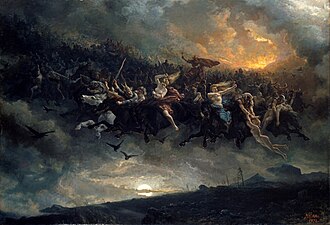
The Wild Hunt never really disappeared because it turned out to be an excellent story. Writers, artists, musicians and later fantasy games repeatedly returned to the image of supernatural riders crossing the night sky. Peter Nicolai Arbo’s famous nineteenth-century painting Åsgårdsreien, usually translated as The Wild Hunt of Odin, helped establish the dramatic Scandinavian image of the Hunt that many people recognize today.
Modern fantasy has reinforced that version even further, usually presenting the Wild Hunt as a clearly defined supernatural force with established members and rules. Historical folklore was rarely that organized. The real tradition is more interesting because the identity of the riders could change depending on where and when the story was being told.
Why It Matters
The Wild Hunt is a good example of how folklore can be both genuinely old and surprisingly modern at the same time. Medieval Europeans were absolutely telling stories about supernatural armies and processions of the dead, and later communities continued telling stories about ghostly hunters racing through winter nights. What becomes questionable is the idea that every one of those traditions represented the same ancient pagan event with the same leader and meaning.
Jacob Grimm did not manufacture centuries of supernatural folklore, but he helped organize scattered traditions into something that looked like one enormous surviving mythology. Once that framework existed, later writers, artists and folklorists reinforced it. The result is a legend assembled from pieces that may be much older than the name we now use for the whole thing.
T Funk Take
This is exactly the kind of folklore rabbit hole I like because I started with the simple version: Odin and a bunch of dead warriors go flying across Europe at night. Then you start pulling on the thread and find out that the actual history is a lot less organized. Different places had different riders, different leaders and apparently different ideas about what the procession even was.
The Jacob Grimm part is probably my favorite piece of this. He didn’t invent people seeing armies of ghosts because those stories existed hundreds of years before he was born, but he seems to have helped put a bunch of them into the same filing cabinet. Two hundred years later, most of us look at the filing cabinet and assume everything inside it was always one story.
I can also understand how something like this develops. You’re standing outside on a winter night with no electric lights, the wind is tearing across the countryside, geese or some other animals are screaming somewhere above you and you have absolutely no idea what’s making the noise. If everyone in your village already knows a story about dead people riding through the sky, I doubt your first thought is going to be migratory bird behavior.
I don’t think Odin and an army of dead warriors are still conducting nighttime patrols over northern Europe, but I like the Wild Hunt even more after finding out how complicated it is. The legend looks ancient because many of its pieces genuinely are, while the version we recognize today was assembled over centuries by storytellers, religion, scholars and artists. That makes the real mystery less about who was riding through the sky and more about how dozens of different ghost stories eventually became one Hunt, and that is enough to keep this one open in the T Funk Era archive.
Sources & Further Reading
-
The Wild Hunt and the Witches' Sabbath
University of Bristol / Folklore
View Source -
Have You Come to Take the King Away?: A Survey of Archaeology and Folklore in Context
University College London — Papers from the Institute of Archaeology
View Source -
Notes on the Folk-Lore of the Northern Counties of England and the Borders
William Henderson / Folk-Lore Society edition — Internet Archive
View Source