Official Archive Record
Case File CF-0134
The Melon Heads: Connecticut’s Big-Headed Forest Legend
Also known as: Melon Heads, Melonheads, Connecticut Melon Heads
What Happened
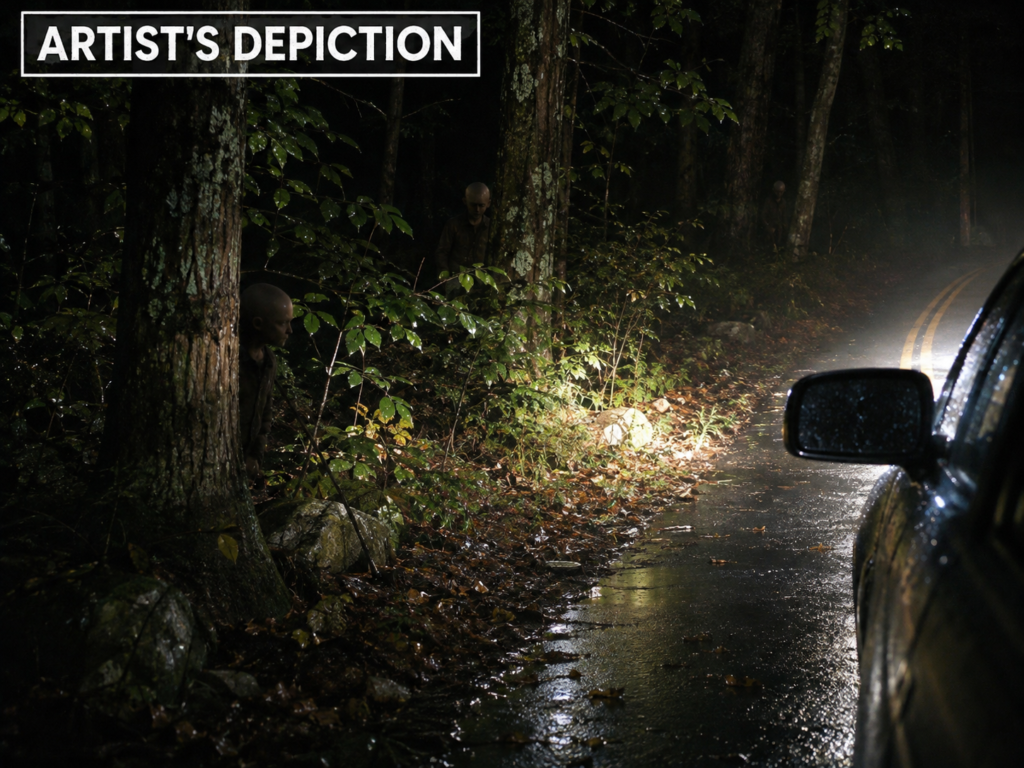
Along the wooded back roads of southwestern Connecticut, generations of teenagers have traded stories about strange figures hiding beyond the headlights. They are usually described as small humanlike beings with oversized, misshapen heads who live apart from ordinary society somewhere in the surrounding woods. Some versions portray them as cannibals, others as escaped patients or isolated families, and nearly every town that tells the story seems to have its own road where the Melon Heads supposedly live.
The Melon Heads are especially associated with Fairfield and New Haven counties. Shelton has Saw Mill City Road, Milford has Zion Hill Road, and Velvet Street between Trumbull and Monroe is one of the locations most strongly associated with the story. Velvet Street has also picked up the nickname “Dracula Drive,” helping turn an otherwise ordinary wooded road into one of the best-known locations in Connecticut monster folklore.
Descriptions of the creatures remain fairly consistent even when the locations change. They are generally portrayed as short or thin humanoid figures with unusually large heads who avoid normal society and become dangerous when outsiders enter their territory. Stories sometimes claim they eat small animals, pets or even people, although most supposed encounters arrive through the familiar urban-legend formula of somebody knowing somebody who supposedly saw them.
Where the Legend Lives
Southwestern Connecticut contains numerous roads that have been attached to the Melon Head story. Velvet Street in Trumbull and Monroe, Saw Mill City Road in Shelton and Zion Hill Road in Milford are among the most frequently mentioned locations. Other versions place the creatures around Oxford, Southbury, Stratford and several nearby communities.
That flexibility is part of what makes the story work so well as local folklore. Instead of having one fixed location where a particular documented event supposedly happened, the legend can move to whichever isolated road is closest to the person telling it. A dark road surrounded by Connecticut woods becomes much more interesting when someone in the car says there are Melon Heads living just beyond the tree line.
Where Did the Melon Heads Come From?
The origin story changes depending on who is telling it. One version claims a family accused of witchcraft during the colonial period was driven into the wilderness and survived there for generations, eventually becoming the Melon Heads. Another claims patients escaped from a psychiatric institution, disappeared into the Connecticut woods and formed an isolated community.
Fairfield Hills Hospital in Newtown is frequently attached to the asylum version, but the documented history creates problems for many versions of that story. Fairfield Hills was a twentieth-century state psychiatric hospital rather than an institution operating during the nineteenth century, which rules out versions claiming that patients escaped from Fairfield Hills during an earlier asylum disaster. There is also no reliable historical record establishing the mass escape, cannibal colony or generations of mutated descendants described by the folklore.
The changing details are a good indication that the asylum story functions more like an evolving legend than a documented historical incident. Real institutions such as Fairfield Hills provided recognizable and unsettling locations that could be attached to stories already circulating in the region.
The Blue Granada
One of the strangest additions to Connecticut’s Melon Head lore involves a group of teenage girls supposedly searching for the creatures during the 1980s. According to the story, the girls drove a blue Ford Granada onto Velvet Street after a football game and eventually left the car with its headlights on while they walked into the woods. They then supposedly heard the car door close and the engine start behind them.
When they looked back, the story says child-sized figures with oversized heads were inside the vehicle and began driving toward them. Some versions go even further and claim the Melon Heads kept the Granada and could occasionally be seen driving it around the area. No reliable documentation establishes that the episode actually happened, but the blue Granada became one of the most memorable details attached to the legend.
A Postwar Legend
The Connecticut Melon Head stories appear to have become especially prominent during the postwar period, as suburban development pushed farther into areas that had previously been more rural. Some interpretations suggest the stories reflected fear or prejudice toward isolated country families who appeared different from newcomers. Whether that explains every version is impossible to prove, but it fits a larger pattern in American folklore where unfamiliar people living beyond the edge of town become the subjects of frightening stories.
The legend also draws from older fears surrounding physical difference, disability and mental illness. Stories about supposedly deformed people, psychiatric patients or isolated families were transformed into monster tales without evidence connecting real people to the behavior attributed to them. That history is worth recognizing because the folklore can be preserved without treating disabled people or former psychiatric patients as monsters.
Legend Tripping
The Melon Heads also fit into a tradition sometimes called legend tripping, where people deliberately visit a location associated with a frightening or supernatural story to see what happens. The Connecticut version is almost perfectly designed for that experience because the locations are ordinary wooded roads rather than inaccessible wilderness. A group of friends can drive there at night already knowing the story, and every movement in the trees or unexpected sound suddenly has a possible explanation.
That does not mean nobody has ever seen something strange on these roads. It does mean separating an actual unexplained observation from expectation, exaggeration and later retelling becomes extremely difficult. Every new group that visits Velvet Street or another supposed Melon Head location gives the legend another opportunity to produce a new story.
More Than One State
Connecticut does not have exclusive ownership of the Melon Heads. Related legends also exist in Michigan and Ohio, although their origin stories and locations differ significantly. Ohio versions are commonly associated with Kirtland, while Michigan versions developed their own stories involving institutionalized children and people with enlarged heads.
The similarities suggest that the basic idea can travel while individual communities rewrite the story around their own landmarks. Connecticut’s version became associated with wooded suburban roads, Fairfield Hills and locations such as Velvet Street, while other states developed different institutions, characters and supposed incidents. The result looks less like one creature migrating across America and more like one adaptable legend finding new places to live.
Why It Matters
There is little evidence for the Melon Heads as literal creatures, but there is considerable evidence that the legend itself is real and persistent. Connecticut writers, historians and folklore researchers have documented the stories, locations and changing explanations for years. The creatures remain part of southwestern Connecticut culture even though the supposed history behind them repeatedly becomes difficult to verify.
That makes the Melon Heads useful for understanding how modern folklore develops. A real road, a real psychiatric institution and a frightening story can be combined until the line between history and legend becomes difficult to see. Once enough people know the same story, the fact that nobody can identify the original Melon Head becomes almost less important than the fact that everyone knows where you are supposedly supposed to look.
T Funk Take
This feels like one of those legends that was almost engineered for teenagers with access to a car. You tell somebody there is a road where weird people with giant heads live in the woods, wait until midnight and then drive out there looking for them. By the time you arrive, everybody in the car is already watching every tree and waiting for something to move.
The asylum explanation is probably the part I find most interesting because attaching Fairfield Hills to the story instantly makes it sound more believable. It was a real psychiatric hospital, it had a huge campus, and parts of it eventually sat abandoned. Once you have that setting, adding escaped patients probably did not require much imagination, even though the documented history does not give us the monster colony the legend needs.
Then we get to the blue Granada, which is where this turns into exactly the kind of story I would have wanted somebody to tell me when I was younger. Now the creatures don’t just hide in the woods; apparently they know how to steal a Ford and drive around Connecticut. I have absolutely no idea how a Melon Head gets car insurance, but that’s apparently a problem for another Case File.
I don’t think we have much evidence that actual creatures are hiding along Velvet Street, but Connecticut definitely has a real piece of folklore here. The story has survived for generations, moved from town to town and picked up new details along the way, which is usually a lot more interesting than simply deciding whether the monster exists. Until somebody brings one out of the woods instead of another friend-of-a-friend story, the Melon Heads stay filed as legend in the T Funk Era archive.
Sources & Further Reading
-
The Melon Heads of Connecticut
New England Historical Society
View Source -
Haunted Connecticut: Our Long History of Strange Happenings and Supposedly Supernatural Events
Connecticut Magazine / CT Insider
View Source -
Fairfield Hills Frequently Asked Questions
Town of Newtown, Connecticut
View Source