Official Archive Record
Case File CF-0133
The Slide-Rock Bolter: Colorado’s Tourist-Eating Mountain Monster
Also known as: Slide-Rock Bolter, Slide Rock Bolter, Macrostoma saxiperrumptus
What Happened
High in the mountains of Colorado, according to an early twentieth-century lumberjack tall tale, an enormous creature waits above steep valleys for unsuspecting travelers. The Slide-Rock Bolter is described as an animal with a gigantic head, tiny eyes, a mouth extending far back along its body and a divided tail equipped with enormous hooks. It supposedly anchors that tail over the crest of a mountain and remains there for days until something worth eating enters the valley below.
When a tourist finally appears, the Bolter releases its grip and throws its enormous body down the mountainside. Grease supposedly drips from its mouth and lubricates the slope, allowing the creature to accelerate like a giant living toboggan while swallowing everything in its path. Trees, animals and entire groups of tourists disappear into its mouth before momentum carries the Bolter up the opposite slope, where it hooks itself over another ridge and waits for the next meal.
A Creature From the Lumber Camps
The strongest historical source for the Slide-Rock Bolter is William T. Cox’s 1910 book Fearsome Creatures of the Lumberwoods, With a Few Desert and Mountain Beasts. Cox collected descriptions of creatures including the Squonk, Hodag, Splinter Cat, Hugag and Slide-Rock Bolter and presented them in the style of a naturalist’s field guide, complete with illustrations by Coert du Bois and mock scientific classifications.
Cox was not trying to convince scientists that these animals had actually been discovered. In his introduction, he explains that lumber camps had long produced exaggerated stories about strange beasts, with tales spreading from one logging region to another and becoming stronger as they were retold. He specifically describes these creatures as products of the lumberjack’s imagination and says that such stories were used to entertain people and frighten newcomers unfamiliar with the woods.
That makes the Slide-Rock Bolter different from something such as Bigfoot or the Fouke Monster. There is no foundational eyewitness case that later became questionable; the foundational document itself tells us we are entering the world of tall tales.
Built for Colorado
Cox places the Bolter specifically in Colorado’s steepest mountain country, claiming it can live only where slopes exceed forty-five degrees. Its anatomy is supposedly perfectly adapted to that environment, with its hooked tail allowing it to hang from mountain ridges while its enormous mouth faces downward into the valley. Cox even gives it the mock scientific name Macrostoma saxiperrumptus, treating an absurd animal with the seriousness of a zoological specimen.
That deadpan presentation is a large part of the joke. The creature’s body is designed backward from the story: if a monster needs to slide down mountains, give it a slippery body; if it needs to remain at the top, give it grappling hooks; and if it needs to eat an entire sightseeing party in one pass, give it a mouth big enough to scoop up tourists like a snowplow.
Tourists Are the Preferred Food
The Bolter’s preferred prey is one of the best clues to the story’s purpose. Cox begins the account by joking that Colorado’s woods were becoming “infested” with tourists during the summer, then makes those tourists the creature’s favorite meal. The monster waits specifically for sightseers to wander into the wrong gulch before launching itself downhill.
That turns the creature into a joke told by people who worked in remote country about outsiders arriving to explore it. A new visitor could be warned with complete seriousness that certain valleys were dangerous because a mountain-sized animal was hanging somewhere overhead waiting for tourists. The more impossible the explanation became, the better the story worked.
The Forest Ranger’s Plan
Cox gives the legend a supposed solution involving a forest ranger working in the rough country between Ophir Peaks and Lizard Head. The ranger decides that the Slide-Rock Bolter has become too dangerous and constructs the perfect bait: a dummy tourist wearing a plaid Norfolk jacket and knee breeches while carrying a Colorado guidebook. Inside the dummy he packs explosives.
The trap supposedly works. A Bolter hanging on the slope of Lizard Head sees the fake tourist, releases itself and swallows the dummy as it barrels downhill. The resulting explosion is so enormous that Cox claims half the buildings in the nearby town of Rico are flattened, while scavenging birds spend the rest of the summer feeding on pieces of the destroyed monster.
It is hard to imagine a clearer tall-tale punchline. A monster large enough to wipe out forests eats enough explosives to damage an actual Colorado town, and the story delivers the result as though it were simply another wildlife-control operation.
Rico and Lizard Head Are Real
Part of what makes the joke work is that Cox anchors the impossible animal to real geography. Rico is an actual historic mining town in southwestern Colorado, and Lizard Head Pass lies north of the community in the San Juan Mountains. The region is genuinely rugged, steep and isolated enough to provide the perfect landscape for a monster that supposedly uses entire mountainsides as hunting ramps.
Rico’s documented history, however, contains mining booms, railroad development and economic decline rather than half the town being destroyed by an exploding mountain monster. The fictional disaster becomes funnier because Cox inserts it into places his audience could actually recognize.
The Original Illustration
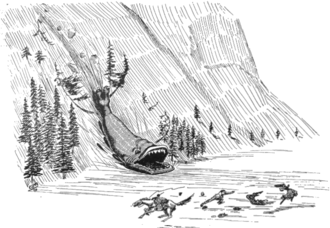
Coert du Bois’s 1910 illustration helped establish what the Bolter looks like. The image shows an enormous fish- or whale-like creature crashing down a steep mountainside with its mouth open while tiny humans flee below. Rocks and trees tumble around it, visually turning the monster into a living landslide.
The original artwork survives in public-domain copies of Cox’s book. Unlike many cryptid cases where modern artists create an appearance decades after vague eyewitness descriptions, the Slide-Rock Bolter’s classic appearance comes directly from the same published source that established the legend.
Fearsome Critters
The Bolter belongs to a larger American folklore tradition commonly called “fearsome critters.” Lumberjacks and other workers in remote camps told stories about imaginary animals whose anatomy often explained some strange feature of wilderness life. The creatures were usually absurd enough that experienced woodsmen understood the joke while newcomers might wonder for a few uncomfortable minutes whether they were being told the truth.
Cox’s collection preserves twenty of these creatures and explains that the stories moved between lumber regions, changing and expanding as workers repeated them. The Squonk supposedly dissolved into tears when captured, the Splinter Cat smashed trees apart with its head and other creatures possessed equally specialized abilities. The Slide-Rock Bolter represents the Rocky Mountain version of the same storytelling tradition.
A Monster Built Like a Landslide
The Bolter also looks suspiciously like a living explanation for something Colorado mountains genuinely do. It waits high on a steep slope, suddenly releases, accelerates downhill and knocks trees out by their roots while debris follows behind it. That description resembles the destructive path left by a rockslide or avalanche, even though Cox does not state that a landslide literally created the legend.
Tall tales frequently turn features of the landscape into creatures with personalities. Someone unfamiliar with a long treeless chute on a mountain might be told that the missing trees were not removed by snow, rock or gravity but by a gigantic animal repeatedly sliding through the valley with its mouth open. The physical landscape then becomes part of the evidence supporting the joke.
Could Anyone Have Believed It?
The original story contains almost every signal that the audience was supposed to recognize exaggeration. The animal is impossibly large, lubricates its own path with grease, eats whole groups of tourists and is destroyed by an explosive dummy whose blast supposedly damages an entire town. Cox also explicitly tells readers that lumberjacks created imaginary animals and told these stories to newcomers.
That does not make the story worthless as a Case File. It actually gives us something rare: a creature whose historical context survives well enough that we can see how monster folklore was deliberately created and transmitted. Instead of arguing about whether a blurry photograph proves something existed, we can examine what people got out of inventing something that everyone eventually understood did not.
The Legend Survives
More than a century later, the Slide-Rock Bolter still appears in books, artwork, podcasts and collections of American monsters. Colorado Public Radio included the creature in its Colorado Postcards series in October 2026, describing Cox’s 1910 account as a collection of tall tales that introduced the mythical Bolter to a national audience.
The creature has also been absorbed into modern cryptid culture, where illustrations sometimes present it alongside Bigfoot, lake monsters and supposedly unidentified animals. That can blur an important historical distinction. The Bolter did not begin as an unresolved zoological report; it began in a tradition where the absurdity of the animal was part of the entertainment.
Why It Matters
The Slide-Rock Bolter is useful because it shows that not every creature in American folklore was originally meant to be believed literally. Lumber camp storytelling could exaggerate dangerous landscapes, tease inexperienced newcomers and build a shared mythology among workers who spent long periods in isolated environments. The monsters became a kind of occupational folklore reflecting the people and places that created them.
It also gives us a useful comparison for more serious cryptid cases. With the Fouke Monster or Mogollon Monster, we have eyewitnesses claiming that they actually encountered unidentified animals. With the Slide-Rock Bolter, the oldest strong source openly tells us that creatures like this came from lumberjack imagination, which means we should preserve it as folklore rather than manufacture a mystery that the original storytellers never really gave us.
T Funk Take
This might be the easiest evidence rating we’ve done because the guy who wrote the main source basically tells us these animals came from lumberjacks making stuff up to mess with newcomers. Then he describes a whale-sized thing hanging off a mountain by hooks in its tail, greasing the slope with its own drool and eating entire groups of tourists. I’m comfortable saying we probably don’t need to organize an expedition.
I do like what these stories tell us about the people telling them. If you’re working in remote mountain country and some new guy asks why an entire strip of trees is missing from the slope, telling him an avalanche did it is boring. Telling him a 200-ton monster slides down that mountain every time it sees somebody holding a Colorado guidebook is a much better way to spend the evening.
The tourist part might be my favorite detail. The creature doesn’t just randomly eat whatever wanders underneath it; Cox specifically jokes about tourists infesting the Colorado woods and then builds a monster designed to solve that problem. Even the trap is a fake tourist wearing ridiculous clothes and carrying a guidebook, so the whole story feels like locals getting some entertainment out of outsiders coming into their mountains.
I wouldn’t call the Slide-Rock Bolter a real cryptid because there isn’t really an unexplained animal here to solve. What we do have is a genuine piece of American folklore with an original illustration, a known 1910 source and a creature ridiculous enough that people are still talking about it more than a hundred years later. That’s plenty strange for the T Funk Era archive without pretending the thing is actually waiting above somebody’s hiking trail.
Sources & Further Reading
-
Fearsome Creatures of the Lumberwoods: With a Few Desert and Mountain Beasts
William T. Cox / University of Nebraska–Lincoln Digital Commons
View Source -
The Slide Rock Bolter
Colorado Public Radio
View Source -
Slide-Rock Bolters
American Folklore
View Source