Official Archive Record
Case File CF-0126
The Legend of Sleepy Hollow: America’s Headless Horseman
Also known as: Headless Horseman of Sleepy Hollow, Galloping Hessian of the Hollow, Headless Hessian
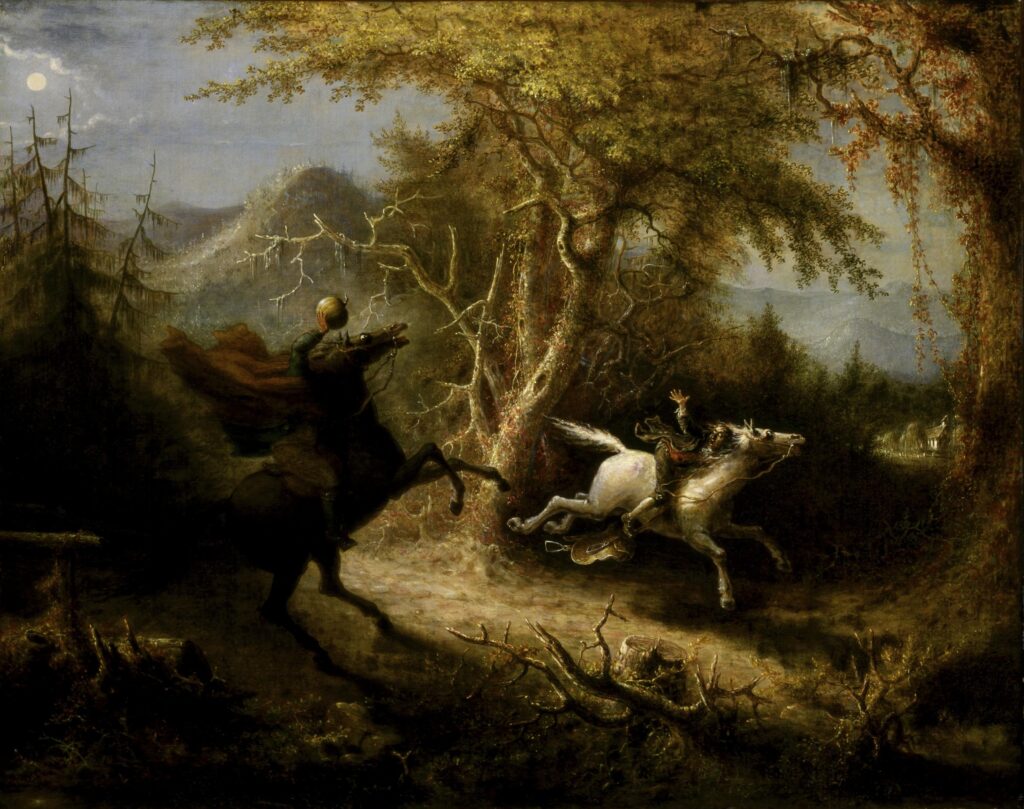
The Headless Horseman of Sleepy Hollow is one of the most recognizable ghosts in American culture. A dark rider charges through the Hudson Valley carrying his severed head, chasing a terrified schoolmaster toward an old churchyard while autumn leaves and a pumpkin complete an image that has become almost inseparable from Halloween. The strange part is that Washington Irving’s original story leaves open the possibility that the famous supernatural encounter was never supernatural at all.
Irving published “The Legend of Sleepy Hollow” in 1820 as part of The Sketch Book of Geoffrey Crayon, Gent. The story drew on the real landscape and Dutch American culture of New York’s Hudson Valley while mixing local atmosphere with older traditions about supernatural riders. By the end, Irving gives the reader both a ghost story and enough evidence to suspect that Ichabod Crane was simply frightened out of town by a rival with a good costume and a pumpkin.
The Hollow
Irving places the story near Tarrytown on the eastern side of the Hudson River, in a secluded valley known as Sleepy Hollow. He describes the region as unusually quiet and filled with stories about ghosts, haunted places and strange nighttime experiences. The atmosphere matters because virtually everyone in the story already expects supernatural things to happen there, making Sleepy Hollow as important to the legend as the Horseman himself.
The place was not completely invented. Washington Irving visited the Tarrytown and Sleepy Hollow area during the late 1790s, exploring the countryside and becoming familiar with its people, landscapes and traditions. The modern Village of Sleepy Hollow credits those visits with providing material Irving later used in his story.
The Headless Hessian
The dominant ghost in Irving’s Sleepy Hollow is a headless horseman said to be the spirit of a Hessian soldier killed during the American Revolution. According to the story, a cannonball removed the soldier’s head during an unnamed battle, and his body was buried in the churchyard near the Hollow. The ghost supposedly rides through the countryside at night searching for his missing head before racing back to the cemetery before daylight.
Hessian troops were real German soldiers hired by Britain during the American Revolution, making the Horseman’s background plausible enough to fit the landscape Irving was describing. Irving, however, never identifies one documented dead soldier as the Headless Horseman. The Hessian is presented as a local legend already circulating among the inhabitants of his fictionalized Hudson Valley.
Ichabod Crane
Into this supposedly haunted region comes Ichabod Crane, a lanky Connecticut schoolteacher who teaches local children and moves from household to household while working in the community. Ichabod is educated but extremely superstitious, and Irving repeatedly shows him reading stories about witchcraft and interpreting ordinary nighttime sounds through that supernatural imagination. His personality makes him almost perfectly designed to become the victim of a ghost story.
Ichabod also has another motivation for remaining in Sleepy Hollow. He becomes interested in Katrina Van Tassel, the young daughter of a prosperous Dutch farmer, and he spends considerable time imagining not only Katrina but the wealth and farmland he might acquire by marrying her. Unfortunately for Ichabod, another man is interested in her as well.
Brom Bones
Abraham “Brom Bones” Van Brunt is Ichabod’s main rival for Katrina. Brom is physically powerful, confident, mischievous and known around the neighborhood for elaborate practical jokes. When Ichabod refuses to be intimidated away from Katrina, Brom begins looking for other ways to make the schoolmaster’s life difficult.
That rivalry becomes important because Brom also knows the local Horseman stories extremely well. At the Van Tassel gathering, he tells the group that he once encountered the Headless Horseman himself and challenged the ghost to a horse race. According to Brom’s story, the Horseman disappeared when they reached the bridge near the churchyard.
Ghost Stories After Dark
The evening at the Van Tassel farm becomes filled with stories about the American Revolution, local ghosts and supernatural encounters around Sleepy Hollow. The Headless Horseman dominates the conversation, and Ichabod absorbs every detail. By the time the gathering ends, his imagination is already loaded with exactly the story he will soon believe he is experiencing.
Something also appears to go wrong between Ichabod and Katrina before he leaves. Irving deliberately refuses to tell the reader exactly what happened during their private conversation, but Ichabod departs looking disappointed and humiliated. He then begins the lonely ride home on an old horse named Gunpowder.
The Ride Through Sleepy Hollow
Every ordinary sound becomes threatening as Ichabod travels through the darkness. Branches rub together, trees take on frightening shapes and memories of the ghost stories return as he approaches places already associated with supernatural events. His fear builds long before anything resembling a ghost actually appears.
Near a small bridge, Ichabod finally sees a large dark figure mounted on a powerful horse. The rider follows him without explaining who he is, and Ichabod becomes increasingly convinced that he is being pursued by the legendary Hessian. When moonlight reveals that the rider appears to have no head on his shoulders, Ichabod sees the missing head being carried in front of the rider instead.
The Chase
Ichabod remembers the stories claiming that the Horseman disappears when he reaches the bridge near the church. He drives Gunpowder toward it, believing that crossing the bridge will place him beyond the ghost’s power. The mysterious rider follows at full speed.
Ichabod makes it across and looks behind him expecting the ghost to vanish. Instead, the rider rises in his stirrups and throws what appears to be his severed head directly at Ichabod. The object strikes him hard enough to knock him from his horse, and the rider disappears into the night.
The Shattered Pumpkin
The following morning, Gunpowder returns without Ichabod. Searchers trace the horses’ tracks toward the bridge and discover Ichabod’s abandoned hat. Beside it lies something extremely important to understanding the entire legend: a shattered pumpkin.
No body is found, and the villagers decide that the Headless Horseman carried Ichabod away. Irving gives the reader another version, however, in which a traveler later reports that Ichabod is alive and has moved elsewhere, studied law, entered politics and become a judge. The missing schoolmaster may therefore have simply fled Sleepy Hollow after being frightened and humiliated.
Brom Knows Something
The strongest clue comes from Brom Bones. Brom eventually marries Katrina, and Irving writes that whenever people tell the story of Ichabod’s disappearance, Brom reacts knowingly. More importantly, he laughs whenever anyone mentions the pumpkin found beside Ichabod’s hat.
Irving never directly announces that Brom disguised himself as the Headless Horseman, but he does not need to. Brom was an accomplished horseman, enjoyed practical jokes, knew Ichabod believed strongly in ghosts and knew exactly how the local Horseman story was supposed to work. The shattered pumpkin makes a very convincing substitute for the head that struck Ichabod.
Was There Ever a Real Headless Horseman?
The Horseman in Irving’s story is presented as folklore rather than documented history. No identified Hessian soldier has been established as the literal source of a supernatural rider who continued appearing after death. The American Revolution provides the historical background, but the ghost belongs to the legend.
That distinction is important because the story itself repeatedly plays with unreliable storytelling. Residents tell stories that have already been exaggerated through repetition, and Irving frames the entire tale as something supposedly preserved by his fictional historian Diedrich Knickerbocker. At the end, even the storyteller says he does not necessarily believe everything in the tale.
The Horseman Had Ancestors
Irving did not invent the basic idea of a supernatural rider without a head. European folklore already contained stories involving phantom horsemen, headless riders and supernatural hunts long before The Legend of Sleepy Hollow. Historic Hudson Valley notes that scholars have identified German, English and Scandinavian traditions involving headless riders chasing travelers as possible influences on Irving.
Irving wrote the story while living in England, where he had access to European folklore and literature. What he accomplished was not simply copying one older legend but transplanting the supernatural rider into an American landscape filled with Revolutionary War history, Dutch settlements and Hudson Valley ghost stories. The result felt local enough to become an American legend of its own.
The Pumpkin Wasn’t His Head
Modern versions frequently show the Headless Horseman galloping through Sleepy Hollow with a glowing jack-o’-lantern where his head should be. That image is visually perfect for Halloween, but it is not exactly what Irving wrote. The Horseman initially appears to Ichabod carrying what Ichabod believes is his head, while the shattered pumpkin discovered the next morning strongly suggests what the object actually was.
Irving never describes a carved jack-o’-lantern burning on the Horseman’s shoulders. Artists, films and Halloween imagery gradually fused the pumpkin clue with the headless rider until the pumpkin became part of the character’s appearance. Historic Hudson Valley specifically notes that later artists embellished Irving’s suggestion into the familiar scary pumpkin head.
It Wasn’t Even Halloween
Another surprising detail is that Irving never says Ichabod’s encounter happens on Halloween. The climactic gathering takes place on a fine autumn day, and the harvest setting provides pumpkins, falling leaves, darkness and everything else needed to make the story feel like Halloween without naming the holiday.
The association developed naturally because the story already contained ghosts, darkness, superstition and one extremely important pumpkin. Later illustrations, children’s adaptations, films and seasonal performances strengthened the connection until the Headless Horseman became one of America’s most recognizable Halloween figures.
Sleepy Hollow Becomes Sleepy Hollow
The legend eventually changed the real community associated with it. The area Irving knew continued developing through the nineteenth and twentieth centuries, and part of it became the village of North Tarrytown. In 1996, residents voted to rename North Tarrytown Sleepy Hollow, officially adopting the literary identity that had been attached to the area for generations.
The Old Dutch Church and other historic locations still connect the modern village with Irving’s fictional landscape. Washington Irving himself lived nearby at Sunnyside later in life, and the story remains central to the region’s identity and tourism. Two centuries after Irving published a fictional ghost story, the fictional place-name had become the official name on the map.
Why It Matters
The Legend of Sleepy Hollow works because Irving never forces the reader to choose between ghost story and practical joke. Ichabod genuinely believes he encountered the Headless Horseman, the villagers are perfectly willing to believe a ghost carried him away and the supernatural interpretation remains available. At the same time, Irving quietly leaves a pumpkin, a living Ichabod and a laughing Brom Bones behind for anyone who wants a more ordinary explanation.
That ambiguity helped the story survive for more than two centuries. The Headless Horseman can be treated as a genuine ghost, a piece of Revolutionary folklore, a practical joke, a literary monster or a Halloween icon without breaking the story. The legend became bigger than its original mystery because Irving gave audiences just enough evidence to keep arguing about what happened after Ichabod entered the Hollow.
T Funk Take
This one might have the most obvious answer of any ghost story we’ve covered, and Irving basically leaves the evidence sitting beside the road. Ichabod is terrified of ghosts, Brom Bones loves screwing with people, Brom wants him away from Katrina and there is a shattered pumpkin sitting beside Ichabod’s hat the next morning. Then Brom starts laughing every time somebody brings up the pumpkin, which is not exactly subtle.
What I like is that Irving doesn’t ruin the story by saying, “Brom did it.” He lets the people in Sleepy Hollow believe the Horseman took Ichabod while giving everybody else enough information to figure out another explanation. That’s probably why the story still works after two hundred years because you can enjoy the ghost without having to pretend the ghost is the only possible answer.
I also didn’t realize how much of the Halloween version was added afterward. The story isn’t set on Halloween, and the Horseman isn’t riding around with a glowing jack-o’-lantern for a head the way we usually picture him. A pumpkin gets thrown at Ichabod, artists apparently realize that’s way cooler if you put it on the Horseman, and eventually the character basically becomes Halloween royalty.
For the supernatural claim, I’m going with the guy carrying a pumpkin before I’m going with a dead Hessian riding around without his head. As a legend, though, this one is hard to beat because it has a real place, Revolutionary War history, an unexplained nighttime chase and one of the best monsters American folklore ever produced. Saving the Headless Horseman for Halloween was the right call, and the Legend of Sleepy Hollow belongs in the T Funk Era archive.
Sources & Further Reading
-
The Legend of Sleepy Hollow
Project Gutenberg — Washington Irving
View Source -
Irving’s ‘Legend’: The Story Behind the Story
Historic Hudson Valley
View Source -
History of the Village
Village of Sleepy Hollow, New York
View Source