
Official Archive Record
Case File CF-0121
The Jack-o’-Lantern: How an Irish Ghost Story Became the Face of Halloween
Also known as: Jack-o’-Lantern, Jack O’Lantern, Jack of the Lantern, Ghost Turnip
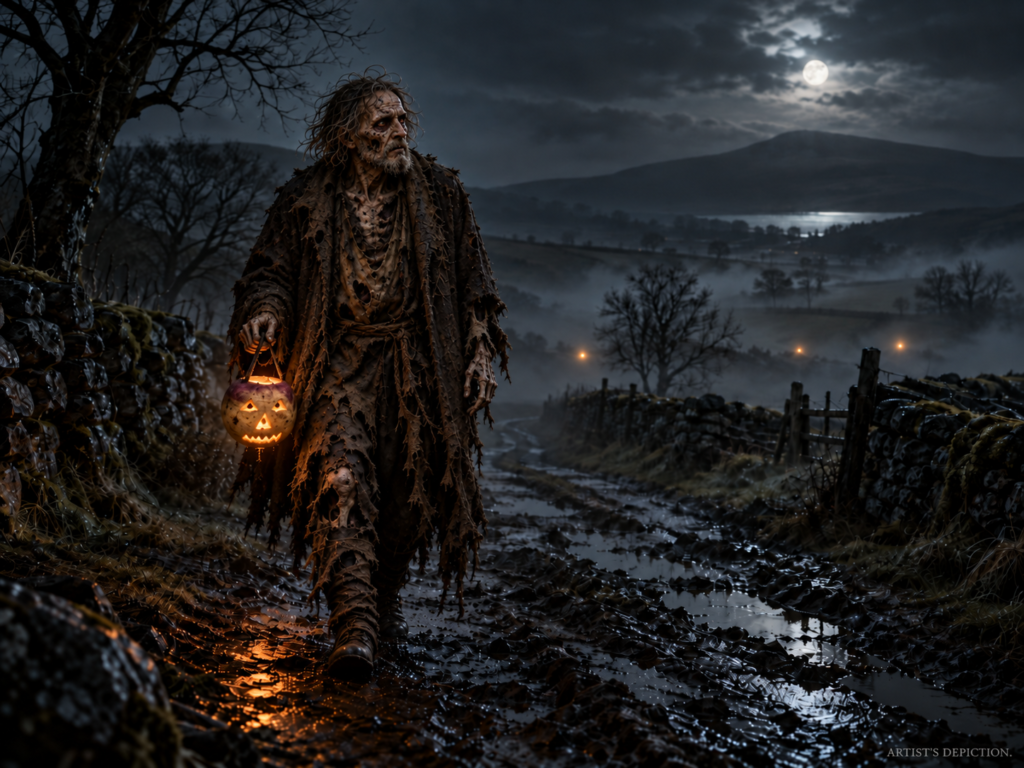
The glowing jack-o’-lantern may be the most recognizable symbol of Halloween. Every October, millions of pumpkins are hollowed out, carved into faces and placed on porches with lights flickering inside them. The tradition feels completely American, but its roots reach back across the Atlantic to Ireland and Britain, where people carved much harder and considerably creepier vegetables such as turnips into lanterns.
Behind the lantern is also a ghost story. Irish folklore connected the name Jack-o’-Lantern with a wandering figure commonly known today as Stingy Jack, a man supposedly rejected by both Heaven and Hell and condemned to roam the Earth carrying a light inside a hollowed turnip. The historical custom, the folktale and the American pumpkin eventually became so tightly connected that they now appear to be one ancient tradition, even though the story is more complicated than that.
The Ghost Turnip
Long before pumpkins became the standard Halloween carving material in the United States, people in Ireland were making lanterns from turnips. A surviving example preserved by the National Museum of Ireland comes from County Donegal and represents the type of Halloween turnip lantern remembered from around 1900. The museum records that candles were placed inside the carved vegetables and that they were used to frighten people on the night of October 31.
The old turnip lanterns look very different from the cheerful orange pumpkins sold today. Their irregular shape, pale flesh and rough skin make the carved faces resemble shriveled human heads. Turnips are also considerably harder to hollow out than pumpkins, which helps explain why the surviving traditional designs tend to be simple, crude and genuinely unsettling.
Who Was Stingy Jack?
The best-known legend tells of a man usually called Stingy Jack who repeatedly outsmarted the Devil. In one popular version, Jack convinces the Devil to turn himself into a coin so the two can pay for a drink, then traps the Devil by placing the coin beside a cross. Jack eventually releases him only after extracting a promise that the Devil will not claim Jack’s soul when he dies.
Jack later tricks the Devil again, this time trapping him in a tree by carving a cross into the bark. When Jack eventually dies, Heaven refuses him because of the life he lived, while the Devil keeps his promise and refuses to take him into Hell. Jack is therefore condemned to wander the darkness between the two worlds, carrying a burning coal inside a hollowed turnip to light his way.
That wandering figure became known in later tellings as Jack of the Lantern, or Jack-o’-Lantern. People supposedly carved frightening faces into their own turnip lanterns to keep Jack and other unwanted spirits away. The story provides a perfect explanation for the tradition, but it is still folklore rather than a documented biography of one historical man.
Jack Was Originally a Light
The name jack-o’-lantern appears to be older and more complicated than the Stingy Jack story usually makes it sound. Before the term became attached to carved pumpkins, it was also used for mysterious wandering lights seen at night, similar to the phenomenon known as the will-o’-the-wisp. Such lights were associated in folklore with spirits, fairies or supernatural beings that could mislead travelers across dangerous ground.
That older meaning fits neatly with the later story of a condemned wanderer carrying a lantern across the countryside. The folktale may have helped turn an unexplained light into a character with a name, motive and history. Over time, the wandering light, the ghostly Jack and the carved vegetable lantern became increasingly difficult to separate.
Halloween in Ireland
Halloween in Ireland developed from several overlapping traditions rather than from one single ancient ceremony passed down unchanged. Samhain marked a seasonal transition associated with the end of harvest and beginning of winter, and later Christian observances including All Saints’ and All Souls’ Day became part of the same period. Traditions surrounding spirits, divination, disguises, fires and seasonal games accumulated around the end of October.
The National Museum of Ireland documents beliefs that spirits of the dead were especially active around Halloween and records traditions including masks, fortune-telling games and carved turnip lanterns. That gives the lantern a genuine place within Irish Halloween tradition without requiring us to claim that ancient Celts were carving modern-style jack-o’-lanterns thousands of years ago. The documented lantern tradition is real; the exact path from ancient seasonal beliefs to the later carved face is much harder to prove.
The Turnip Was Not Just Irish
Carved vegetable lanterns were not exclusive to Ireland. Similar traditions existed in Scotland and parts of England and Wales, where turnips, mangelwurzels and other root vegetables could be hollowed out and carved into faces. Some were connected with Halloween, while others were apparently used for pranks or simply to frighten people walking after dark.
That broader history is important because the modern story can become too neat when everything is credited to one Irish legend. People across Britain and Ireland were carving vegetable lanterns in different contexts, and the Stingy Jack story became one of the best-known explanations for why the custom existed. Folklore rarely develops with the clean origin point we would like it to have.
Then the Pumpkin Takes Over
The biggest transformation happened when immigrants brought Halloween customs to North America. Pumpkins were already abundant on the continent and were far easier to hollow out and carve than dense turnips. Smithsonian Gardens dates carved pumpkin jack-o’-lanterns in the United States to the mid-nineteenth century and notes that the pumpkin gradually replaced the old root vegetables.
The substitution changed the appearance of Halloween forever. A pumpkin provided a large orange surface that could support more elaborate faces, while its hollow interior made carving dramatically easier. What had once been a relatively small and disturbing vegetable lantern became something families could make quickly and display prominently outside their homes.
An American Halloween Symbol
By the late nineteenth and early twentieth centuries, the pumpkin jack-o’-lantern had become closely associated with American Halloween celebrations. Newspapers and photographs increasingly showed carved pumpkins alongside other seasonal traditions, helping standardize the orange glowing face as part of the holiday. Smithsonian collections include American jack-o’-lantern photography from 1912, demonstrating how familiar the image had become by the early twentieth century.
The American pumpkin did not erase the older tradition so much as overwhelm it. Millions of people now carve jack-o’-lanterns without ever realizing that earlier generations were doing essentially the same thing with turnips. The pumpkin became so successful that the older version now looks like the strange variation rather than the original form.
What Happened to the Ghost?
Stingy Jack gradually became less important as the jack-o’-lantern became more popular. Most people carving pumpkins today are not attempting to keep a wandering Irish spirit away from the front door. The lantern has shifted from supernatural protection and Halloween mischief into decoration, family activity and an almost universal symbol of the holiday.
That transformation is common in folklore. Traditions often survive after the beliefs that originally gave them meaning have weakened or disappeared. Someone can carve a frightening face into a pumpkin without believing that anything supernatural is outside waiting for it.
The Old Turnips Are Still There
The original style has not disappeared completely. The National Museum of Ireland preserves its famous ghost turnip in the Irish Folklife Collection, and museums and communities continue demonstrating traditional turnip carving around Halloween. Seeing one makes the connection to older ghost stories much easier to understand because the result looks less like seasonal decoration and more like something deliberately designed to frighten whoever finds it glowing in the dark.
That surviving artifact is especially valuable because it gives the story something physical. Stingy Jack remains folklore, but carved turnip lanterns are not speculative. People actually made them, carried them and used them to frighten each other on Halloween night.
Why It Matters
The jack-o’-lantern is a good example of how traditions evolve without completely losing their identity. A wandering-light legend, stories about a condemned soul, Halloween beliefs about spirits, carved root vegetables and American pumpkins all contributed to the symbol we recognize today. No single part of that history explains everything by itself.
The result also shows how immigration changes traditions rather than simply preserving them. Irish and British customs arrived in a place where a much better carving material was readily available, and the pumpkin took over. The face remained, the light remained and the name remained, but almost everything else around the lantern changed.
T Funk Take
I think we downgraded the scariness when we switched from turnips to pumpkins. A pumpkin can look creepy if you work at it, but those old carved turnips look like somebody found a dried human head in a root cellar and stuck a candle inside it. If somebody left one of those glowing on my porch at night, I would probably assume Halloween had taken a very different turn.
The Stingy Jack story is also exactly the kind of folklore I like because it gives a simple object this ridiculous backstory. Apparently Jack scams the Devil more than once, gets himself banned from both Heaven and Hell and then spends eternity wandering around with a burning coal inside a vegetable. That is a lot of mythology just to explain why we carve a face into something from the produce section.
What I don’t want to do is pretend we can trace every pumpkin on an American porch directly back to one ancient Samhain ritual because the history isn’t that clean. We know people carved turnips into frightening lanterns, we know the Stingy Jack story existed and we know immigrants helped bring those traditions to North America, where pumpkins eventually took over. The parts between those points were built by generations of people adding, changing and combining traditions.
That actually makes the jack-o’-lantern more interesting to me. We didn’t inherit one perfectly preserved ancient custom; we inherited a tradition that kept changing until an Irish ghost carrying a turnip somehow became millions of orange pumpkins sitting outside American houses every October.
I still think we should bring the turnip version back, though. Pumpkins are Halloween decorations. Those turnips look like evidence.
Case remains a legend in the T Funk Era archive.
Sources & Further Reading
-
Ghost Turnip
National Museum of Ireland
View Source -
The Origins of Halloween Traditions
Library of Congress
View Source -
Ghosts of Pumpkins Past
Smithsonian Gardens
View Source