Official Archive Record
Case File CF-0091
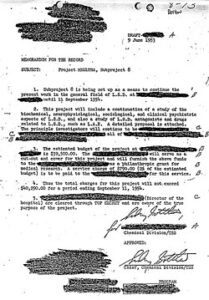
The Alien DNA Hunt: The CIA and Consumer Genetics Claim
Also known as: CIA alien DNA search claim, Alien bloodline screening allegation
You send away a saliva sample to learn about your ancestors. Somewhere else, according to the allegation, someone is checking whether those ancestors came from Earth.
That is the premise of a story linking the CIA, consumer DNA testing, and supposed alien descendants living among us.
It is an attention-grabbing accusation. The evidence available for this case does not establish that the operation exists.
What Was Claimed
A May 26, 2026 New York Post report attributed the allegation to philosopher and author Jason Reza Jorjani, speaking on American Alchemy. He reportedly cited Lyn Buchanan as his source for claims that intelligence personnel could access Ancestry and 23andMe data to identify supposed extraterrestrial ancestry.
That is an indirect account. It does not establish that either company participated in such an operation. Reporting on the allegation
On September 20, the Daily Mail circulated a headline about the accusation on X. The screenshot supplied for this case documents that post, but a headline cannot independently verify what it describes.
The original interview was not independently reviewed for this entry. Its contents are therefore attributed through the reporting, rather than presented as a verified firsthand account.
What DNA Tests Actually Tell Us
Genetic ancestry testing compares patterns in a person’s DNA with reference data from other people. Those comparisons help estimate ancestry and identify possible family relationships.
The reference databases have limitations. Some populations are represented more thoroughly than others, and companies can use different methods. Results can differ between services or change as reference information improves. These tests also typically examine only part of a person’s genetic information. MedlinePlus Genetics
An uncertain ancestry result is therefore not evidence of extraterrestrial origin.
To make that leap, investigators would need to establish much more than an unusual result. They would need independently examined samples, reproducible findings, and a defensible reason to identify the material as extraterrestrial rather than an unexplained human variation, contamination, or a testing problem.
Nothing reviewed for this case supplies that chain of evidence.
What About Access to the Data?
23andMe’s published Trust Center states that it will not voluntarily release personal data to law enforcement. That is the company’s stated position, not an independent audit of every possible access route. It is also not a specific response to this alien-search allegation. 23andMe Trust Center
A company policy cannot prove that unauthorized access is impossible. Equally, the possibility of unauthorized access cannot establish that a particular secret operation happened.
The accusation requires separate evidence for several steps: access to the data, use by the alleged agency, a search for the claimed genetic marker, and proof that the marker means what the story says it means.
Even confirming one step would leave the others to be demonstrated.
Why It Matters
This story combines questions about personal information with an extraordinary explanation for why someone might want it.
Who can access genetic data? What permissions did a customer give? How are results interpreted? Those questions deserve clear answers regardless of anyone’s views about extraterrestrial life.
But concern about privacy does not supply evidence of alien ancestry.
The same distinction applies to the headlines. Several publications repeating an allegation may increase its audience without adding another witness, document, or laboratory result.
The word “accused” matters. It tells us an allegation has been made. It does not tell us the allegation has been substantiated.
The material reviewed establishes that the story circulated. It does not establish a CIA search for alien bloodlines, company cooperation with such a search, or the discovery of extraterrestrial DNA in customers.
For now, this case records an unsupported conspiracy claim and the questions that would need answers before its status could change.
T Funk Take
The CIA searching your DNA? Maybe they did.
Maybe they were looking for a particular person they already had their eye on. Could a genetic database have helped them identify that person or find a relative? That’s one possible reason I can imagine for wanting access. It doesn’t establish that they actually got it.
Then there’s the privacy question. Would you give up some of yours if it could save someone else’s life?
That’s a difficult question. What’s more valuable? I guess your answer depends on who you are, where you come from, and what you’ve experienced. I’d also want to know who gets to decide that the trade is necessary.
The idea that they were looking for Martian DNA sounds like nonsense to me. How would they know if they found it? What would they compare it with? And what would they do with that information?
Unless they already had a sample they wanted to investigate and were looking for people who shared certain genetic markers with it.
But even a match wouldn’t establish that the original sample came from somewhere beyond Earth.
That’s all speculation on a one-star case. I can imagine reasons someone might want access to a DNA database. That doesn’t mean this particular story happened.
The Alien DNA Hunt stays filed under an extraordinary accusation waiting for something concrete.
Sources & Further Reading
-
Whistleblower claims CIA used DNA data from Ancestry and 23andMe customers in search for aliens
New York Post
View Source -
What is genetic ancestry testing?
MedlinePlus Genetics — U.S. National Library of Medicine
View Source -
Trust Center
23andMe Research Institute
View Source