Official Archive Record
Case File CF-0110
The Salem Witch Trials: When Fear Became Evidence
Also known as: Salem Witch Trials, Salem Witchcraft Trials, Salem Witchcraft Outbreak
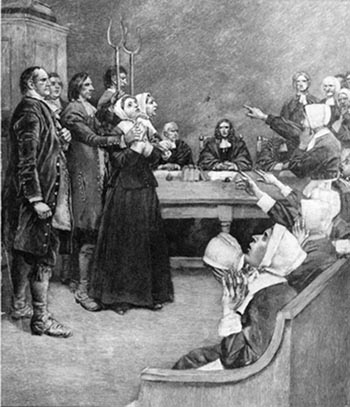
In 1692, residents of a small Massachusetts community began accusing their neighbors of one of the most serious crimes imaginable in colonial New England: witchcraft. What began with a few young girls experiencing strange fits turned into arrests, interrogations, courtroom accusations and executions. More than 200 people would eventually be accused, and the legal system created to investigate the crisis accepted testimony about invisible spirits and supernatural attacks as evidence. By the time the panic ended, 20 people had been executed and several more had died in jail.
No witches were proven to exist, but the consequences of believing they did were very real. The Salem Witch Trials became one of the clearest examples in American history of what can happen when fear, rumor and an accepted belief in hidden enemies begin replacing ordinary standards of evidence.
What Happened
The crisis began in Salem Village, a farming community separate from the nearby port of Salem Town. Early in 1692, nine-year-old Elizabeth “Betty” Parris and her cousin Abigail Williams began behaving strangely. Contemporary accounts described screaming, convulsions and other disturbing behavior that local adults could not explain. Other young people in the community soon reported similar experiences.
The explanations available to a seventeenth-century Puritan community were very different from those we might consider today. People in colonial Massachusetts generally accepted that Satan, witches and supernatural attacks could be real, so when ordinary explanations failed, witchcraft became a possible answer. Before long, the afflicted girls began naming people they believed were responsible.
The First Accused
The first three women formally accused were Sarah Good, Sarah Osborne and Tituba. All three were vulnerable in different ways: Good was poor and frequently depended on charity, Osborne had been involved in disputes over property and inheritance, and Tituba was an enslaved woman in the household of Salem Village minister Samuel Parris.
Warrants were issued for the three women at the end of February 1692, and they were examined on March 1. Good and Osborne denied practicing witchcraft. Tituba eventually confessed, and that confession changed the direction of the entire investigation.
Tituba’s Confession
Tituba told magistrates about supernatural beings, strange animals and a larger network of witches. Her statements gave Salem something far more frightening than three isolated suspects because they suggested a conspiracy operating inside the community.
If one witch could identify another, and that witch could identify several more, the investigation had no natural stopping point. An accusation led to questioning, questioning produced another accusation, and that accusation produced another arrest. Soon respected church members, farmers, businessmen and even children were being accused alongside people already living on the margins of society.
Spectral Evidence
One of the most dangerous features of the trials was the use of what became known as spectral evidence. An accuser could claim that the spirit or apparition of another person had appeared and attacked them even when the accused person was nowhere nearby.
That created an almost impossible problem for the defense because there was no practical way to prove that an invisible spirit had not appeared. The special Court of Oyer and Terminer created to hear the witchcraft cases permitted this kind of testimony. A claim about something only the accuser said they could see could therefore contribute to a real criminal conviction.
The Court of Oyer and Terminer
Governor William Phips established the Court of Oyer and Terminer in May 1692 to deal with the growing number of witchcraft cases. Lieutenant Governor William Stoughton served as its chief magistrate, and the court began hearing cases in June.
Bridget Bishop became the first person executed after being convicted of witchcraft and was hanged on June 10. Sarah Good, Rebecca Nurse, Susannah Martin, Elizabeth Howe and Sarah Wildes were hanged on July 19, followed by additional executions in August and September. In total, 19 people were executed by hanging, despite the popular image of Salem witches being burned at the stake.
Giles Corey
The twentieth execution was different. Giles Corey was an elderly farmer accused of witchcraft along with his wife, Martha, but when he was brought before the court he refused to enter a plea.
Under English legal procedure, a defendant who refused to plead could not proceed to a normal jury trial. Authorities attempted to force Corey to enter a plea using a punishment known as peine forte et dure, placing him on the ground while heavy stones were gradually piled onto his body. He died on September 19, 1692, after roughly two days of crushing pressure.
Later tradition says that when officials demanded that Corey plead, his response was “more weight.” The exact wording is disputed, but the manner of his death is well documented. Three days later, his wife Martha was hanged.
Confessing Could Save You
One of the most disturbing patterns in the trials was that admitting to witchcraft could sometimes improve a prisoner’s chances of survival. The authorities wanted information, so a person who confessed could identify other supposed witches, describe meetings with the Devil and provide new names for investigators to pursue.
People who insisted on their innocence could be seen as refusing to confess to something the court had already decided was real. That produced a terrible incentive: tell authorities the supernatural story they expected to hear and you might live, while continuing to insist you were innocent could lead toward execution. A system supposedly designed to discover the truth had begun rewarding the production of more accusations.
The Accusations Spread
As the summer continued, the accusations became increasingly difficult to contain. People with good reputations were accused, church members were accused, and former Salem Village minister George Burroughs was accused of secretly leading witches.
The crisis was no longer limited to a handful of socially isolated suspects. Even people connected to prominent families and government officials began appearing in accusations. The accusation itself had become dangerous enough to destroy almost anyone, and public confidence in the proceedings began to weaken.
George Burroughs and the Lord’s Prayer
George Burroughs’ execution became one of the moments that shook public confidence in the trials. Before he was hanged on August 19, he reportedly recited the Lord’s Prayer correctly in front of the crowd.
That created a problem because many people believed a genuine witch would be unable to recite the prayer properly. If Burroughs could do it while standing on the gallows, some spectators began wondering whether an innocent man was about to die. Cotton Mather, an influential Puritan minister who supported the prosecution of witchcraft, reportedly addressed the crowd and reminded them that Burroughs had been convicted by law, and the execution continued.
The Evidence Begins to Collapse
By the fall of 1692, doubts about the trials were becoming harder to ignore. The use of spectral evidence became a central problem because if Satan could appear in the shape of an innocent person, then seeing someone’s apparition proved very little about whether that person had actually done anything.
Religious leaders including Increase Mather warned against relying on such evidence. Governor Phips later wrote that he became convinced innocent people could be accused when the Devil supposedly appeared in their shape. The governor finally stopped the Court of Oyer and Terminer, which was dissolved at the end of October 1692.
A Different Court
Dozens of accused people were still sitting in jail when a new Superior Court of Judicature began hearing the remaining witchcraft cases in January 1693. The approach had changed, and spectral evidence no longer carried the same weight it had during the earlier proceedings.
The results changed dramatically as well. Most defendants were acquitted, and although some people were still convicted, Governor Phips issued pardons and prevented further executions. By May 1693, the remaining prisoners had largely been released and the witch hunt was effectively over.
The Aftermath
The legal consequences continued for decades. Families of the accused petitioned the government to clear the names of people who had been convicted, and in 1711 Massachusetts reversed several convictions and authorized compensation for some of their families.
Additional legal actions over the following centuries cleared more names. Massachusetts eventually reversed the convictions associated with the trials, but the physical end of the prosecutions did not end the argument over how the crisis had happened in the first place.
What Caused the Salem Witch Trials?
There is no single explanation that accounts for everything. Salem Village was already divided by religious disagreements, family disputes and economic tensions, while the wider colony had experienced war, displacement and disease. The community also existed in a culture where belief in witchcraft and Satan was not considered unusual or fringe.
Those conditions created an environment where supernatural accusations could be taken seriously. Personal grievances could become witchcraft accusations, fear could make strange behavior appear sinister, and once respected authorities accepted the basic premise that hidden witches were attacking Salem, every new accusation seemed to confirm that the threat was growing. The investigation began producing the evidence it expected to find.
Was It Ergot Poisoning?
One modern theory proposes that some of the strange behavior displayed by the accusers may have resulted from ergot, a fungus that can infect rye and produce neurological symptoms. It is an interesting hypothesis, but it has never been established as the explanation for Salem.
Other theories have involved illness, psychological stress, social conflict, deliberate behavior and combinations of several factors. More than three centuries later, there is no medical test available that can tell us exactly what caused the original fits. What we can examine much more clearly is how the community and its legal system responded to them.
Why It Matters
The lasting lesson of Salem is not really about witches. It is about evidence and what happens when authorities begin with the assumption that an invisible threat is already real.
Once officials accepted that hidden supernatural forces were attacking the community, ordinary standards of proof began breaking down. Claims that could not be independently observed or disproved were allowed to carry enormous weight, while accused people were placed in an impossible position where denial could be interpreted as deception and confession could save a life.
The system rewarded the production of more witches. Eventually people recognized the problem, but only after innocent people had already been imprisoned and killed.
The Salem Witch Trials remain famous because the danger they demonstrate is not limited to seventeenth-century beliefs. A society convinced that a hidden enemy is everywhere can eventually begin seeing evidence everywhere too.
T Funk Take
The part of the Salem Witch Trials that gets me isn’t really the witchcraft. It’s the evidence.
Imagine somebody walking into court and saying your invisible spirit appeared in their bedroom and attacked them. You weren’t there, nobody else saw it, there is no photograph or physical evidence, and there is no way for you to prove that your ghost wasn’t there. Now defend yourself.
I can understand people in 1692 believing in witches because they lived in a completely different world and had completely different explanations for disease, strange behavior and things they couldn’t understand. What I have a harder time understanding is the legal system allowing those beliefs to replace evidence.
Then it gets even worse. If you confess, agree that witches are everywhere and give investigators more names, you might survive. If you keep saying you’re innocent, apparently that can help get you hanged. That is a system almost designed to manufacture witches.
I also think this is why Salem is still relevant more than 300 years later. The names change, the fears change and the thing everybody is terrified of changes, but human beings don’t change that much.
Once we decide the enemy is everywhere, we start looking for proof. If we’re not careful about what counts as proof, eventually we’ll find exactly what we’re looking for.
I don’t think witches attacked Salem in 1692. Fear did enough damage on its own.
Case closed in the T Funk Era archive.
Sources & Further Reading
-
Salem Witch Trials Papers
Massachusetts Archives
View Source -
About the Supreme Judicial Court
Commonwealth of Massachusetts
View Source -
The Salem Witchcraft Papers
University of Virginia Library
View Source