Official Archive Record
Case File CF-0095
The Max Headroom Signal Hijacking
Also known as: Max Headroom Signal Hijacking, Max Headroom Broadcast Signal Intrusion, Max Headroom Incident
On the night of November 22, 1987, television viewers in Chicago witnessed something that looked like it belonged in a science-fiction movie.
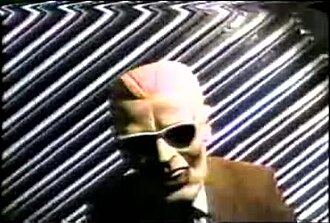
Twice in the same evening, someone managed to overpower the broadcast signals of major Chicago television stations and replace normal programming with footage of a person wearing a Max Headroom mask.
The hijackers were never identified.
What Happened
The first intrusion occurred during the sports segment of WGN-TV’s 9 p.m. news broadcast.
Without warning, the normal picture disappeared. A person wearing a rubber Max Headroom mask appeared on screen, rocking back and forth in front of a moving sheet of corrugated metal designed to imitate the computer-generated background associated with the television character.
There was little usable audio, mostly electronic buzzing and interference.
WGN engineers reacted quickly. Within roughly half a minute they regained control of the station’s signal and returned to the broadcast.
It could have ended there as one very strange technical prank.
About two hours later, it happened again.
This time the target was Chicago public television station WTTW during an airing of the Doctor Who serial Horror of Fang Rock.
The same Max Headroom figure appeared, but the second transmission was much longer and included distorted audio.
For roughly ninety seconds, the masked person delivered a bizarre collection of jokes, television references, insults, noises and apparently meaningless statements. The broadcast eventually became even stranger, ending with the person partially exposing himself while another individual struck him with a fly swatter.
Then the pirate transmission vanished and Doctor Who suddenly returned.
How Was It Done?
This wasn’t somebody simply breaking into a television studio.
Investigators believed the intruders had managed to overpower the microwave links being used to carry television programming between broadcast facilities and transmitters.
That required more than owning a video camera.
WTTW engineers later said whoever was responsible likely possessed significant knowledge of broadcast equipment, radio systems or microwave transmission.
The first attack also demonstrated something important: after WGN successfully defeated the intrusion, whoever was responsible apparently still had the equipment and ability to attack another television station later that same night.
Federal regulators investigated.
No one was ever charged.
Who Was Behind The Mask?
Over the decades, theories have pointed toward broadcast engineers, amateur radio operators, technically skilled television enthusiasts and people with some connection to Chicago’s broadcasting industry.
None has been proven.
There have also been alleged suspects and internet investigations attempting to identify the voices and people appearing in the recording.
Again, nothing has produced a confirmed identity.
At least two people appear to have participated in the second recording: the person wearing the Max Headroom mask and another person who appears near the end of the transmission.
There may have been additional people operating the broadcasting equipment.
Who they were, where they transmitted from and exactly why they did it remain unanswered questions.
Why It Matters
The Max Headroom incident is unusual because there is almost no question that the central event happened.
There are recordings.
There were thousands of potential viewers.
Broadcast engineers witnessed the intrusion from inside the affected stations.
Contemporary news organizations reported on it immediately.
And the Federal Communications Commission investigated it.
The mystery is the identity of the people responsible.
The incident also came from a period when television broadcasting depended heavily on analog microwave links that could sometimes be defeated by another sufficiently powerful signal.
Modern digital systems, encryption and changes in broadcast technology have made an attack conducted in exactly the same way considerably more difficult.
But in 1987, somebody apparently knew exactly where the weakness was.
T Funk Take
This one is great because we don’t have to argue about whether something strange actually happened. We have the tape.
Some individuals managed to hijack television broadcasts not once, but twice in the same evening. What is strange to me is that I don’t remember anything quite like this happening before or since. Just one bizarre evening when television signals were pirated in Chicago.
We still have no idea who did it. I assume tracing a microwave transmission back to its exact source wasn’t an easy thing to do in 1987, and the technology has changed so much since then that pulling off the same kind of stunt today would be a very different challenge.
Another strange feature of this case is that no one has ever convincingly claimed responsibility. No bragging. No deathbed confession. No paper trail that has finally led investigators back to the people involved. After all these years, whoever did it has remained remarkably quiet.
That might be the strangest part of the whole thing.
Only time will tell if we ever find out the rest of the story.
Case remains open in the T Funk Era archive.
Sources & Further Reading
-
30 Years Later, Notorious ‘Max Headroom Incident’ Remains a Mystery
WTTW Chicago
View Source -
Video pirate breaks into regular programing
United Press International (UPI)
View Source -
Thirty years later, “Max Headroom” TV pirate remains at large
Ars Technica
View Source