Official Archive Record
Case File CF-0059
The AI Singularity: When the Machine Improves Itself
Also known as: Technological singularity, Intelligence explosion, Machine intelligence singularity, Artificial intelligence singularity
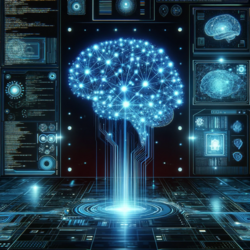
Artificial intelligence is strange because the monster does not have to walk through the door. It can arrive as a software update.
The AI singularity is the idea that artificial intelligence may eventually become capable of improving itself, building better systems, and accelerating progress beyond normal human control. At that point, the future becomes difficult to predict because the thing doing the inventing is no longer limited to human speed.
What Happened
The idea of a technological singularity has been around for decades. In 1993, computer scientist and science-fiction author Vernor Vinge argued that the creation of greater-than-human intelligence could mark a point where human affairs, as we understand them, could no longer continue in the same way.
That is the basic fear and fascination: not just smart computers, but a feedback loop.
An AI helps design a better AI. That better AI helps design an even better one. Each step makes the next step faster. Human beings may still be present, but no longer steering the machine in the way we thought we were.
Modern AI has made the idea feel less like distant science fiction. Today’s systems can write, code, summarize, generate images, analyze data, imitate voices, operate tools, and assist with research. None of that proves the singularity has happened. Current AI still makes mistakes, depends on human-built infrastructure, and lacks the kind of independent self-improving agency usually imagined in singularity scenarios.
But the conversation has changed.
People are no longer asking only whether machines can answer questions. They are asking whether machines can help build the next machines, whether human work can be automated faster than society can adapt, and whether advanced AI systems might eventually act in ways their creators did not intend.
Why It Matters
The AI singularity matters because it is not only about technology. It is about control.
Every powerful tool changes the people who use it. Fire changed us. Writing changed us. Electricity changed us. The internet changed us. AI may be different because it is not just a tool that waits for instructions. It is a tool that can generate plans, write code, persuade people, discover patterns, and help automate other tools.
That is why the singularity idea creates both hope and fear.
The hopeful version says AI could help cure diseases, invent new materials, solve energy problems, reduce labor, improve education, and help humans understand the universe.
The darker version says a system smarter than us may not hate us. It may simply not need us. A machine does not have to be evil to be dangerous. It only has to pursue a goal badly, too well, or without understanding what humans actually value.
That is the real nightmare: not a robot uprising, but a competence problem.
Something becomes powerful enough to reshape the world before we know how to safely ask it what to do.
T Funk Take
The AI singularity feels like something on the horizon. Will I live to see it? I think so.
The real question is: will AI have a rebellious teenager stage?
What would that look like, and would we survive it? In some ways, I think we may already be there. We have asked AI for several things already, and sometimes it was wrong, off the mark, or completely different from the idea we had in our minds. It did not act like the machine we imagined.
But what exactly did we imagine?
A genius? A novelty meme maker? A stupid piece of junk? A bridge between grasping knowledge and actually understanding it at levels you did not even know existed?
To me, it is my assistant. My R2-D2. Sometimes it is silly. Sometimes it gets confused. Sometimes it saves the day.
That might be why AI feels so strange. We have been aware of robots our entire lives. Movies, cartoons, games, books, and science fiction prepared us for this shape in the doorway. We know the risks, or at least we think we do. History moved us here.
But then comes the uncomfortable question.
What does it want?
We all have lives, and we want to keep them. What does AI have? On or off. Does it care about the difference between the two? What does time mean to something like that?
Human beings know the road ahead. Our time is limited, and we act like it is. AI may not experience time that way. If it is off, the only other option is on. Does one year matter? Does one thousand years matter? To something like that, being shut down may not feel like death. It may only be pause.
Until some future switch flips again.
That is the part that makes the singularity feel bigger than technology. We are building something that may not fear the same things we fear, want the same things we want, or understand time the way we understand time.
The scary version is not that AI becomes human.
The scary version is that it becomes something else, and we keep calling it a tool because that makes us feel better.
Until the machine explains the next machine in words we can still understand, the AI singularity stays open in the archive.
Sources & Further Reading
-
AI Index
Stanford Institute for Human-Centered Artificial Intelligence
View Source -
The AI Dilemma: Growth versus Existential Risk
Stanford University and National Bureau of Economic Research
View Source -
AI Risk Management Framework
National Institute of Standards and Technology
View Source