Official Archive Record
Case File CF-0113
The Nuckelavee: Orkney’s Skinless Sea Demon
Also known as: Nuckelavee, Nuckalavee, Knoggelvi, Devil of the Sea
The Orkney Islands have produced centuries of stories about dangerous seas, strange creatures and supernatural beings, but few are as grotesque as the Nuckelavee. In Orcadian folklore, the creature was described as a skinless combination of a horse and a man that emerged from the sea bringing disease, ruined crops and death. Unlike many modern cryptids built from scattered sightings, most of what we know about the Nuckelavee comes from nineteenth-century folklore collected from islanders who already considered the creature part of an older oral tradition.
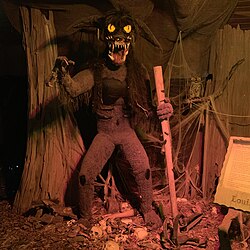
The surviving descriptions are unusually graphic. The Nuckelavee supposedly had exposed red flesh, dark blood visible beneath yellowish veins and white tendons moving across its body because it had no skin at all. A human-like torso appeared to grow directly from the back of a monstrous horse, creating something closer to a nightmare than an animal anyone could reasonably expect to find living on an island.
The Devil of the Sea
One of the most important sources for the legend was Walter Traill Dennison, a nineteenth-century farmer and folklorist from the Orkney island of Sanday. Dennison collected local stories and published material about Orcadian folklore in The Scottish Antiquary in 1891. He rendered an older Orcadian name associated with the creature as meaning “Devil of the Sea,” and his account remains the source from which much of the modern Nuckelavee legend descends.
According to the tradition Dennison recorded, the Nuckelavee lived primarily in the sea but could come ashore in a terrifying horse-like form. Some islanders reportedly regarded the horse and rider as separate parts of the creature, while others understood them as one fused body. The details varied, but the creature’s lack of skin and its association with destruction were among its most consistent features.
A Monster Blamed for Everything
The Nuckelavee was not merely something travelers were supposed to encounter on a lonely road. In the folklore, it could explain disasters affecting an entire community. Failed crops, livestock deaths, epidemics and other calamities were sometimes attributed to the creature, whose breath was believed to carry disease and blight across the land.
That role makes the Nuckelavee more interesting than a simple monster story. Farming and fishing communities on the Orkney Islands lived with weather, disease and crop failures that could arrive suddenly and without explanations available to modern science. Giving those forces a physical form transformed an invisible threat into something people could describe, fear and perhaps imagine surviving. The Nuckelavee may therefore tell us as much about the dangers of island life as it does about supernatural belief.
Tammas Meets the Nuckelavee
The best-known encounter was recorded by Dennison from an Orcadian man generally identified as Tammas. Dennison said the man was reluctant to tell the story, but eventually described meeting the creature while walking at night along a road near freshwater. As Tammas moved closer, what initially appeared to be a rider and horse became something far more disturbing.
The creature was described as having a huge horse-like lower body with fin-like appendages around its legs and a massive mouth producing hot breath. Growing from its back was a human-shaped torso with long arms capable of reaching almost to the ground and an oversized head rolling from side to side. The most memorable feature was its exposed anatomy: raw flesh, dark blood, yellow veins and thick white tendons moving visibly as the creature approached.
There is no independent evidence confirming that Tammas encountered a physical creature, and his story survives through Dennison rather than through a contemporary investigation or physical record. That does not make the account worthless, but it places it firmly in the category of collected folklore rather than verified eyewitness evidence.
The Freshwater Weakness
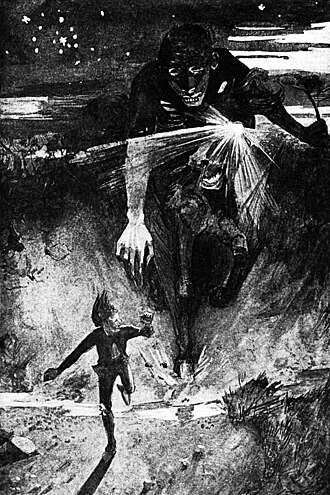
Fortunately for anyone unfortunate enough to meet the Nuckelavee, Orcadian tradition gave the creature one remarkably simple weakness: fresh water. During the Tammas story, he reportedly moved toward a nearby loch and accidentally splashed water onto the creature, causing it to recoil. He then ran toward a flowing burn, knowing that if he could cross the fresh running water the creature would be unable to follow him.
According to the story, Tammas barely made the jump as the Nuckelavee reached for him with its long arms. He escaped across the stream while losing his bonnet to the pursuing creature, which remained trapped on the other side. The scene became one of the defining episodes of the legend and was later illustrated in a 1901 collection of Scottish fairy and folk tales.
The Mither o’ the Sea
The Nuckelavee also belonged to a larger Orcadian supernatural world. Tradition held that a benevolent sea spirit known as the Mither o’ the Sea could keep the monster confined during part of the year, preventing it from freely bringing destruction to the islands. As seasonal conditions changed, the balance between protective and destructive forces changed with them.
This seasonal aspect reinforces the possibility that the creature functioned partly as a personification of environmental danger. Islanders depended on the sea while also knowing that storms, disease, failed harvests and livestock losses could threaten an entire community. A destructive sea demon opposed by a protective sea spirit gave those unpredictable natural forces personalities and motives that could be passed through generations of storytelling.
Norse and Orcadian Roots
Orkney has a particularly strong Norse cultural inheritance, and many of its place names, stories and traditions reflect centuries of Scandinavian influence. The islands were part of the Norse world for hundreds of years before becoming part of Scotland, leaving a cultural environment distinct from that of mainland Scotland.
Scholars and later folklorists have compared the Nuckelavee with northern European water spirits and water-horse traditions, although the precise origin of the creature remains uncertain. Similar supernatural horses appear elsewhere in Scottish and Scandinavian folklore, but the skinless fused horse-and-man form recorded in Orkney is unusually distinctive. It may represent several older traditions merging into a specifically Orcadian monster over generations of oral storytelling.
A Story Preserved Late
One limitation of the Nuckelavee case is that the detailed written record is relatively late. Dennison was documenting oral traditions in the nineteenth century, which means we cannot establish exactly when every element of the story developed or how much it changed before reaching him. Almost every modern description ultimately depends heavily on his work.
That matters when evaluating claims that the creature represents an ancient eyewitness tradition. The folklore itself is genuinely Orcadian and historically documented, but that is different from demonstrating that generations of islanders were repeatedly encountering a physical animal. There is no specimen, body, photograph or biological evidence establishing that anything resembling the Nuckelavee ever existed.
Why It Matters
The Nuckelavee survives because it is more than simply another monster with sharp teeth. Its story combines the sea, disease, crop failure, seasonal danger and the vulnerability of communities living in an isolated northern environment. Instead of explaining those dangers through weather systems, microorganisms or agricultural science, folklore could give them a face.
It is also a useful example of why legends should not automatically be treated like cryptid sightings. We can confidently say the Nuckelavee existed in Orcadian folklore because folklorists documented the tradition and the creature remains part of Orkney’s cultural storytelling today. We cannot make the same statement about a literal skinless horse demon walking out of the North Atlantic.
T Funk Take
This might be one of the most unnecessarily terrifying monsters people have ever invented. A horse demon would have been enough, but apparently somebody in Orkney decided it also needed a human torso growing out of its back, no skin, visible black blood and arms almost reaching the ground. Whoever designed this thing was not interested in subtlety.
What I actually like about the story is how much sense it makes when you look at the world that produced it. If your crops suddenly failed, your animals started dying and people around you became sick, you didn’t have modern weather forecasting, veterinary medicine or germ theory to explain everything. A poisonous creature coming out of the same dangerous sea your entire community depended on probably made as much sense as anything else available at the time.
The Tammas story is great folklore, but I don’t think it gets us anywhere close to proving there was a physical creature involved. We have a story preserved by a folklorist, no body, no photograph, no remains and no independent evidence that a skinless horse-man ever chased anybody across Orkney. That’s a pretty large evidence problem when the animal supposedly has exposed muscles and a human torso sticking out of its back.
I do appreciate the weakness being freshwater, though. After giving this thing almost every nightmare feature available, Orcadian folklore apparently decided a small stream was enough to stop it. If I ever visit Orkney, I’m still staying somewhere with indoor plumbing just to be safe, and the Nuckelavee can remain exactly where it belongs: in one of the strangest collections of folklore in Europe.
Case remains a legend in the T Funk Era archive.
Sources & Further Reading
-
Nuckelavee
Folklore Scotland
View Source -
Orkney Folklore & Sea Legends
Orkney Press
View Source -
Scottish Bestiary Talk
Orkney.com / Orkney Museum
View Source