Official Archive Record
Case File CF-0111
U.S. Government-Funded Podcasts: Public Diplomacy or Propaganda?
Also known as: Government-Funded Podcasts, U.S. Public Diplomacy Podcasts, Government-Sponsored Media
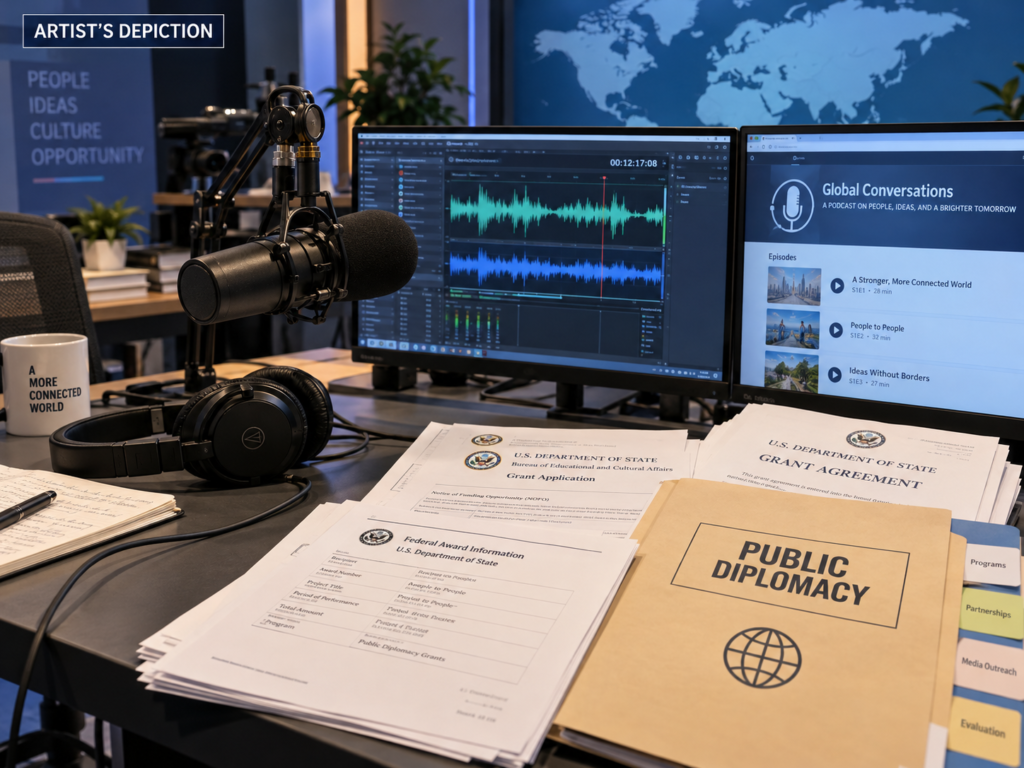
The United States government funds podcasts, and that statement sounds more conspiratorial than it actually is. The funding is not necessarily secret, and the programs are generally aimed at foreign audiences rather than Americans. Federal records openly describe grants and media networks that produce podcasts, radio programs and other digital content as part of U.S. public diplomacy and international broadcasting. The more interesting question is what happens after the government pays for the microphone.
Is the result independent journalism, public diplomacy, government messaging or propaganda? The answer depends heavily on which program we are talking about, who controls the editorial process and whether the audience understands who is paying for the content.
A Government-Funded Podcast Is Real
In 2022, the Public Affairs Section of the U.S. Embassy in Mogadishu announced a grant program called “Showcasing the U.S.-Somali Partnership.” The proposal was unusually specific, calling for a 24-episode Somali-language radio and podcast series with each episode running approximately 30 minutes. The stated goal was to demonstrate how U.S. assistance was contributing to Somalia’s stability, prosperity and self-reliance while increasing awareness of the U.S.-Somali partnership.
This was not a journalist independently deciding to investigate U.S. foreign aid and later discovering that the government happened to pay the production costs. The government’s desired subject, audience and objectives were spelled out before the program was created. The Embassy also said it would help identify beneficiaries of U.S. programs to appear in the episodes, and the selected media outlets and social-media accounts used to distribute the content were subject to final approval by the U.S. Embassy. That is government-sponsored podcast production in the most literal sense, and it was publicly disclosed.
Public Diplomacy
The program fits into a much older American practice known as public diplomacy. Governments have always attempted to explain themselves to foreign populations, and the United States has used radio, newspapers, films, cultural exchanges, educational programs and international broadcasting for decades. Podcasts and social media are simply newer delivery systems for the same basic objective.
The State Department’s Somalia proposal openly identified its money as Public Diplomacy funding. Its purpose was not hidden: the program was intended to improve understanding of the United States’ relationship with Somalia and highlight programs financed by American assistance. That makes the arrangement substantially different from secretly paying someone who presents themselves as an independent commentator, although whether an average listener understands the funding relationship is a separate question.
The U.S. Agency for Global Media
The federal government also finances a much larger international media system through the U.S. Agency for Global Media, or USAGM. USAGM oversees or funds organizations including Voice of America, Radio Free Europe/Radio Liberty, Radio Free Asia, the Office of Cuba Broadcasting and Middle East Broadcasting Networks. These organizations produce conventional news, television, radio, websites, social media and podcasts.
Middle East Broadcasting Networks, for example, operates Radio Sawa and has produced numerous podcasts covering news, culture, sports, science and documentary subjects. USAGM openly states that MBN is financed by the U.S. government through a federal grant, and some of those podcast productions have won major industry awards. If the question is simply whether American taxpayers have funded podcasters, the answer is clearly yes.
Journalism or Government Messaging?
This is where the distinction becomes important. USAGM says its broadcasters are protected by a legally mandated editorial firewall, meaning the government provides the money while journalists are supposed to make their own editorial decisions without government officials telling them what stories to publish or how to report them. Congress has required the networks to meet professional journalism standards, and the law protects their professional independence.
Government funding therefore does not automatically mean that every sentence in a podcast is a government talking point. Government funding and government editorial control are two different things. The Government Accountability Office has nevertheless found that the boundaries of that firewall have not always been perfectly clear, and a 2021 GAO review concluded that differing interpretations had created problems and recommended that Congress clarify what government oversight is permissible without interfering with editorial independence.
A Different Kind of Podcast
The State Department’s public-diplomacy grant in Somalia is different from an independent newsroom funded through USAGM. The Embassy established the objective, and that objective was explicitly to increase awareness of America’s partnership with Somalia. The Embassy participated in selecting subjects to feature and required final approval of participating media outlets and social-media accounts.
That arrangement looks much closer to strategic communications than independent journalism. There is nothing inherently mysterious about that because governments routinely produce communications intended to explain or promote their policies. But calling every government-funded podcast simply “independent media” would erase an important distinction between journalism, public diplomacy and government communications.
What About Americans?
This is where online claims about government propaganda often become exaggerated. U.S. international broadcasting historically operated under legal restrictions intended to keep public-diplomacy programming focused on foreign audiences. Changes to the Smith-Mundt framework in 2013 made it easier for Americans to access material that had been produced for foreign audiences, particularly in an era when the internet makes geographic boundaries nearly meaningless.
Those changes did not create general authority for USAGM to build propaganda campaigns aimed at American voters. USAGM’s statutory mission remains international, but an American can still encounter the material online. That creates a strange modern reality in which something created with taxpayer money for an audience overseas can appear on the same podcast platform as an independently produced American show, and the listener may not immediately know the difference without checking who produced it.
Secret Domestic Podcasters?
This is the point where the evidence becomes much thinner. There are plenty of claims that the U.S. government secretly pays domestic political commentators, influencers or podcasters to repeat approved narratives, but the records examined for this Case File do not establish that broader accusation. They establish something narrower and much easier to prove: U.S. agencies openly finance international media organizations, podcasts and public-diplomacy projects.
That distinction matters because a grant announcing that the U.S. Embassy wants a Somali podcast explaining American assistance is not the same thing as secretly depositing money into an American commentator’s account while pretending there is no relationship. If evidence of that second arrangement appears, it would be a different Case File. The documented case here is about disclosed government funding and the different levels of editorial control that can come with it.
The Propaganda Question
The word “propaganda” creates its own problems because people often use it to describe any information produced by a government they distrust. Governments generally prefer terms such as public diplomacy, strategic communications or international broadcasting, and those labels can describe meaningful differences when journalists have legal protections against political interference. Funding still matters, however, because knowing who paid to create information helps an audience evaluate it.
A documentary funded by a corporation does not automatically contain false information, but knowing the corporation financed it is relevant. The same principle applies when the sponsor is a government. The important questions are who paid, who chose the subject, who controls the editorial process and whether the audience knows the relationship exists.
Why It Matters
Podcasting has made government communications much less recognizable than they were during the era of shortwave radio. Voice of America sounded like international broadcasting because it was literally a radio station, while a podcast now appears in an app beside thousands of privately produced programs. The technology has changed, but the underlying practice has not.
The United States government still communicates with foreign populations, still funds media intended to advance public-diplomacy goals and also funds news organizations whose journalists are legally supposed to remain editorially independent. Those things can exist at the same time. The interesting part is learning which one you are listening to and understanding how much control the government actually has over the message.
T Funk Take
I don’t think the conspiracy here is that the United States government funds podcasts because it clearly does. You can go read the grant paperwork, see the objectives and see who is paying for the program. What interests me is how normal the whole thing looks now compared with the older image of government broadcasting.
Fifty years ago, if the U.S. government wanted to communicate with people in another country, you might picture a giant radio transmitter broadcasting Voice of America overseas. Today the same basic idea can show up as a podcast sitting next to everything else on Spotify or Apple Podcasts. That doesn’t automatically make the information false, but I still want to know who paid for it.
I also think there is a real difference between funding journalism and paying for a communications campaign. If the government gives money to a news organization but the journalists genuinely control what they investigate and publish, that’s one thing. If an embassy says it wants 24 podcast episodes showing people how beneficial its programs are, that is clearly something different, even if the information in those episodes is accurate.
I apply that same standard everywhere. Corporation, political organization, foreign government, U.S. government, nonprofit or some billionaire with a microphone: tell me who is paying, and then I’ll decide how much weight I want to give the message. What I did not find was evidence supporting the broader claim that the U.S. government is secretly paying ordinary American political podcasters to pretend to be independent while repeating government talking points.
Maybe evidence for something like that exists somewhere, but this case doesn’t prove it. What it does prove is that government-funded podcasting isn’t a theory at all; it is a documented part of public diplomacy and international broadcasting. Case remains open in the T Funk Era archive.
Sources & Further Reading
-
Showcasing the U.S.-Somali Partnership — Notice of Funding Opportunity
U.S. Department of State / U.S. Embassy Mogadishu
View Source -
MBN Wins Gold, Silver and Listener's Choice at the Signal Awards
U.S. Agency for Global Media
View Source -
U.S. Agency for Global Media: Additional Actions Needed to Improve Oversight of Broadcasting Networks
U.S. Government Accountability Office
View Source