Official Archive Record
Case File CF-0102
The Beast of Bray Road: Wisconsin’s Werewolf
Also known as: Bray Road Beast, Wisconsin Werewolf, Beast of Bray Road
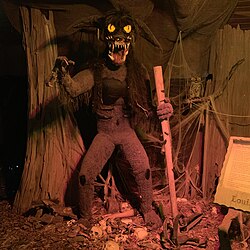
A quiet country road outside Elkhorn, Wisconsin, does not seem like an obvious place to look for a werewolf. But beginning in the late 1980s, several local residents reported seeing something strange near Bray Road. They described a large, hairy animal with a long canine muzzle, pointed ears and an unusual ability to stand or move on two legs.
Some witnesses thought it looked like an enormous dog. Others reached for a much stranger comparison: a werewolf. The creature eventually became known as the Beast of Bray Road, one of the Midwest’s best-known modern cryptids.
What Happened
Rumors of a strange animal around rural Elkhorn had circulated for several years when reporter Linda Godfrey began investigating the story in 1991 for a local newspaper called The Week. Godfrey did not begin the assignment assuming a monster was roaming Wisconsin. The story sounded like the kind of strange local rumor that could probably be explained with a few phone calls.
Then she contacted Walworth County’s animal welfare officer, Jon Fredrickson. Fredrickson already had a file labeled “Werewolf.” Inside were notes describing several sightings of an unusual animal, including reports of a large pointy-eared creature, strange tracks and an animal allegedly chasing a deer while appearing to move on two legs.
Fredrickson himself suggested something much more ordinary. He thought witnesses might have encountered a coyote or wolf under unusual conditions. But some of the witnesses were convinced they had seen something else.
The Creature Beside the Road
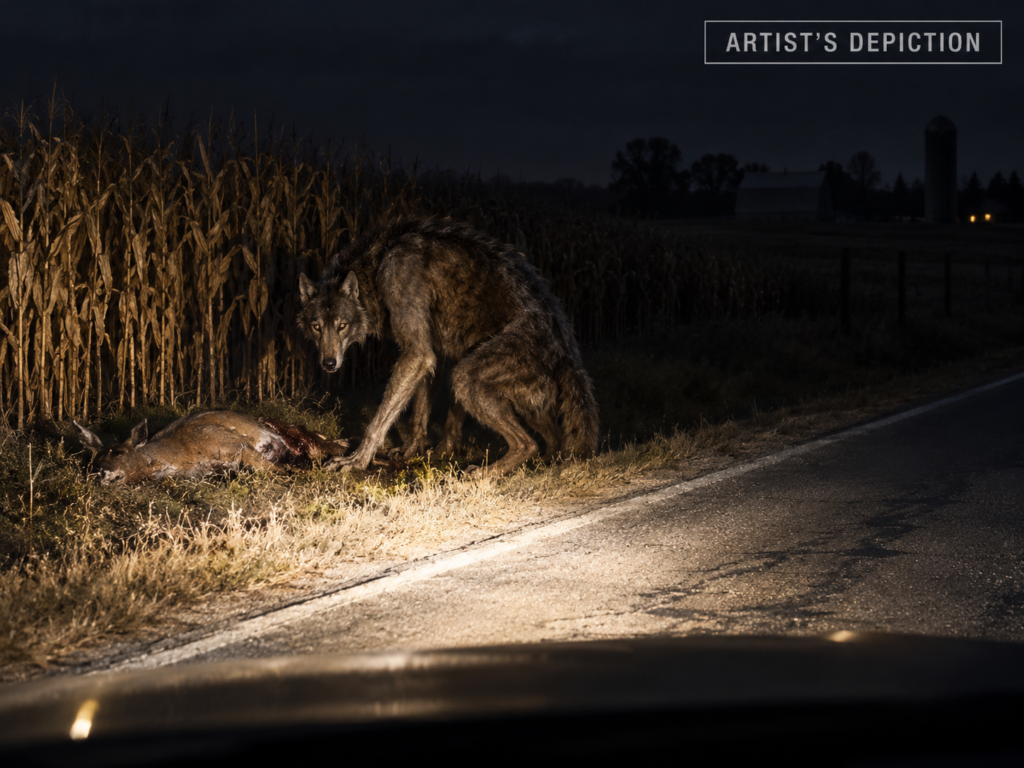
One of the most detailed early witnesses was later publicly identified as Lori Endrizzi. Endrizzi said she was driving along Bray Road in the fall of 1989 when she noticed something crouched beside the road. At first, the posture made her think she might be looking at a person.
Then she got closer. She described a brownish-gray, hair-covered creature with pointed ears, a long muzzle, claws and large teeth. According to her account, it appeared to be kneeling while eating roadkill and holding the food in its front limbs in a way that reminded her of hands. She estimated it was roughly the size of an average adult man.
What apparently bothered her most was that the creature did not immediately flee when illuminated by the car’s headlights. It turned and looked at her. Endrizzi kept the story mostly to herself for roughly two years because she expected people would ridicule her, but then other people began reporting similar encounters.
The Halloween Encounter
Another important report occurred around Halloween in 1991. A teenage driver told Godfrey that she was traveling along Bray Road when her front tire suddenly lifted as though she had struck something. She stopped farther down the road and got out to investigate but found no obvious animal or blood on the road.
Then something ran toward her. She described a large, dark-haired creature moving extremely fast and believed it was running on two legs because she could clearly see its chest as it approached. She jumped back into the car and accelerated away.
The witness claimed the animal reached the vehicle and struck or grabbed the rear of the car before sliding off. She later reported scratches on the vehicle. Later that same evening, while driving with a younger passenger, she said they saw a large creature crouched along the roadside again. The incident became one of the central stories behind the Beast of Bray Road legend.
More Than One Witness
Godfrey’s original investigation did not rely on only one encounter. Another family told her that an eleven-year-old girl had previously seen what she initially assumed was a large dog. According to the girl’s account, the animal suddenly stood upright.
She described silver and brown fur, a face resembling a coyote and unusually powerful rear legs. The children ran toward the house, and the creature reportedly followed part of the distance before turning back toward a cornfield.
Other stories circulated through the area as well, although some were secondhand and could not be independently confirmed. That creates an important distinction in the evidence: there really were local residents telling remarkably strange stories, but that does not establish that the creature they described was an unknown species.
A Television Investigation
The story became national news after Godfrey’s article appeared on December 29, 1991. In 1992, Wisconsin Public Television reporter Art Hackett went to Bray Road to investigate. Hackett interviewed local residents, including people who had actually reported unusual animals in the area, and his report confirmed that the witnesses and the road were real while also showing how exaggerated some national tabloid coverage had become.
Farmer Scott Bray told Hackett that he had seen an unusually large, rough-haired animal on his property in 1989. He thought it was some kind of dog, but said it moved strangely and left a surprisingly large footprint. Lori Endrizzi repeated her own account on camera.
Other residents were far more skeptical. One suggested that people were misidentifying coyotes, while a local game warden said nighttime conditions, shadows and ordinary animals could produce strange impressions. Nobody produced a werewolf.
What Could It Have Been?
The most obvious explanations are also the least exciting. Wisconsin has coyotes, large domestic dogs and wolves. An animal rising momentarily onto its hind legs, jumping, running through uneven terrain or being viewed from a moving vehicle at night could appear much stranger than it actually is.
The county animal officer suggested wolves or coyotes in the original investigation. There are also problems common to almost every cryptid case: most encounters occurred at night, they were brief, witnesses were often inside moving vehicles, and descriptions were reconstructed afterward from memory.
The publicity creates another problem. Once the phrase “Beast of Bray Road” entered the public imagination, every unusual animal in the region had a ready-made identity. That makes later reports harder to evaluate independently.
The Evidence Problem
The Beast of Bray Road has something many cryptid stories lack: documented contemporary witnesses. What it does not have is equally important.
There is no verified body, skeleton, hair sample or DNA from an unknown animal associated with the case. No clear photograph from the original cluster of sightings establishes the creature’s existence. Tracks and scratches were reported, but none became definitive physical evidence of an unknown species.
That leaves eyewitness testimony as the heart of the case. Several people apparently saw something unusual. Exactly what they saw remains the question.
From Monster to Wisconsin Folklore
The Beast did not disappear when the news cycle ended. The original newspaper story was picked up by larger media outlets, and the creature quickly became part of the identity of the Elkhorn area. Books, documentaries, T-shirts, television segments and eventually movies followed.
Linda Godfrey continued investigating reports of upright canine creatures for decades and became closely associated with what later became known as “dogman” phenomena. The Wisconsin Historical Society has even incorporated the Beast of Bray Road into programs dealing with Wisconsin legends and folklore.
Whether or not an undiscovered creature ever walked along Bray Road, the Beast itself became real in another sense. It became folklore.
Why It Matters
The Beast of Bray Road sits in an interesting place between a newspaper story and a monster legend. The witnesses existed. The contemporary newspaper investigation existed. The animal control officer really had collected reports.
None of that proves a werewolf, dogman or unknown species existed. It does show how cryptid legends can form around sincere eyewitness experiences that nobody can completely explain afterward.
Something frightened people along Bray Road. Whether that something was an unknown creature, an ordinary animal viewed under unusual conditions or several unrelated incidents that eventually became one story remains unresolved.
T Funk Take
This is the kind of cryptid case I like because there is actually something to investigate. A reporter didn’t just repeat a campfire story twenty years later. She went out while the sightings were happening and talked to the people involved. Then she walks into the county animal officer’s office and the guy already has a folder labeled “Werewolf.” That would definitely get my attention.
The problem is that everything gets much weaker when we move from “people saw something strange” to “there is a giant upright wolf creature living in Wisconsin.” I believe people saw something. I don’t have a good reason to believe they saw a werewolf.
Most of these encounters happened at night, from cars, and lasted a short amount of time. That is about the worst possible situation for identifying an animal accurately. But the kneeling part is strange. More than one description makes this thing sound less like somebody catching a glimpse of a normal dog running across the road and more like they were looking at something behaving in a way they didn’t expect an animal to behave.
Then again, weird does not automatically mean unknown species. If someone eventually drags a seven-foot wolf-man out of a Wisconsin cornfield, I’ll happily reopen my opinion.
Until then, we have witnesses, a newspaper investigation and one of the better names ever given to a cryptid.
Case remains open in the T Funk Era archive.
Sources & Further Reading
-
Tracking down 'The Beast of Bray Road'
The Week / Walworth County Community News
View Source -
The Beast of Bray Road
PBS — In Wisconsin
View Source -
The Mystery of 'The Beast'
Walworth County Community News
View Source