Official Archive Record
Case File CF-0097
The Hessdalen Lights: Norway’s Unexplained Valley Phenomenon
Also known as: Hessdalen Lights, Hessdalen Phenomenon, Hessdalen Phenomena
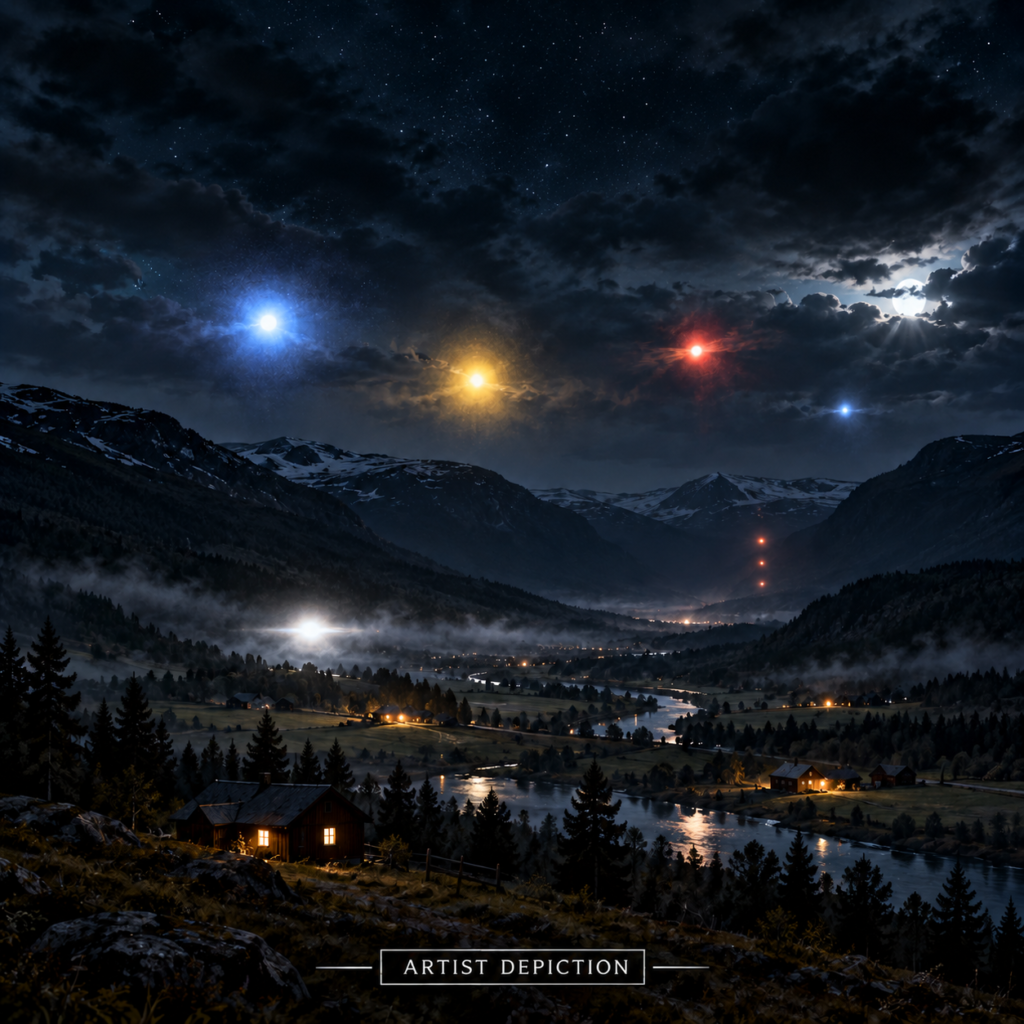
For more than forty years, strange lights have appeared over a remote valley in central Norway. Some remain stationary. Others move slowly across the valley, change direction or suddenly disappear. Witnesses have described them as white, yellow, blue and red, sometimes hovering low enough to appear against the surrounding mountains rather than high in the sky.
The difference between Hessdalen and many other unexplained-light stories is simple: scientists and investigators actually went there with instruments.
And the lights did not stop appearing.
What Happened
Hessdalen is a small valley in central Norway near the town of Røros. Although stories of unusual lights in the region reportedly go back much further, the modern mystery began in December 1981 when residents started reporting strange luminous objects appearing around the valley.
At the height of the activity, sightings were occurring frequently enough that residents, engineers and researchers decided the phenomenon deserved a serious investigation. Project Hessdalen was established in 1983.
During a field investigation between January and February 1984, researchers used cameras, radar, spectrum-analysis equipment, a magnetometer, seismograph, infrared equipment, Geiger counters and other instruments to try to determine what people were seeing.
They recorded 188 reports of lights during the investigation. After attempting to remove aircraft, stars, vehicles and other known sources, investigators classified 53 reports as possible examples of the Hessdalen phenomenon.
They still did not know what was causing them.
What Do the Lights Look Like?
There does not appear to be one single appearance. The original investigators described several types.
Some were short, intense white or blue flashes. Others appeared as yellow or yellow-white lights that could remain stationary, move slowly through the valley or suddenly accelerate. Witnesses also occasionally reported multiple lights maintaining positions relative to one another.
Some observations lasted only seconds. Others reportedly remained visible for much longer.
That creates an important possibility: everything called a “Hessdalen Light” may not necessarily have the same cause. Some sightings could be conventional aircraft, stars, satellites, vehicles or other ordinary sources, while another portion represents the actual phenomenon researchers are trying to explain.
The Blue Box
The investigation did not end in the 1980s. In 1998, Project Hessdalen installed an automatic monitoring station that became known as the Blue Box.
Instead of depending entirely on someone happening to be outside when a light appeared, cameras and sensors could monitor the valley continuously. The system has been upgraded over the years, and Project Hessdalen continues collecting photographs, videos and sensor data.
That makes Hessdalen unusual. This isn’t only an old UFO story being reconstructed from memories decades later.
The location can still be monitored. If the phenomenon appears again, researchers can attempt to measure it.
What Could Cause It?
One possibility being investigated is that the answer may be beneath the valley rather than above it.
A scientific study published in 2024 examined the geology beneath Hessdalen using very-low-frequency electromagnetic surveys. Researchers identified conductive zones associated primarily with mineral deposits and geological structures beneath the valley.
They suggested that the unusual geology could help create conditions involved in producing luminous atmospheric phenomena.
That is a possible mechanism, not a solved case.
Atmospheric electrical effects, geological processes and plasma-like phenomena have all been discussed during decades of research. There is also the unavoidable problem of ordinary objects being mixed into the reports.
A camera detects a light. That doesn’t automatically mean the light is unexplained.
The difficult part is separating airplanes, satellites, vehicle lights and other normal objects from whatever remains after those explanations are eliminated.
Why It Matters
Hessdalen matters because the question isn’t simply whether people have reported strange lights.
They clearly have.
Researchers have photographed unusual lights, tracked objects with instruments and maintained monitoring equipment in the valley for decades. The more difficult question is what those observations represent.
If the answer is a rare natural phenomenon, Hessdalen could provide an opportunity to study an atmospheric or geological process that isn’t yet completely understood. If several different things are being grouped together under one name, continued monitoring may eventually separate them.
And if something remains after conventional and natural explanations are exhausted, then the mystery becomes even more interesting.
Either way, Hessdalen gives investigators something most unexplained cases do not: a place to keep looking.
T Funk Take
This is the kind of unexplained case I like because we don’t have to start by arguing about whether anyone saw anything.
People saw lights. Researchers went there. They brought cameras, radar and other equipment, and some of the observations were strange enough that the investigation has continued for decades.
Now we get to ask the more interesting question: what is actually causing them?
My first thought is that we might be making a mistake by assuming every Hessdalen Light is the same thing. A plane could explain one. A vehicle on a distant mountain could explain another. Some type of electrical or geological phenomenon might explain another.
Remove those one at a time and see what’s left.
The geology is especially interesting. If something underneath this particular valley helps create unusual electrical conditions in the atmosphere, that would explain why people keep seeing the phenomenon in the same place.
And honestly, finding out that the Earth can occasionally produce glowing objects in the atmosphere through some process we didn’t completely understand would be fascinating on its own. It doesn’t need to be a spacecraft to belong in the archive.
The best part is that the cameras are still running.
Unlike a mystery where something happened once fifty years ago and disappeared, Hessdalen gives us another chance. Maybe the next light provides the measurement that finally explains the rest.
Until then, keep the Blue Box running.
Case remains open in the T Funk Era archive.
Sources & Further Reading
-
Project Hessdalen 1984 — Final Technical Report
Project Hessdalen
View Source -
About Project Hessdalen
Project Hessdalen
View Source -
Contribution of VLF Electromagnetic Survey to the Investigation of Hessdalen Lights (Norway)
Journal of Applied Geophysics / Elsevier
View Source